Batik yin yang cats

I went to a Batik workshop about three years ago when I first got my studio at Spode. I’d never done it before, but basically we used hot liquid wax as a resist to dyes. When you paint coloured dyes over the pattern you make, the colours are not absorbed into the cloth or canvas where the wax had been painted. Then you have to het a hot iron and paper and iron the wax out with the paper between the cloth and the iron so the wax gets absorbed into the paper. There is probably a clearer way of explaining, but as I say I only went to one workshop. My friend made this heavy frame for the yin yang cats. There is glass in it to protect the fabric. I was rather pleased with the result.
Drawing with nail varnish

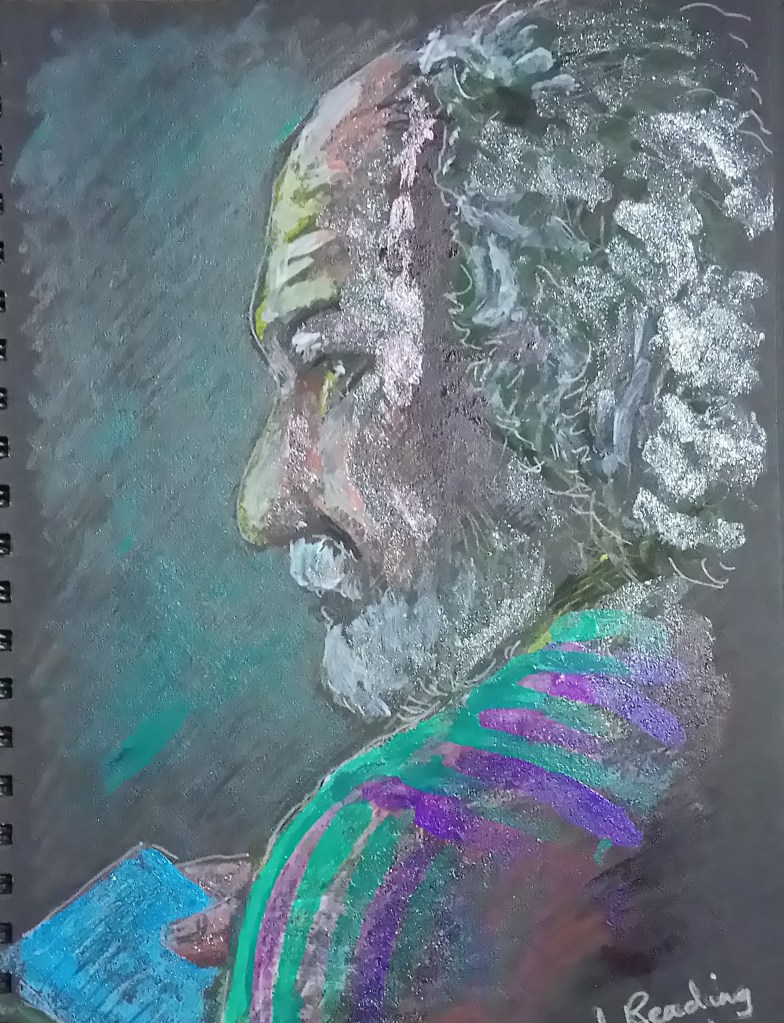
This is a thing now. I had a sketchy picture of my hubby done on black paper. I’d used pastels to do the drawing back in September, but after playing with nail varnish to draw a landscape view, I decided to use them on the drawing. It certainly had an interesting effect. It’s shiny and the colours change depending on where the light bounces off. I finished it off with adding a few lines with a silver marker pen. It reminds me of oil on water.

The back yard, mid october

Despite the cold, wet weather the flowers in the back yard continue to survive. If we get any bad frosts I think they will go, but the sheer number of them packed together offer shelter to all of them.

So pleased we had the hanging baskets filled by a little farm nursery back in May/June, they have certainly been worth the initial cost. I go outside and am immediately cheered.

Orme does Picasso

Orme arts autumn challenge. We agreed to attempt to reproduce a Picasso weeping woman painting. We did one or two panels each. I drew the top and bottom middle pages. The top on was mainly marker pens, but I could not get the purple colour so I used a mixture of white, blue and magenta to try and get it. Not right though. I also did the bottom middle panel. In that case I used watercolour paints then a black marker pen over the top.

Even though a number of artists put this together I think there is a good coherence and the squares are well matched. I’m pleased with the result.

Beautiful brickwork

I don’t know much about bricks, except that they are fired clay. But I do like to see them when they are used decoratively. The way they are laid is called the ‘bond’ where it depends whether they are laid horizontally across the surface of the wall, or with the short end showing on the face of the wall and the length turned 90° so that the brick is across into the layer behind or allows the wall to turn the corner at the edge of the building.

As you can see from this photo, different coloured bricks are often used to make patterns and shapes in the brickwork or are used to frame tiled areas of text stating when the building was built.

I also know that brick sizes changed over time. That they were smaller in the past and hand made. Then molds were made and the brick sizes became standardised. I don’t know all the history of that sorry.

Spectrum

White light

Split into colours

Created by sunlight

Rainbows glow

Chemicals create different colours, sodium used in street lights glows yellow. Chemicals are used in fireworks, like strontium (red?) or copper green, creating different colours, blues, purples, oranges.

The reason sunlight is made up of a spectrum is because the sun is made not only of hydrogen and helium but all the chemicals in the periodic table up to iron (any chemicals beyond that can only be created in Super Novae explosions). All the chemicals in the sun glow in different colours, which is why they show up when the white light from the sun passed through a prism. If you split the spectrum further you can find dark lines, these are markers of which chemicals are present. The older the star the more chemicals. As a star gets older it starts to burn up its hydrogen and helium. New chemicals are created by atoms fusing together. That’s where new chemicals are made. When you think about it, if it wasn’t for stars burning or exploding we couldn’t exist.

Basis for a drawing

This was the view I was looking at when I did my Sketch earlier on. As you can see things were a lot darker in reality. I looked more at the shapes, concentrating on drawing them in first, then adding trees and branches afterwards. The silver grey seems to sit back in the background, the tones do not match this photo but does that matter? I keep drawing and hope I’m progressing. X

Orange

Today’s prompt for band of sketchers was the colour orange. I gathered a group of things together and used permanent markers to draw it in. I tried to colour the areas without drawing it out first.

Orange is a peculiar colour, some people identify reds as orange, and orange as yellow. Everyone has different eyesight and abilities to differentiate colours. I imagine someone with colour-blindness would just see muddy browns?

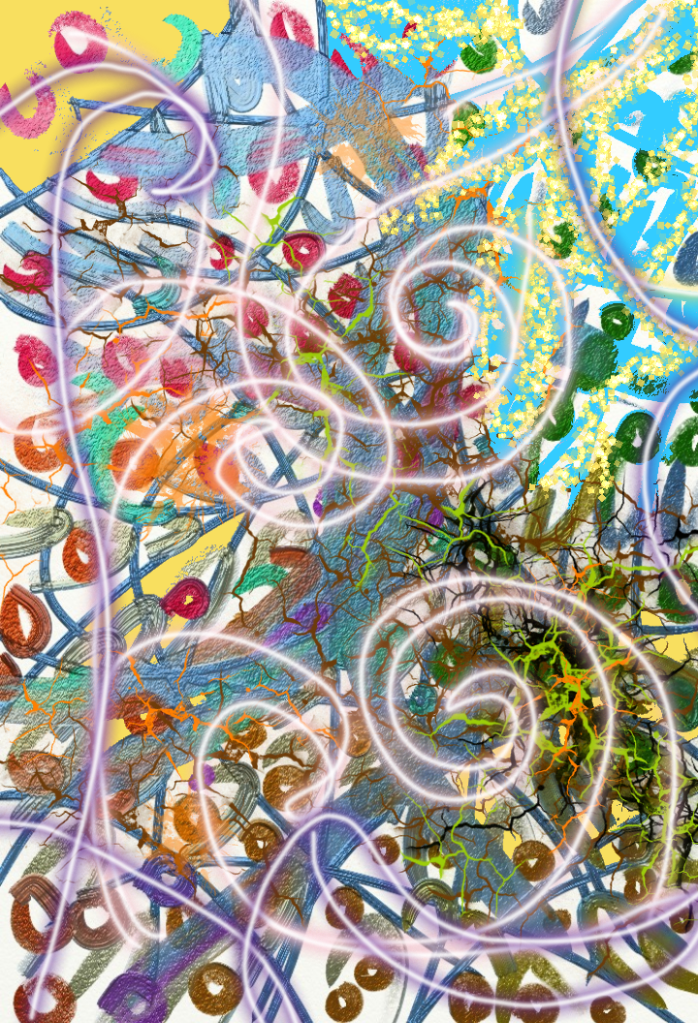
digital background

Another doodle, this time a possible background for something, or even a stand alone piece of art. Created in ArtRage oils and sketch app, digital drawing. learning to use different tools in the apps. I did this a while ago. If I’m not learning and playing with things I get really bored.

that’s it for now, I really have tired myself out just sitting at the computer and typing. Need a rest. Phew! Plus I have not had an evening meal yet and I will have to cook it, might be back later if I feel a bit better.

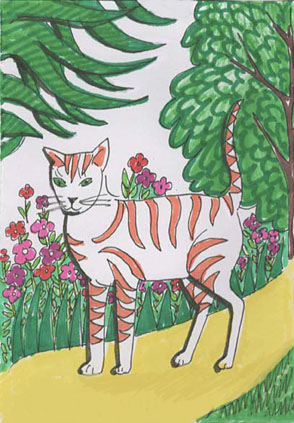
cat and dragon doodle

A cat I drew for one of my projects last semester, I seriously need to tidy up my style a bit. Then I have been doodling again ….

Now I’m working on a cheeky dragon for a possible pin badge.

Question? Do you think people would be interested in buying a well drawn and crafted pin badge of a dragon? This is just a sketch…

What colours should dragons be?

My idea is for a spotty dragon, do you think that would work?

what should it be made in, metal or plastic?

Any ideas/ suggestions?