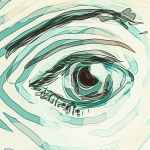
Falling asleep with my finger on the screen of the Sketchbook app on my phone. I’d chose a smudge and soft pastel app. I started with an image in mind, but I woke up from my doze a few times and saw the straggly pattern developing! I could have worked on it but just let the ‘process’ carry on.
It is entirely random and I can alter angles and colours and opacity if I want to. But I like the idea of having no volition over it, making it really random.
I don’t see what or which word I can object to? There are many words in this world that people use, sometimes a lot of people use the same word, but how can I object? Isn’t that censorship? I hate prejudice, and would not use such words, but sometimes they have to be spoken to explain their use, their critical importance in a conversation.
It’s hard to explain what I mean. But if someone were to use a derogatory comment then they might need to be prosecuted for it’s use. How can you take action if the word is not repeated? It’s a conundrum. The word might be ambiguous on the one hand or too direct on the other, in which case it might not be allowed.
Some words thankfully go out of fashion. I’m glad they have, but it doesn’t mean that there’s others that are also lost shouldn’t be saved.
I guess I’m on the fence for this prompt. Enough said?
I Clavdivs (or I Claudius) by Robert Graves is going to be shown on BBC Four from tomorrow night. I loved that TV series which was originally on in 1976. The novel it was based on was written in 1934.
The title sequence of a snake writhing across a mosaic floor with the words I Clavdivs written on it always makes me chuckle, the u’s were written as v’s hence the odd way it looks and sounds.
The machinations of the Roman Emperors from the death of Julius Ceasar to the reign and eventual demise of Claudius is shown in the TV series. It’s like a series of plays, not lavish, but grimy and ordinary. Brian Blessed played Augustus Ceasar, Patrick Stewart stars in it, as does Sian Phillips and other stars from that era. John Hurt plays Caligula. There are executions, poisonings, ghosts and hysterical scenes. It’s amazing and overblown and interesting. Claudius is played by the excellent Derek Jacobi who later played Brother Cadviael in the murder mystery series. Jacobi is able to play the part with skill, as an idiot who limps and stutters but who is intensely inlligent despite appearances. So if you get the chance, try and watch it.
I play with these drawings to create a double image of two faces. One side has more texture than the other using different apps.
One side is sharper than the other, the left hand side has been processed through photodirector to add texture.
Does it matter what I did or why? Isn’t it more important to create something? I explain what I’ve done, but is there any significance? I see work in exhibitions wherr the piece of art will have a longwinded explanation of what the Art is about. I like to play and explore, I might not have a specific intention, but I hope what I do has some integrity….
Artrage doodle, it started as a background and was possibly going to be a river with fish in it, but when it came to the final image, this strange face snuck in. I am struggling with energy, trying to stay awake because sleeping on an old armchair will do that to you. I’ve made lots of mistakes in the writing on here, I keep on doing it because I’m falling asleep as I draw and write. So it’s a very random drawing. X
I like light classical music, piano sonatas, even film scores.
I don’t always know the name of the musical piece, or the composer, one of my worst skills is answering music quiz questions. But it doesn’t matter what it is as long as it gives me a feeing of gentle calmness.
Singing with a choir has the same effect. Especially when we are practicing and not performing. I hear the other parts, soprano and alto, and try and meld my voice in with the others. It gives me a real sense of peace and quiet. Gentle Maori lullabies effect me, and sweet folk aires from ancient history. They are all really meditations. That and the breathing required to do it help make me feel at peace.
Just turn the oven down to 5 and set it for another hour?
Muttering in the kitchen….
OK done it..
Beep beep beep…
Why is the alarm beeping? It shouldnt happen for an hour?
Well I set it. Let me come and look..
You always tell me what to do. But you need to listen.
The cooker has two alarms, so I presumed he had set the top oven alarm. I also could see 1:08 on it but this seemed to be indicating the time?
I reset that to 22:00 and set the alarm (I thought) foe an hour. But what confused me was the time had a bell on it. An alarm. I tried changing the time, it would only go up to 23:59?
What? Set everything to zero, I did that and the cooker switched itself off! There is a timer that Starts and Finishes while you are away from the cooker… I’m learning!
Eventually I got it sorted
I know why he struggled. We both need more practice at setting timers. I hope the food cooks OK
The industrial revolution in Britain and Europe began the transformation of alchemy to science. Inventions were happening and knowledge became more and more important.
As instruments improved things like telescopes and microscopes gave us a better understanding of the micro and macro aspects of life and the universe. We could see smaller and smaller living organisms, such as unicellular plants and animals, and then bacteria and finally viruses.
That understanding gave us vaccinations and antibiotics and began to initiate preventative medicine instead of simply trying to deal with the ravages of Plague and poxes.
There are many branches of science where humans have delved into how things work. They may have started as a philosophical perspective, such as Geography and Meteorology, but then deeper understanding of the underlying issues. Dinosaurs and fossils were discovered. The age of the the Earth extended from the supposed 6000 years since the biblical flood backwards over millions, then billions of years.
Meanwhile Issac Newton was discovering the ‘clockwork’ universe. Where stars moved in their courses. What then happened took decades and centuries, but scientists like Einstein changed the modern world.
I’ve been watching “The Ascent of Man”, by Jacob Bronowski, talking about all the changes and revolutionary things that happened in the last few centuries. It not only covers discoveries, but also how destructive factories could be to humanity. Thankfully not all manufacturers treated their workforces so badly.
I conclusion there is simply too much to discuss about sciences, it is impossible to understand all their aspects. But hopefully we can use science to improve our world, even if it’s only to work out methods that are less destructive to nature.
A butterfly sunbathes on top of the fence. I couldn’t get a decent photo because it was too far away. It looks more like a speckled leaf. The edge looks like a wrinkled and twisted old dry oak leaf. There are plenty of flowers lower down on the fence for it to collect nectar as it sips from them.
I imagine it was trying to warm up as we have had lots of cold and damp days recently.
Talking about insects there was a Huge bumblebee in the bathroom yesterday. I tried to get it out, I couldn’t reach up to the window so opened the bathroom door and in the end opened the back door as well and it just flew out into the sunshine. It was good to see two different pollenating insects in the garden on the same day.




 Mallaband-Brown