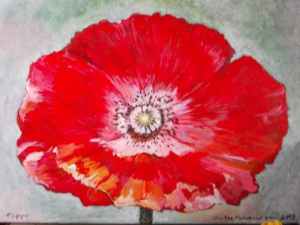
Painted this today, only 5×5 inches. I might add more to the background. It’s meant to have droplets of water (like tears) on the petals. I’m also trying to emphasise the flower with a strong red but I don’t know if I should darken the greens. Still I have at least painted again.
I painted this a few years ago, it’s based on a poppy with a white centre. Most poppies have dark splodges in the centre. I think this looks more subtle. I’m toying with the idea of painting a mixture of both on a larger canvas? The background would be greens and straw coloured. Got to possibly block out or draw out their positions and then maybe add some forget-me-nots.
Thinking of trying another idea for a painting. Wheat and poppy. Using red, blue green and yellow with thin black outlines. It would have to be stylized to fit in with the new technique I’m using but I don’t want to overdo it. I love the way poppy petals are shaped and coloured.
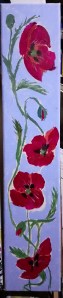
I did a bit of work on this long thin poppy painting too. I need to finish it by next week. I do seem to like putting myself under pressure! I imagine this hung on a narrow section of wall. I want to add a lot of detail and make the poppies stand out against the pale blue background. I hope it has an art nouveau appearance.
Three years ago I painted my hubby ‘my green man’. It came up on my Facebook memories today. He is a green man, gardening does him good, helps him to try and relax. He is a bunging in gardener, there’s no rhyme or reasoning to his planting, and he just plants things where he likes, but he must have green fingers. That’s why I painted him as a green man. Acrylic on canvas.
It took centuries to discover why plants are (usually) green and how they grow and create food from thin air. I was watching a programme about botany last night and there was a long explanation about the science of it.
First people experimented by weighing a plant before and after tending it for five years and finding that although it gained weight it did not affect the soil. Then they tried growing plants but without light, which meant they would not thrive. They realised that they created starch in their leaves, but took time realising they absorbed carbon dioxide and gave out oxygen as a byproduct.
The whole programme was very informative but I wasn’t taking notes. But the idea that humans could understand it and may be able to use the process artificially is amazing. The ability to turn sunlight into fuel would be something that could help humankind.
Making anything with symmetry and filters on my phone. Purple and green. Subtle architecture. I can see elven and pixy faces in green in the bottom row of the picture. Yes , there goes my pareidolia again! Pattern and colour. Fun!