Papier-mache pot

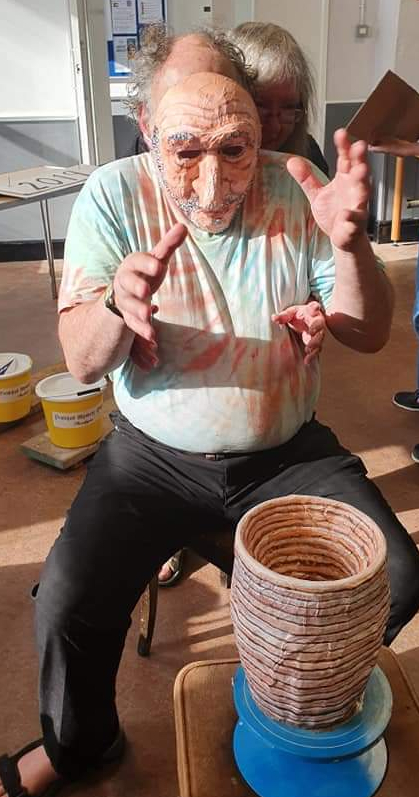
In the play we are doing this weekend my partner has to pretend to throw a pot on a wheel. We don’t want anything big, heavy or breakable, so I’m Papier-macheing a black plastic flowerpot. I had to buy some pva glue but only wanted just enough, not a great big tub or a tiny bottle. So instead of the adult craft section I found a bottle of clear pva in the children’s section at a craft shop.

Got home and started ripping up newspaper. This is many layers later, I’ve added a few layers about two thirds up to give it a slight bulge. When it’s dry I will paint it white as a base coat then a pale brown “clay” colour with shading to make it look hand thrown. I’m hoping it will look reasonably realistic.

X

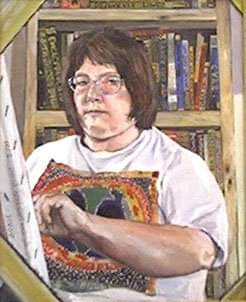
When I was forty

FB_IMG_1562542111826

I did this self portrait. I don’t do many and haven’t done one recently. Maybe I should. At this time I had the front bedroom as a studio, until we got too much stuff and I moved my painting stuff out. My tee shirt was a recycling one but I haven’t seen it for years. I’m not sure what I think about this, but it’s another Facebook memory. It’s a bit blurred. I still have the original upstairs, will have to find it out.. Almost twenty years later.

X

Props and costumes

It takes a lot to put a play on. Not just scenery but props and costumes. We couldn’t do it without the efforts of people making things, painting things white, gluing tea pots to boards, finding jugs and tankards, the infinite number of things that just help. So instead of pretending you can have something physical, like a coin to pay someone. Props make acting easier.

Then there is costume. Lots of things get re used, cut down to size, have material let in to make it bigger. Hats are made or sometimes built. Members of the cast bring in their own clothes to enhance the look of the play.

We might only be doing something that lasts 40 minutes but it’s taken a few months of hard work and planning to bring it all together.

X

Last year’s scenery

FB_IMG_1562490907053this is the scenery I painted last year. Two eight by four boards attached together to make an eight foot square panel.

In some ways painting on calico is more difficult because of the way the paint sits on it. However at least I’m not struggling to line up the two sections. I do love doing this. It makes my year.

X

Busy painting

My friend took these on Friday. I was busy painting a willow pattern background for the penkhull mystery play.

I’m hopefully finishing it next week. I’m about half way through so it should be done on time. It’s a painting on calico that had been primed with white emulsion so the paint does not go on easily and it’s a bit wrinkled where the emulsion has dried. Anyway I will persevere. Then I’m hopefully getting some new paintings done for a craft fair and an exhibition in September. It’s all go!

Kaleidoscopic

IMG_20190706_115034

I like this word, kaleidoscopic, I can’t always spell it but it’s something I remember as a child’s toy. A tube you rotate and glass or plastic pieces fall in an enclosed end of the tube so that when you look through the eyepiece they change patterns. The inside of the rest of the tube has mirrors along the length of it so the image is split into sections like a sliced up pie.

It’s difficult to try and explain exactly how it works without taking one apart but you get beautiful patterns similar to the image above (this is just some patterned cloth).

Flower photos

I took these photos a couple of days ago outside the studios at Spode. Su Hurrell is an artist there and she works with urban garden planting. She works with other artists and uses objects like washing machines, old chairs, a chest of drawers and other objects.

Other places are being greened in the town centre. There is Spode Rise garden by the China Halls in Kingsway, Stoke, and then some wild planting along London Road and Hartshill and in Lonsdale Street.

I enjoy seeing  these plants, it’s great to see people using planting in exciting new ways.

Staffordshire knot

_20190704_003239

The Staffordshire, or Stafford knot, the symbol of the county. It was painted on a  wall in the Beehive pub in Honeywall, Stoke-on-Trent. I had a look at Wikipedia and there is a lot of information there about it. It seems to have a celtic derivation and can be seen in celtic patterns. A noble family in the country town of Stafford used it as their symbol in medieval times. The design is also linked to the Saxon Staffordshire hoard of gold artifacts that was found a few years ago.

It is the simplest knot and this can be multiplied to create various patterns. There is an old stone cross in a churchyard in Stoke-on-Trent which has the symbol carved on it. Incidentally it was used as a surgical knot but was found to be dangerous and would slip if not used correctly.

It was also said to have been used as a knot to hang three men because the hangman could not decide who to hang first. This is not believed to be true and is probably an urban myth.