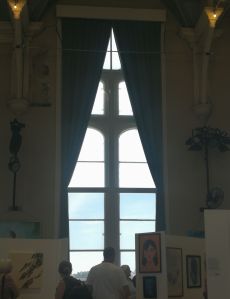
Town Hall window with curtains, I loved the silhouette this made, the brightness of the daylight outside emphasised the shape, and the height makes it feel elongated. It’s like a tall house with a pointed roof.
Taken in the ballroom of Fenton town hall, Stoke-on-Trent.
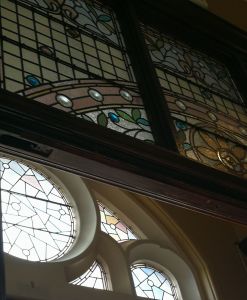
Not in a church, but in Fenton Town Hall. In Stoke on Trent, Staffordshire.
History of the hall from Google : Fenton Town Hall is 138 years old. It was built in Albert Square between 1888 and 1889 by local architect Robert Scrivener and financed by pottery magnate William Meath Baker.
I love the fact that municipal buildings can be beautiful and subtle too. Just because they are used for local political work or council business does not mean they have to be brutalist (although more modern buildings can be very ugly). I guess you have to balance cost and utility. But I love beautiful architectural design.
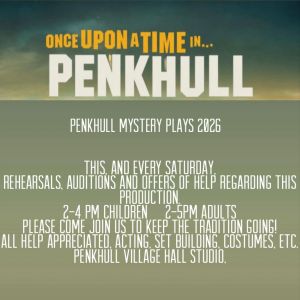
The rehearsals are on from tomorrow. In addition we need makers helping with scenery and costumes. Actors would help too. There’s only so much us oldies who have been involved for twenty years can do.
So if you are in the area why not pop in and see what we are up to?
Last summer I was helping produce a play called the Six Towns. It was for the Penkhull Mystery Play on a Saturday in July.
Not that many people saw it because it was outside on the church green. As it was on a windy day the voices of the performers were lost to the audience. Our retelling of the story will be slightly longer and will also be inside with microphones. It was successful in July so I hope it does equally well in February and helps raise funding for the Mystery Play coming up in July.
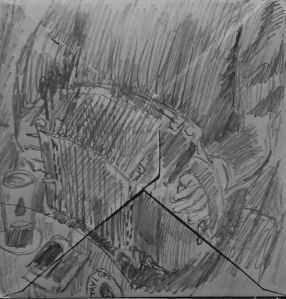
Can you see this… Sketch of an accordion.. On the back of an envelope in pencil. I loved the curve of it. The way the lines flow up through the instrument and into the knitted jumper. Yes I loved drawing the hands as he played. There is a round table with a half empty glass of bass beer (with a triangular trade mark), a notebook and his mobile phone. Plus a bass beer mat. I am not advertising though. It was lovely and welcoming at the Beehive pub in Honeywall, Stoke-on-Trent.
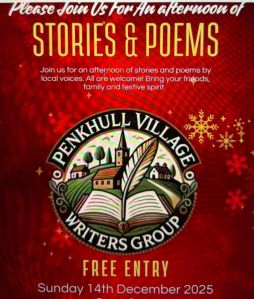
It should be a good afternoon, the previous one for Halloween went really well. I’m hoping friends will be able to come and listen to our group read stories and poems with a possible festive twist. We hope it will be cosy and cheerful.
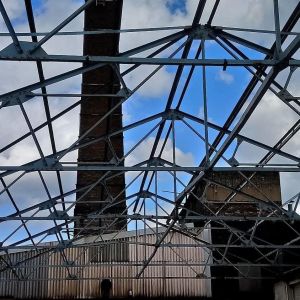
It’s almost a couple of years since I left the Acava art studios at the Spode factory site in Stoke on Trent. I had some good times there painting and getting to know some lovely people.
I won’t miss the freezing cold corridors in winter. I was cosy in my studio, but open the door and the temperature dropped. If you went and made a coffee in the kitchen it would be tepid by the time you got back to your room!
The building had a large mass, which didn’t matter when the kilns were lit, it would hold heat really well, but as a result of the pottery closing and being emptied the building no longer stays warm.
I miss being there. I’m sad I had to leave. But I could no longer afford it. At least I got some good photos while I was there.
Who is the most famous or infamous person you have ever met?
Arthur Berry was an artist, author, poet and playwright from Stoke-on-Trent, Staffordshire, England.
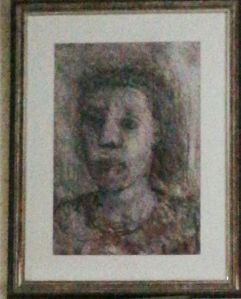
One of Arthur’s portraits.
Arthur was also one of my tutors at college and I was really happy when he said my paintings had a bit of something about them. He always seemed to wear a flat cap and tweed jacket. He was a well built man but had a withered arm. His voice sometimes boomed with emotion and joy.
His art is distinctive, charcoal and pastels, oils, mixed media. Often called the Potteries Lowry, he depicted local people and the interior and exterior landscape of the industrial north Midlands city of Stoke-on-Trent.
The works are semi abstract and strongly atmospheric. The portraits show emotions and feelings, aging couples kissing. The titles are often amusing.
Arthur wrote a series of intriguing plays, darkly comic. Set in old libraries or local pubs. They depict everyday life in the 6 towns of potteries, Grit, Grime and Clay. I saw several of them in the Victoria Theatre in Hartshill. This was replaced by the New Victoria Theatre in Newcastle under Lyme.
Arthur’s poems were funny and about his life and surroundings. His “ode to the oatcake” celebrating a local food delicacy which he once described as the potteries papadum
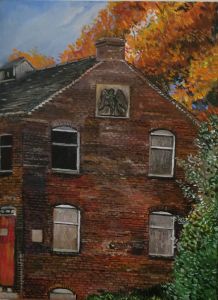
Old buildings in our city don’t always last. They are often left to rot. Trees and bushes grow out of brickwork, splitting the seams and unzipping the building. Making the ancient pottery a ruin.
Some places dismantle buildings. For example the Black Country Museum in Dudley, West Midlands, England. It often numbers each individual brick of a house, or factory, or school and rebuilds it within the grounds of the museum. It has working chain makers and underground canals that run through caves with fossils imbeded in the walls.
Meanwhile our industrial heritage in Stoke on Trent is gradually rotting, or is even burnt down by arsonists. We really should take better care of out industrial archeology even if it means donating it to the black country museum.
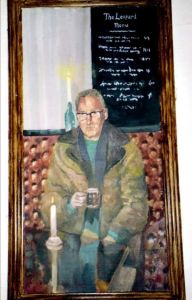
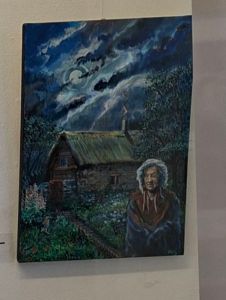
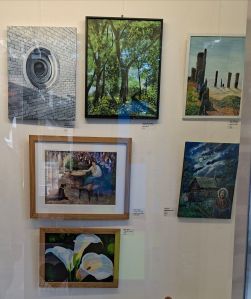
Found an old photo of my mural of Walter a regular at the Leopard Hotel in Burslem, the other picture is my reimagined portrait of Molly Leigh, based on the mural I did of her. Both murals were destroyed when the pub burnt down a couple of years ago. I might try and recreate the Walter one too. The final photo is of my Molly Leigh painting and my Spode circular window painting in the Orme Art Group Exhibition at the Brampton museum and art gallery in Newcastle under Lyme. It’s on at the moment.