Time travel

IMG_20130101_000120

A Dalek at Froghall a few years ago… That’s another story…

I was reading the New Scientists back page last week and there was a question about time travel. Where would you go to in the past or future? Something along those lines. The answer one person gave is that as the planet moves through space, if you travelled six months forwards or backwards for example, when you rematerialised Earth would be at the other side of its orbit. Difficult unless you are in a vessel with an airlock. They went on to explain that as the sun is also moving through the milky way galaxy, its planets spiral around it in its wake, so where Earth was a year ago is far behind where it is now.

I realised from reading that, that your time machine would have to move in space as well as time. In something like the T. A. R. D. I. S. This is a time machine in the Sci fi series Dr Who. It means “Time and relative dimensions in space”. In other words it can travel in space as well as time.

Considering the show was first broadcast in the 1960’s that’s pretty clever. Working out you need to be able to find the Earth’s coordinates in time and space. Mind you they were closer in time to Einstein so they might have had more of an idea about it than we do…..

X


My moon

DSC_2404

Yes it’s a blurry shot of the moon. But it’s the best I’ve taken with my phone. I don’t have a good zoom on it so it only magnifies x5. You know when you look at the moon you can see a small amount of detail, you can see the shape of the moon depending on what phase it is in. This was a bit more than a three  quarter moon. When I looked through a small pair of binoculars I could see craters and mare (areas of flat land that were thought to be seas in the past). But through my phone camera on automatic exposure it was just one brilliant blob. I didn’t know what to do. I tried the manual exposure option that reduced the brightness, but the exposure was still not revealing the shape. So I decided to play with the settings, I don’t know what I did, but I adjusted things and I managed to get the image above. I cropped the picture to enlarge it. This is the result. Boring? Yes possibly, but I was pleased.

Green skies

_20200104_013144

Something bloomed into the sky after the meteorite fell. A green mist rose from the sea and started spreading across the land. For a while it lay in the hollows and valleys, but steadily crept higher.

People noticed it and shied away from it. They travelled inland and up hills and mountains. Soon they were isolated, no one would cross the green air.

The small islands of high land topping the green murk gradually were overcome. People breathed their last air as it rose, scrabbling for height, but succumbing to the green gas. They were suffocating and dying.

Asian mountains stayed above the haze for a while longer. But like everywhere else the human population passed away. Eventually the only survivors were left alone, high above Earth, in the space station. There was nothing left for them to do but wait for the end.

But then a miracle (if after all the death that could be said) happened. The gas started to clear. After three weeks it had gone completely. It was then that the astronauts realised that all Earth’s animals had survived. They realised that it was the humans haemoglobin in their blood that had been affected. Other animals had different DNA.

But the problem was how would they descend from the space station? What would become of them?

I like noticing things…

DSC_2393

For instance, this is the just after full moon. Its in the same place in the sky as it was over the last few days, but not at the same time! I know the Earth and Moon orbit each other, and the moon is tidally locked with us. Which means it has one side always facing towards us. But as I say its in about the same place, but each day its a bit later, so after 5 days it’s moved from being there at 2am to 6am…..

Think about it. The Earth rotates in 24 hours, if the Moon is coming up later each day it must be going round the Earth at a certain speed. I don’t have the mathematic skill to work that out but if it takes 6 days to move 4 hours then if you multiply 4×6 you get 24 (hours) for it to end up in the same place so if you multiply 5(days)x6 you get 30, which is approximately a month to get to the same place in the sky and appear again at 2am. The Moon waxes and wanes while doing this. From that you can tell approximately where the sun is in relationship to us. If the half moon, and all the other phases are facing one way before full moon, the Sun is on the lighter side of the Moon. If its curved the other way as the moon starts to go away from full, then it’s on the other side. You can guess when the sun will rise from this, the smaller the area of brightness the more to the side of the Earth the sun must be. I can’t work out whether the sun would be rising sooner or later depending on its phase. I can see in my mind that if you were looking at both Earth and Moon from space they would be lit from the same direction, but sometimes you see the Moon in daylight, so I don’t know how that works. I think I would need to start drawing very long thin triangles, based on say a quarter of a centimeter on one side and 93 centimeters on the other two to work something out (based on the ratio of distances from the Earth to the Moon and the Earth to the Sun – .5:93…this is just scaling down the siz. I’m thinking in miles because I don’t know the distances in kilometers…. Its all got a bit complicated….

I remember once watching the moon every day for a week from the top of the hill, each day it got closer to the setting sun, till finally there was almost an eclipse. Somewhere on Earth there must have been an eclipse in the following day or so, but we missed it because the sun had already set.

Left side of the Universe

sketch-1575306063238

This was a phrase I thought of this afternoon, then realised it was impossible.

The Universe is apparently infinite, so you can’t have a centre, you can’t have a top, bottom, side, front or back?

Obviously we know that stars are a certain distance away, and if you look at star maps you can identify individual stars. But did you know they move? Stars move around the centre of the galaxy. Some faster than others. The distance to a star is measured by parallax. Hold your hand out at arms length, look at the tip of your thumb with one eye, then the other. Notice how the background seems to move. That’s because each eye is at the base of a very long thin triangle and your thumb is at the tip. Now think of the stars. How do you measure their parallax.? The answer is take the measurements at opposite sides of the Earth’s orbit, six months apart.

What was found was the stars are not fixed. They are moving due to the matter around them and their relative speeds. So stars in one position a thousand years ago might have moved quite a distance.

That’s not all, the Galaxies that contain the stars are moving too. Some, like our galaxy, the Milky Way, and the Andromeda galaxy are due to collide in the next few billion years. We won’t be around to see it, but it has been modeled.

Then looking further out Galaxies seem to be flying away from each other at a rapid rate. You would think gravity would hold them together, but something in the Universe, (dark matter, dark energy) is pushing it apart.

This was measured by noticing the galaxies light from further away appears redder ( red shifted). In other words travelling away from us.

To explain, if you hear a fire engine siren it sounds different moving towards you than moving away. That is because the sound waves get squashed up as they move towards you, and stretch as they move away. Light does the same thing, as an object moves towards you it squashes up and changes to a bluer colour. As it moves away it stretches and we see a redder colour.

I’m not a scientist, so I can only hope what I’ve written makes sense. All I know is that something might be in an exact place now but because everything is in constant motion you just can’t say where the ‘left side of the universe’ actually is!

Trees

IMG_20191114_201703_788

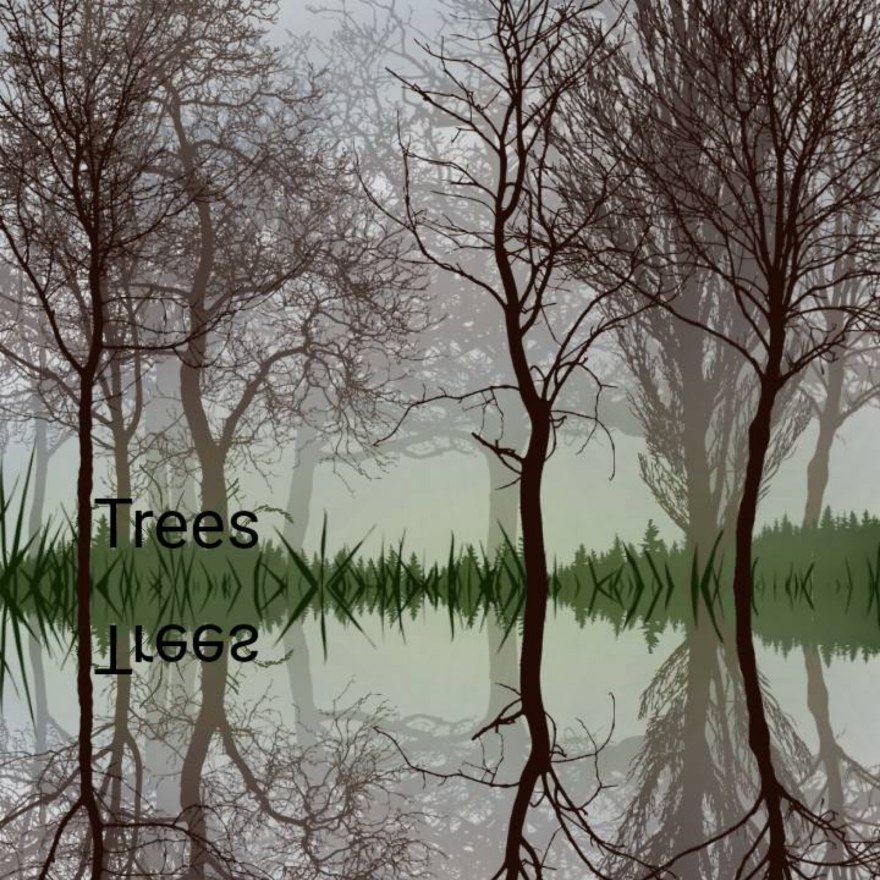
The trees spread across the world, as man finally withered and died. Killed off in a last great mass extinction caused by  humankind’s continuous destruction of the animal population and most of the plant world. Pestilence, fire, flooding and starvation had done their jobs.

All that was left were trees, rivers, marshes, seas and oceans.

The trees kept pumping out oxygen, the world was now habitable for any incomers, but there were none. Aliens may have admired our world, but they exist in civilisations too far away. None of them had things like warp drive. A nice idea, but not really feasible.

Nothing grew, except a soup of bacteria. One day that might evolve into the next great family of animals, insects, worms, critters. If man returned millions of years later he would not recognise the planet or its contents. Maybe the trees would remember….

Grab the moon

sketch-1573581782690

It wasn’t a cloud, but the dark shape was reaching out, obscuring the moon. Something that had eyes, that twinkled in the moonlight. Something that had hands or arms to grab, what? The moon is a quarter of a million miles away. The object must either be close to Earth and not that big, or if it was close enough to capture the Moon then it would be millions of miles across.

Suddenly the light was blotted out. The huge shape turned and fled, the moon was gone. Its gravitational power gone too. Earth, which had its North and South poles tipped away from the vertical by a celestial accident in the past, now started to twist and dip. The planet becoming unstable and dangerous. People could only try to survive, and make signs and march to the chant ‘bring back our moon’. But nothing happened…..

Jupiter 2009

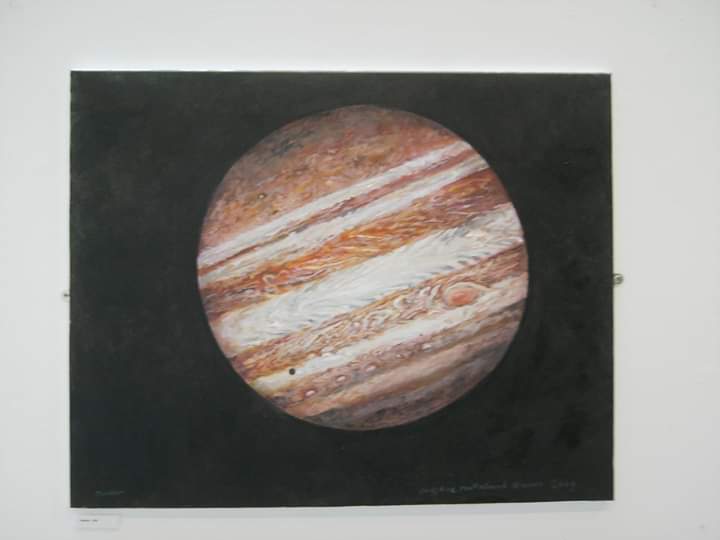
FB_IMG_1572912413208Ten years ago, and before that, I was painting Jupiter. I love the planet, though its atmosphere is hellishly difficult to paint, swirls that meld into one another, colours that blend and merge.

I think I said it was like knitting the painting, because I built it up band by band.

Now I want to do more in the astronomical area. I’m thinking of painting on perspex if I can get the right effects. I woukd do something like the ‘pillars of creation’ dusty nebula. I am thinking of having different layers. How I would display it, and how accurate it would be? I don’t know-yet!

Observe

FB_IMG_1572547168568

Photo of Jodrell Bank Observatory I took in 2011.

See that star up there?

That’s a planet Galileo saw.

See the dots across its face?

Moons that circle it apace.

Moving further into space,

Stars and gas, nebulae like lace.

Gazing further, higher, far

Supernovae, neutron star.

Galaxies fly apart so fast

Hubbles constant, Doppler’s haste.

Black holes tug at other worlds,

Gravity wells where stars are hurled.

Big bang  was expanding

Dark matter we’re  not understanding..

Cosmic microwave background energy.

Look out from our earth observatory.


Green skies

IMG_20191016_182532_487 (2) (2)_optimized

The Aurora borealis is something I’ve never seen but always wanted to. When I see photos of it I’m amazed that electrons from the suns solar wind can cause such beauty.

The electrons and other particles travel along the magnetic lines of force at the North Pole (and South – the Aurora Australis I think it’s called). As they interact with the magnetic field they glow. The different colours denote different elements. I think Green is Nitrogen and Pink is Oxygen.

The Aurora occur at the poles because they are where the magnetic field is at its weakest and drops down towards the pole. If you have seen iron filings round a bar magnet you can see how the field curves round and down.

So what is solar wind? It is the matter that pours out from the sun when there is a hole in the corona (upper atmosphere of the sun). There are coronal mass ejections where the sun spews out masses of ionised electrons which interact with Earth’s atmosphere.

There is a lot more about aurora’s but my knowledge is not good enough to explain more.