Busy painting

My friend took these on Friday. I was busy painting a willow pattern background for the penkhull mystery play.

I’m hopefully finishing it next week. I’m about half way through so it should be done on time. It’s a painting on calico that had been primed with white emulsion so the paint does not go on easily and it’s a bit wrinkled where the emulsion has dried. Anyway I will persevere. Then I’m hopefully getting some new paintings done for a craft fair and an exhibition in September. It’s all go!

Where was I?

An attempt at a Minton tile and my own design in minton colours, both for the mystery play. The one based on the minton design was hard to get right. It’s a bit wobbly. The second one has a bit of a Tudor rose feel to it. I started with the outside on the Minton copy and the inside with my own design. Im not sure it works, but when you put them together it makes a nice pattern. Hopefully they will like it for the play.

Most of the rest of the day was spent rehearsing and recovering from last nights show. These days I get tired more quickly. It’s annoying. Tomorrow is another rehearsal day. Only a week to go till the play.

Flower photos

I took these photos a couple of days ago outside the studios at Spode. Su Hurrell is an artist there and she works with urban garden planting. She works with other artists and uses objects like washing machines, old chairs, a chest of drawers and other objects.

Other places are being greened in the town centre. There is Spode Rise garden by the China Halls in Kingsway, Stoke, and then some wild planting along London Road and Hartshill and in Lonsdale Street.

I enjoy seeing  these plants, it’s great to see people using planting in exciting new ways.

Staffordshire knot

_20190704_003239

The Staffordshire, or Stafford knot, the symbol of the county. It was painted on a  wall in the Beehive pub in Honeywall, Stoke-on-Trent. I had a look at Wikipedia and there is a lot of information there about it. It seems to have a celtic derivation and can be seen in celtic patterns. A noble family in the country town of Stafford used it as their symbol in medieval times. The design is also linked to the Saxon Staffordshire hoard of gold artifacts that was found a few years ago.

It is the simplest knot and this can be multiplied to create various patterns. There is an old stone cross in a churchyard in Stoke-on-Trent which has the symbol carved on it. Incidentally it was used as a surgical knot but was found to be dangerous and would slip if not used correctly.

It was also said to have been used as a knot to hang three men because the hangman could not decide who to hang first. This is not believed to be true and is probably an urban myth.

Making glass pieces

I went to a glass workshop with my friend Angela Ashton at Spode today. I’ve previously made square or oblong pieces but today I had a go at curving the edges to make round glass cabochons. I was allowed to use a glass grinding machine to create the curves. Then you place coloured glass on top in strips and small pieces. I used some glass with a special shiny sheen, dichromic I think it was called. As you tip it in the light it changes colour.

At the end of the workshop I decided to create a long coloured strip that could be hung up in a window. I’m hoping this will be an interesting piece. I used clear and opaque glass in horizontal layers over the top of a long transparent oblong. Once the coloured pieces were laid on and tacked in place with glue I placed clear glass in vertical strips on top. Each of these will prevent air getting to the glass. When the glass is exposed to high temperatures it can change colour due to chemical reactions including oxidisation. The heat fuses the glass together.

I should get the resulting pieces in a few days. Then I will go back and may make holes in them using a diamond bit drill so they can hang up or be turned into necklaces.

X

Enamel kiln

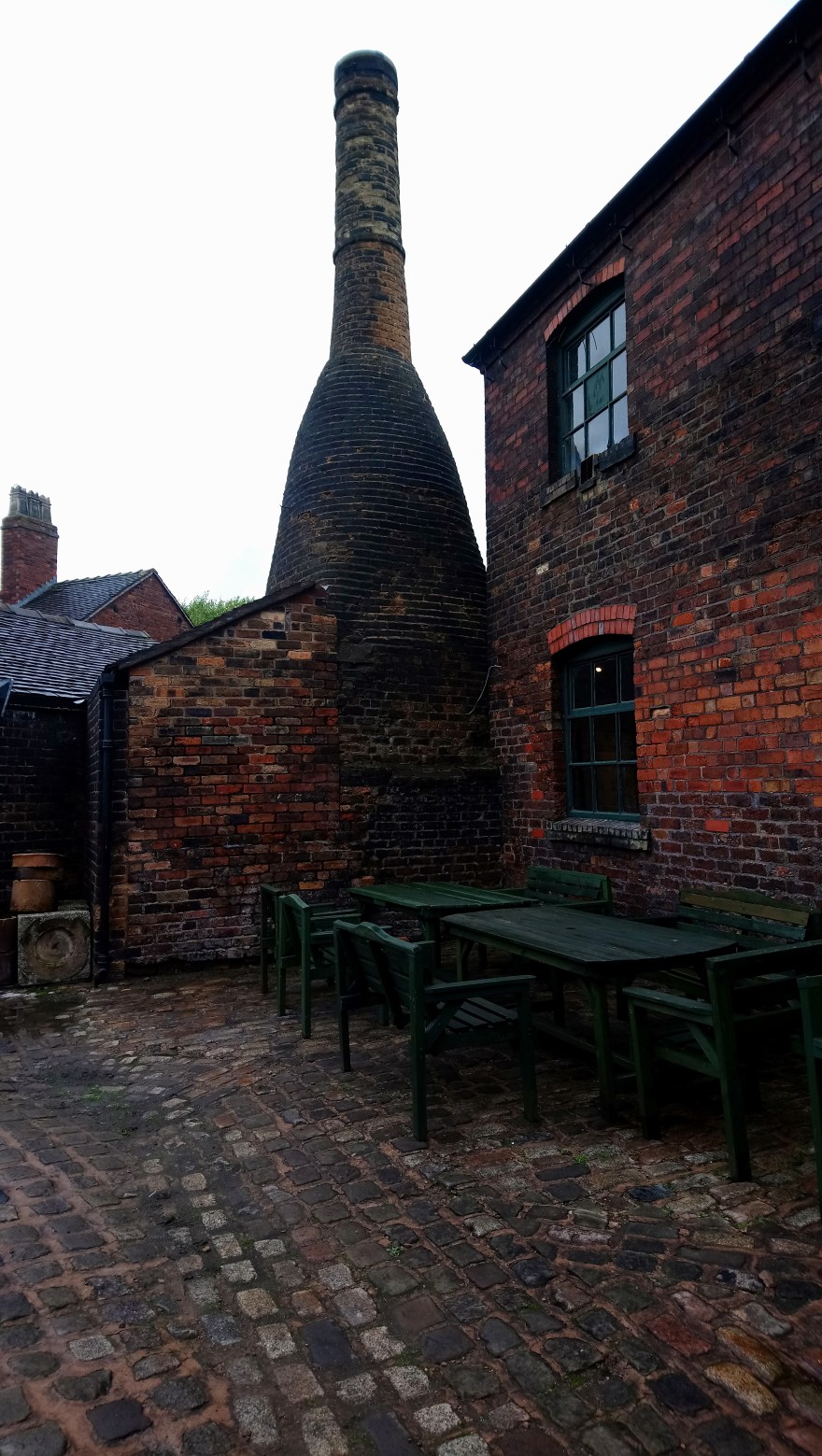
DSC_0026Enamel kiln at Gladstone pottery museum, Longton, Stoke-on-Trent, Staffordshire. These burn hotter than a normal pottery kiln. This is to create enamel from powdered glass, fired about 1400°C. There is a working enamel kiln at Stevensons in Middlewich on the banks of the Trent and Mersey canal. Enamels are used from jewellery to bathroom ware. This is because it has to be stronger and not chip or crack.

The industrial heritage of this country is hanging on. Places like the Black Country museum in Dudley in the West Midlands give us a place to see how the past was. Manufacturing changes and evolves. Soon robots and AI might be the only way things are made. But despite the old dirty polluting past may have been bad, it still stirs memories and romantic ideas of the way things were.

X

Spode Site

On a bright sunny day Spode can be fascinating. The huge chimney with its Spode sign and the skeletal remains of the factory show a stark yet beautiful side of the manufacturing world.

Spode Site is in the town of Stoke-upon-Trent and is situated in an area bounded by Glebe Street, Church Street and Eleanora Street.

The site is mostly off limits to the public, but studio holders and visitors are able to access parts of it to use and to produce arts and crafts and enjoy workshops.

The hotel at the site seems to be doing well and they have expanded the area outside for seating.

Then in September the BCB (British ceramic biannual) arrives in town. There should be plenty to see and do.

Art at the Villas

DSC_1997

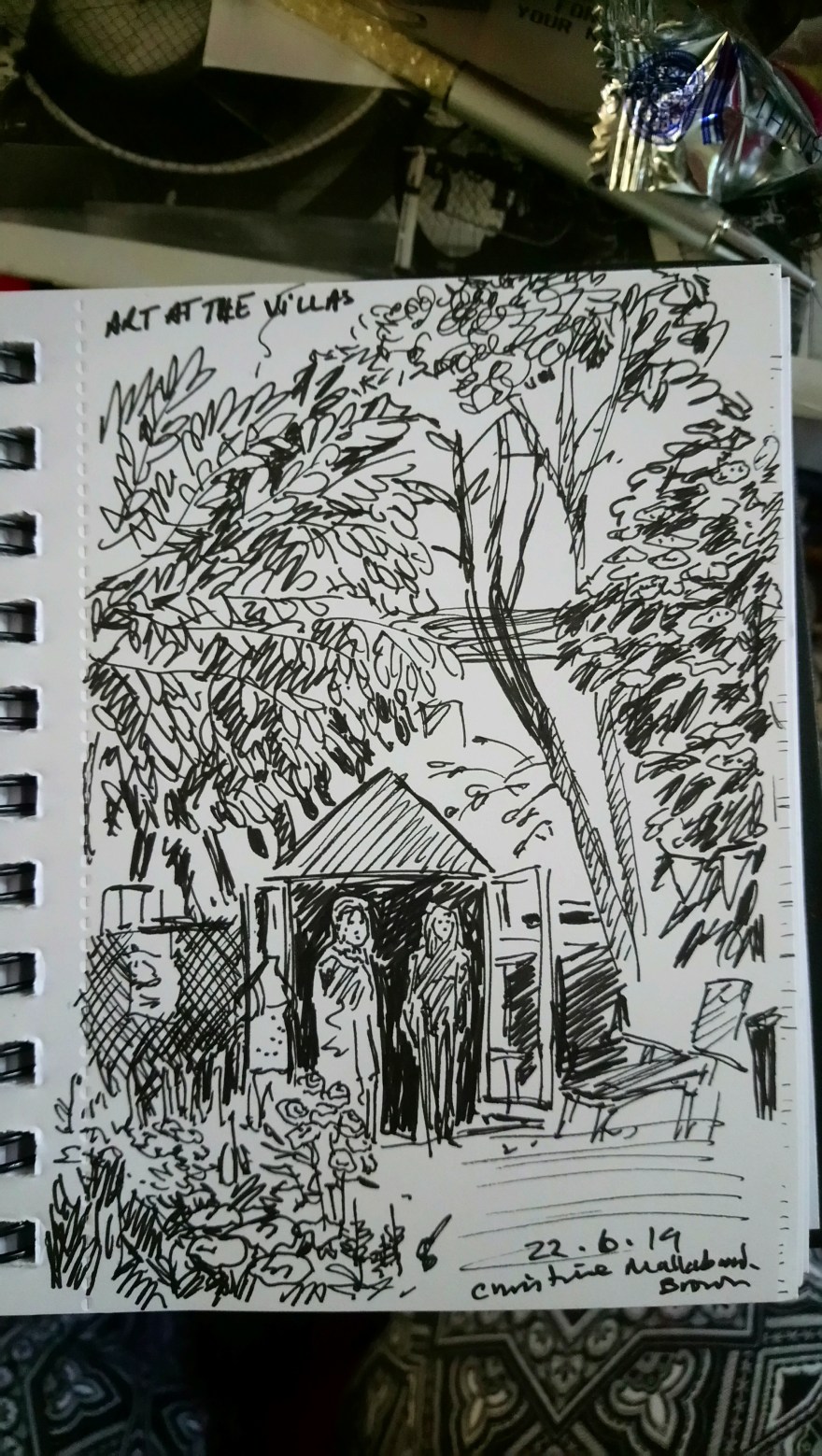
I was going to get up early today and going on a community walk along the local canal, but I got up late. I also considered going to an Urban Sketchers event at the Chatterley Whitfield nature reserve. But again I was too late. In the end we went to the Villas which is just down the road. There was an event called art at the Villas. The show was almost at the top of the road on the right hand side. The road is unadopted so go carefully driving up there. We parked at the bottom and walked.

The house we went in and its garden were full of interesting art. There were prints, original tee shirts, paintings, ceramics and a warm welcome. They were also accepting donations for charity. If you feel like visiting its in the Villas up the hill on the right off London Road, Oakhill , Stoke-on-Trent.

Since I was there and had missed other sketching opportunities I did a quick drawing of the garden and summerhouse in the distance.

X

X

Minton tiles

DSC_1981.JPG

One thing I have got to do is paint some images of minton tiles. These were made in their millions over many years and can often be found in the hallways of town houses especially in Stoke-on-Trent. People are enthusiastic about them even now and get excited about them when they find them in old houses.

There were apparently 12 original designs which are documented in a little book called touching history by Hans van Lemmen and Bret Shah. This is available through StokeYourGratitude.org.uk #StokeYourGratitude

In the paper!


I can’t use the actual painting in this blog because I don’t have the memory on my plan. But imagine this is a mural of the Burslem Chartists riot of 1842 that I painted in the Leopard Hotel, Burslem, Stoke-on-Trent in about 2007.

DSC_1992

The mural includes the hotel, the original town hall in Burslem and Josiah Wedgewood House.

The painting included police and members of the Staffordshire troop taking on rioters in Burslem. The rioters were Chartists and were fighting for the rughr to vote. One of them was killed, his name was Josiah Heapy and he now has a memorial in Swan Square, Burslem.

My mural included local people from 2007 depicted as rioters. These include local historians Fred Hughes and Mervyn Edwards and the then owners of the pub, Neil Crisp and Neil Cox. Other members of the hotel staff are included. I really wish I could show it you. If I sort things out I will post photos.

X