Raku and sawdust..

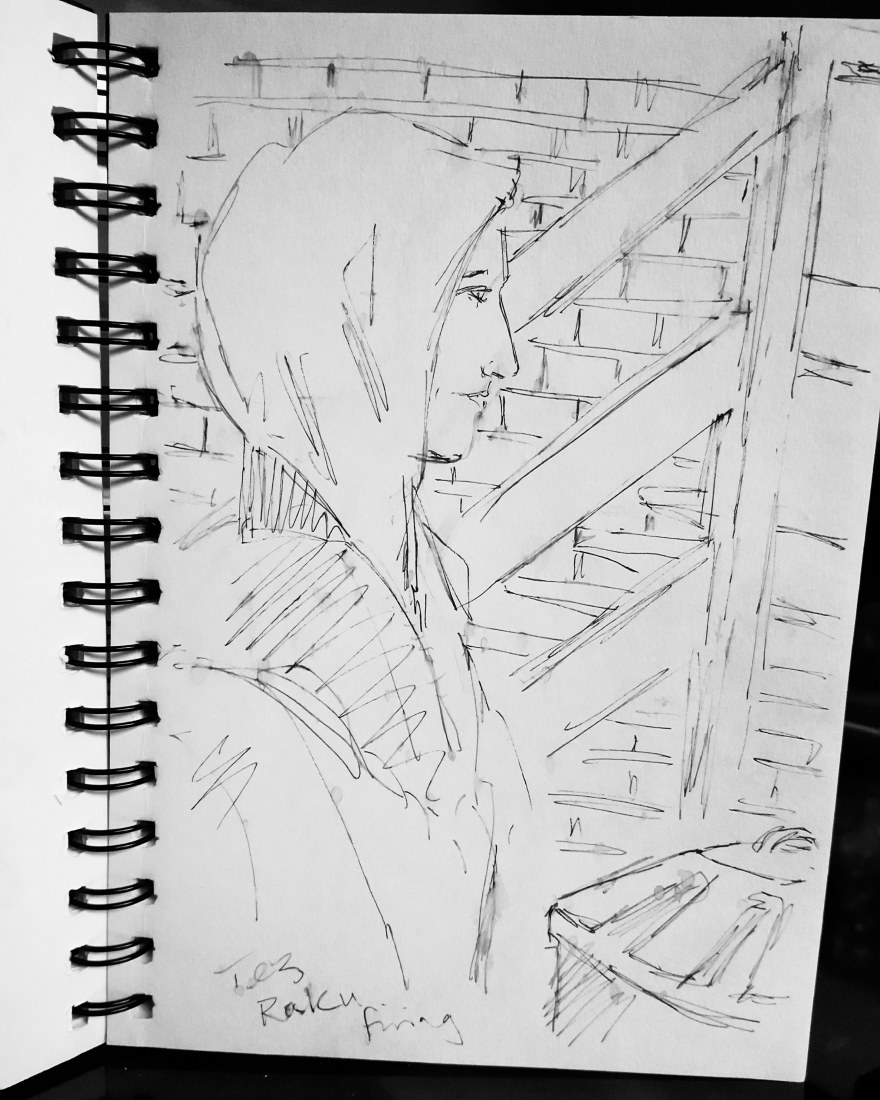
While we were at Gladstone today we saw a couple of interesting ceramic techniques. The first was by a lady called Tez. She was firing some raku Pottery. She had some pots in a metal bin with a gas jet heating it at the base. I didn’t find out what temperature she was firing at, but she said it takes about 40 minutes for a firing plus the work on the pots afterwards. Once they had been fired the pots were taken out of the bin and put in another one to rapidly cool causing crazing in the glaze. The lady put lots of beech shavings on top of the pots so that it smothered the fire. We were told that the wood sucks the oxygen out of the air around the pots and is a reduction reaction causing the copper in the glazes to shine through in a wonderful sheen.

The other technique we saw was more subtle. This time another potter put her pots in a box of burned sawdust ash. The pot was then covered in fresh sawdust mixed with white spirit. She sprinkled some of the burnt ashes on the pot to mask some areas then set light to the sawdust. As it burned it gave a mottled effect on the pot. It looked like it was being aged.

Finally there was some traditional stone ware pottery for sale. Fired in an ordinary kiln but also lovely to look at

X

Today at Gladstone

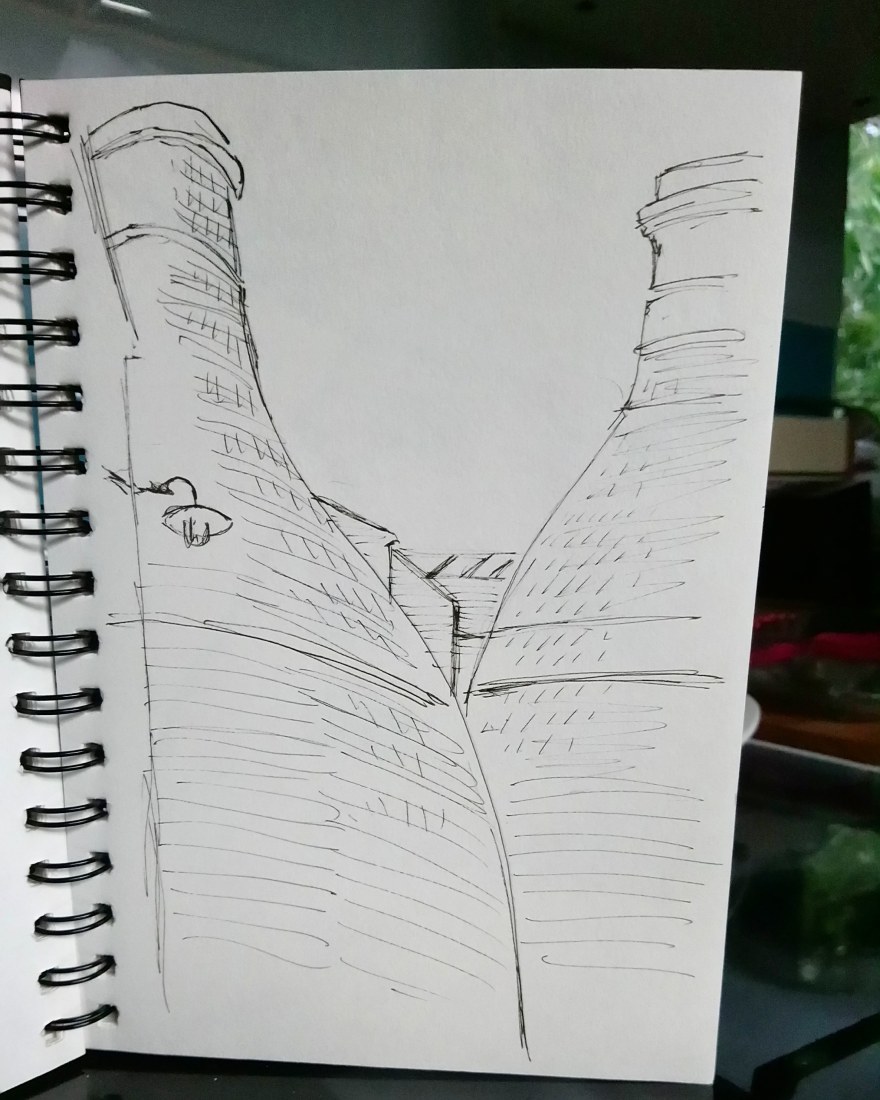
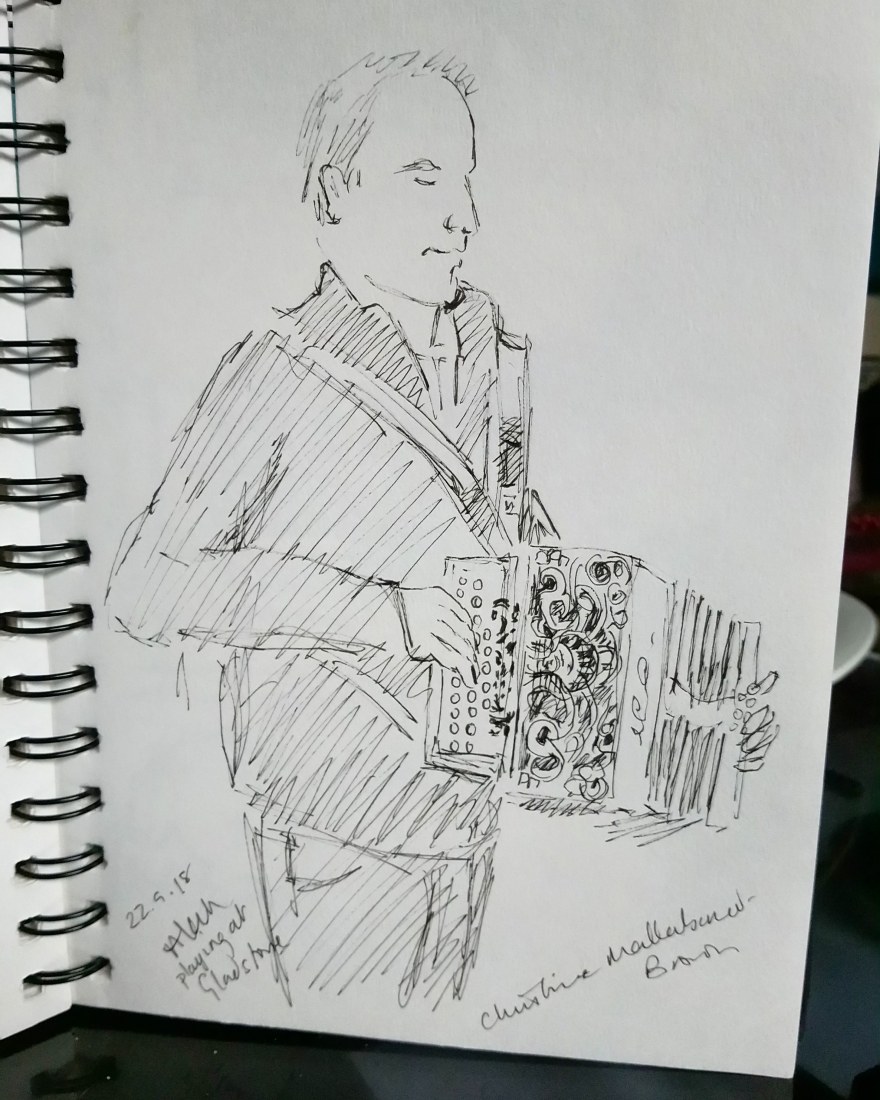
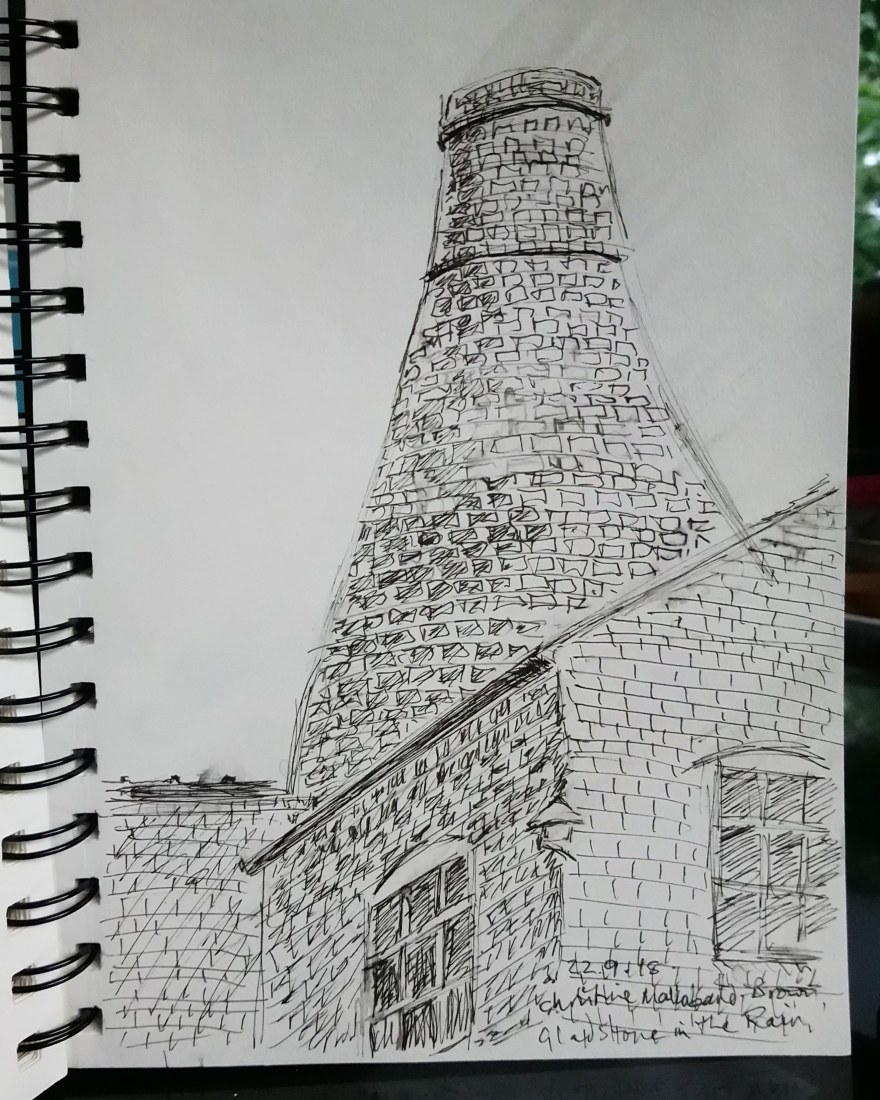
I’m in a group called urban sketchers. Today we braved the wind and cold and went out to draw and sketch there. I got quite chilly and damp but it was worth it. There were about 8 or 9 of us there.

There is so much to see at the Gladstone Pottery museum. Plus there is a nice little shop with Pottery for sale and a good friendly cafe upstairs.

Sited in Longton, Stoke on Trent, the Gladstone Pottery museum shows you the history of ceramics. There is a flushed with success section about toilets and a display of ceramic flower making, pot throwing, an old engine house, a doctors house and surgery. A selection of historical tiles and much more.

X

Transitions


We have an art challenge at Spode studios to come up with an art work which follows the theme “transition” or “transitions”.

I would normally come up with a realistic painting but I’m also toying with something more abstract. These are initial digital drawings, working on the transition from grainy to smooth, straight to curvy, and changes of colour.

I might try and turn one of these into a large painting. In a way it’s also making me think about changing my work practice from quite a straightforward way of working into something more involved.

Watch thus space for possible updates….

I might even enter something into the exhibition….

Old cars and engines

Today I had a break from my exhibition for an hour, so I went and sketched a few of the classic cars. I have to say there were a lot of Austin and Morris cars, plus things like the Scimitar car that I drew.

Each sketch took between 10 and 15 minutes. I tried to be accurate, but when you are standing in a field with cars or engines, people have a tendancy to walk in front of you or stand in the way.

Drawing is slow motion photography I guess you could say, you click a camera, but your hand and eyes have the effort of coordinating to get an image. It’s not easy to draw a new subject. Wheels can be too big or small. A bumper might be too high up, and cut across where the radiator grill should go. Also when you use a thin nibbed pen you have the difficulty of getting dark areas without wanting to spend ages cross hatching.

Movement is another problem, while drawing the diesel engine I tried to get a feeling if the spinning motion, but it started to get messy. There are so many pipes and wheels and tubes. I have no idea what bit does which action, its hard to link things up in your head.

Anyway I took photos of the cars for comparison, I may paint some of them.

Recent minatures

20180914_004757

If you wonder where I have been, I have been painting these tiny miniature paintings on canvases around the size of a matchbox.

I’m quite enjoying doing them. I would like to present them in small gift boxes but I don’t know where I can get some from.

People don’t seem to have room for art, so the idea is they might buy one of these to put somewhere special… you never know…

I haven’t done much this month but at least I have got going again over the last few days. I’m putting an Exhibition up later today which will be up on Saturday and Sunday at Etruria.

Details are that the Etruria Industrial museum is holding a static steam engine day on Saturday and a classic car day on Sunday.

Might see you there…..

X

Its Wednesday. ..

I think this is finished now, although I might change the blues…. added cat for scale 😀.

I’m go I to start doing some more paintings as I want some new work for an exhibition I’m in this weekend at Etruria Industrial museum.

My green man/woman pictures are built around the idea of tiles which were made in Stoke-on-Trent at factories like Mintons.

I also want to do some small paintings based on classic cars because the exhibition is at the same time as a classic car rally and a static steam engine event. That’s this weekend at Etruria, Stoke-on-Trent.

X

Surreal canal

IMG_20180905_013714_523

Using the Layout app from Instagram, I created this surreal image using a photo of a local canal with a strange thin building projecting upwards from what appears to be a circular or oval pool, the water was so still it had a lovely reflection on it, and this has added to the final picture.

The building is the edge of an old, derelict, warehouse that stands like a cliff face next to the canal, in the past ware from the pottery would have been transported from the pottery, south and east to the Midlands or north and west to the coast at Liverpool or up to Manchester and beyond. In fact Stoke-on-Trent lies at the heart of the canal system, and was built around the coal, clay and water of this area. Manufacturing of pottery, steel making and coal mining was on a massive scale here. Industrial archaeology will reveal the landscape as an amazing historical treasure trove of creativity. Some of the buildings were lost to demolition and decay, many bottle ovens have gone. The rest have protection orders on them, but are not necessarily being maintained. Warehouses and factories are crumbling. It is sad that history is being lost.


Started again

I’m just starting a painting about 2ft by 2ft 6 inches.

It’s a view of the Spode site looking from the building that houses Hulton Pottery which is a small studio pottery on the Spode site, looking down the run of buildings then on to the iconic Spode Chimney that stands high above the site.

Spode is changing, parts have been demolished, other parts will be gone soon. However new people at moving into the studio’s on the site. Together with the visitor centre and the hotel it is becoming more vibrant and interesting.

Hopefully the weather won’t get too cold this winter, that’s what really puts me off going. I have a studio but my mind isn’t on things really. I have found it really hard to get motivated but perhaps I have turned a corner…..

So I will leave you with the beginnings of a painting..with luck I can get it finished soon.

X

Weeping Window


We visited Middleport pottery in Middleport, Stoke-on-Trent today to see “weeping window” a memorial made of 11,000 ceramic poppies placed on a bottle oven in the pottery. The poppies are some of the ones that were on display previously at the Tower of London and have been travelling around the country for the last couple of years. You are supposed to book a visit but as the number of people going to see the display has reduced we were allowed in without booking. We had to park on a designated car park as the local streets have parking restrictions at the moment and you could get fined.

The poppies commemorate the worth anniversary of the 1st world war,”the war to end all wars” which sadly did not stop humans fighting over and over again as they have since our ancestors first fought many thousands of years ago. Many if the poppies were made in Stoke-on-Trent so its good to see them come home although there was a fight to get them.

The display of poppies cascade down the oven, spreading out on the ground, representing blood and the fallen soldiers that were killed in the war.

I drew the scene but had to slightly shorten the bottle kiln to fit it on the page. I also struggled to represent so many poppies. We then visited the rest of the pottery, including the steam engine although it was not working today. There was quite a crowd so I only sketched it briefly.

On our return to the car park there was a large poster with the poem by John McCrae written in 1915. I decided to draw my own version of a poppy to go along with it.

Middleport pottery is very interesting, there is a museum on site, plus artists and ceramicists with their own studios. The tea shop was very busy but we managed to get a table. There was also a display by students from clay college who are doing a two year full time course to learn the skills of pottery making before they are forgotten.

Although the weeping window display ends in mid September the pottery is well worth a visit. It’s surprising how much goes on round here!

Visiting the Moon

Today we visited the museum of the Moon, an art installation which is on till tomorrow. We got in free but there have been events there that you had to pay for.

The Moon is a huge inflated sphere, a balloon, hung from the ceiling of the Kings Hall in Stoke-upon-trent, part of Stoke’s town hall.

I’m afraid I didn’t get the details of the artist who made it, but it is very beautiful. The Moon is fully rendered with all its craters and mare (or seas). The seas are actually flattened areas where magma or lava has welled up from the interior and flowed out across the Moon’s surface. They are caused because of the speed of impact from asteroids and meteors hitting the Moon, the energy of momentum is converted into kinetic, heat, energy.

But thats the side we see, because the Moon is tidally locked with us, so the face we see is always pointed towards the Earth. If you observe the Moon over time it swings and sways so you can see slightly more than 50% of the Moon but we never see the back. The sides, top and bottom is squashed up so its not easy to distinguish what is visible.

So walking around the installation you can see things you might only have seen in blurry film from the Apollo missions almost 50 years ago. Huge craters where impacts must have shook the Moon to its core. You realise how much more scarred and cratered the dark side of the Moon is. Pitted and dented, the back of it has been impacted over millennia.

The Moon has also slowed the Earths spin which is why when humans are shut away in dark caves to experiment with our body clocks, we think a day ends after 23 hours or so. That is because as we evolved over millions of years the Moon was orbiting the Earth closer to us, and as it moved away gradually  (less than a centimetre a year?) it slowed the Earths’ spin to 24 hours a day.

At the moment the Sun can be eclipsed by the Moon. It just happens that the Moon is 400 times closer to us than the Sun and 400 times smaller. So the Moon appears to be exactly the right size to cover the Sun when there is an eclipse. As time goes by the Moon will move further out and “perfect” eclipses will end. Finally the Moon will break away from the Earth. When that happens the Earths rotation will become chaotic. It already spins on an axis that is tipped over at about 23°. If the Moon flys off into space its gravity will no longer help hold the Earth steady. Who knows we could end up tipped right over.

I’m not an expert so my figures might not be completely accurate. If you want more information please check out Astronomy websites.

The Museum of the Moon is an installation run be Appetite. They help produce various arts projects over the year. We also heard diary entries from the First world war, and a dance performance called “in Flanders feilds.”

I drew the Moon because my camera isn’t good in low light levels. The juxtaposition of the Moon installation and the old Kings Hall made for a marvellous and eerie afternoon out.