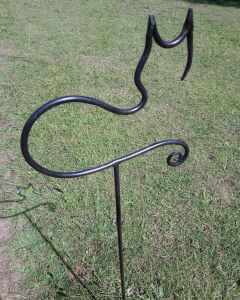
I bought this beautiful cat plant support today from my friend that runs #Sculptedsteel (on Instagram). I already have a larger cat sculpture from her but I think this is really elegant especially with the curl at the end of its tail. It’s about a meter tall and ideal for a climbing plant to support it as it grows. I will find something to train up it.
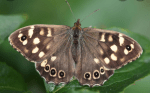
We just saw this butterfly on the buddlea in our garden. It was feeding on the nectar from the flowers of the bush I think.
It seems appropriate to have a name with wood in it as our garden is very woody now. I guess we will have to try and cut things back a bit because it’s very overgrown, but I’m glad we have made room for nature, and by planting trees we are helping reduce our carbon footprint.
They grew, but haven’t ripened yet. I was hoping the hot sunshine would help turn them blue.
In other news we had to move all our plants off the pavement in front of out house. Workmen are putting in fibre optic cables and will be digging in front of our house tomorrow. So the poppies, festuca grass, nasturtiums, passion flower and honeysuckle and ivy all had to be moved. We could see mats of roots under where the pots had been. I hope they all survive and we can put them back.
Our back yard is a bit frazzled. The plants are brown in places but we have watered them in the evening. The tomatoes in a little hanging basket have developed but are yet to ripen as are the blueberries that a friend loaned us a few years ago when she moved. I’m still caring for them, I hope she’s OK but we have got out of touch with her. Anyway cool and thundery weather is on the way..
Our back yard is blooming despite my hubby putting icecubes in the hanging baskets! Now I need help cutting back the main garden, I need help. We are not fit enough to do it anymore and what we’re shrubs have turned into trees and huge bushes. I know the neighbours are not pleased but we don’t have the serious finances to tackle it plus we want it to remain a wildlife haven. Goodness knows what we can do about it. Maybe get on one of these TV rescue programmes!
I was discussing poppies with a friend today who wanted to find out what a certain poppy was. I identified it as an oriental poppy. She then showed me another one which had a great ruff of petals. I thought it was a double so checked on the Internet and it was. I also love many different poppies. Californian, Himalayan, Welsh, I’m sure there are more types than that but I’m not sure of them. What I really like is the variety of colours and shapes they come in. This photo was taken above Bovisand Bay in Devon. I took a few photos of them. The grass was so dry it could have been hay.
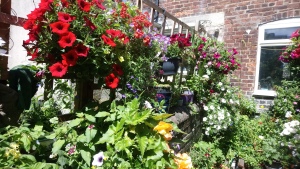
The trouble with attaching hanging baskets to the fence is that as they grow and get heavier with watering it starts to bend. It’s quite a strong trellis but I think it will need replacing in a couple of years.
The wall the fence is attached to is the same old bricks the house is made of with curved coping stones on the top to keep moisture out of the centre of the wall.
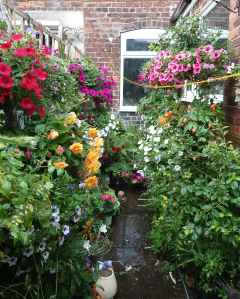
Each basket has many different plants crammed in them, then there are a series of smaller baskets with single species in them. There are individual pots balanced on the top of the wall and lots of them on the ground below. Planting up pots requires a balance of compost with crocks (broken pottery) in the bottom of the pots so they have drainage, but then I usually place a saucer or a bowl underneath to catch the water so that it doesn’t dry out. We have a hose pipe so we can water everything regularly.
Looking back down the backyard. It was lovely to get out in the sunshine for a few minutes. I decided to take a photo from near our living room window towards the back of the yard which has an overgrown hedge and Russian vine growing through it. Our yard is a sun trap and the hanging baskets and plants are getting very blousy! I must admit we cram a lot in every year.
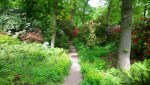
For mist of our existence humans lived outside or in caves or huts. It is only within the last few thousand years that we started to live in villages, then towns and finally cities. With each increase in population we have moved away from greenery and plant life. The movement into flats and apartments has imprisoned us in concrete even more.
Humans need shelter from the elements, either the cold of the winter, the heat of the summer and the changes in wind and rain. So buildings are needed, but perhaps we should include more greenery in these places. Not just lawns or neat hedges, but more green walls or indoor planting.
It’s good for our mental health, a connection to our historical past. If it could also be used to clean the air, or add a layer of cool air to our streets surely it is worth pursuing?
Instead I see stories in the press of trees being cut down, ancient ones, to make way for railways, or being blamed for damaging buildings, instead of reversing the engineering and not building next to ancient trees. Let’s have an intelligent discussion about this. Green in important to out health and our planet.
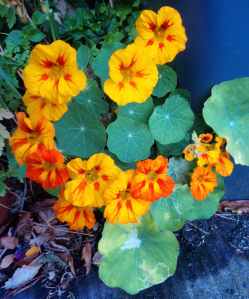
Suddenly overnight, they are in flower. They thrive on poor soil. Some of the leaves have been munched slightly. These are on the front of our house, but when they grow in the garden you can eat the leaves, seed pods and flowers. They are nice to eat as a garnish in salads.
Nasturtiums come in a variety of colours and with plain or variegated leaves. As long as they get some water occasionally they will grow and scramble up surrounding plants or up walls, but they are not frost hardy and will die back when the weather turns cold.





 Mallaband-Brown