Light in the sky

Half past five in the evening and the clouds scud by. There’s still light in the sky but the rain showers keep pounding the windows. I love the newly washed look of the air. Almost sparkling. When I came here forty years ago there was far more heavy industry in the area. Smoke and dust polluted the air. A smog sometimes settled over the city and you could smell the fumes from the tyre factory or enamel being fired onto pottery if the wind was in the right direction. Now the wind is more a carrier of sound. The local A road and the motorway. The occasional sound of pile drivers when new buildings are erected, which is not very often. Sometimes smoke travels on the forlorn breeze as an old building accidentally burns down. So sad. So much bustle gone. We are a warehouse city of poorly paid jobs. No real chances. No ambition if the naysayers are believed. I think we can do better. Think creative, be creative. Let a bit of light shine on us. X
Mugs and Mojo

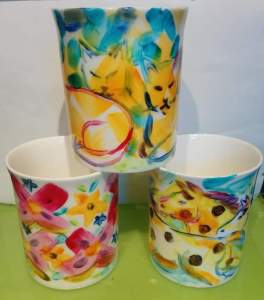
I painted these mugs with special overglaze paints about three years ago when our art group at Etruria were still meeting. We haven’t done anything recently because of Covid. It’s only when I look back at things like this that I realise I was doing so much more than now. It’s only when I remember these things that you know I am, or was, capable of so much more than I’m doing now. The designs were from my imagination. Painted directly, no sketching out first. Give me my Mojo back!

Sunshine and clouds

Walking home, Stoke-on-Trent, about 3.15pm this afternoon. The low sun barred by dark clouds. It didn’t rain but the bright sunshine really shone out behind the clouds. The lamp posts give a sense of scale. You can see the shadow of the cloud on the right cast at an angle so it gives an indication of where the sun is. It never emerged as I walked as the clouds were really slow moving.

Changing spots

When I was painting in the Leopard Hotel I designed a coat of arms for the hotel. The hotels ginger cat lies across the top of a shield with garlands of leaves and berries around it. The shield is split into four sections. From the top left there are crossed knives and forks on a blue ground with a gold chevron. The top right is a portrait of Prince Leopold (not sure where he was from) it was possible that the Leopard could have been named after him. Bottom right are three foaming tankards in gold. And bottom left is a painting of a Leopard. The motto on the banner underneath says ‘The Leopard can change its spots’. The idea behind it was that the pub had just been taken over and the landlords Neil Cox and Neil Crisp wanted to turn it into a friendly place to eat great food and wonderful beer. I think they made a great job of it and for a few years it prospered but the changing face of the town, the empty buildings and then covid finally managed to close it. Sorry for the fuzzy photo.

Willow pattern painting

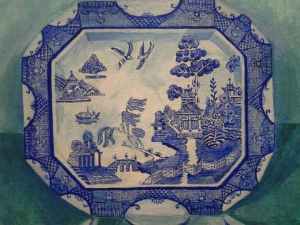
I painted this a few years ago. It’s an octagonal platter shape. I used a few images of willow pattern plates and amalgamated them. It’s mostly based on a Spode style of pattern. The edge design was made up by myself. The painting is meant to look like the platter is leant up against a background. That’s why I added shadows and played with adding a reflection below it. I can’t remember what else I added to it. I did a series of paintings of ceramic objects, there was also a jug and a teapot and a large vase painting. It was good to imagine pottery from my adopted home of Stoke-on-Trent.

On the walls

Photo courtesy Fred Hughes

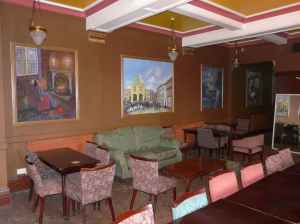
I got a couple of photos from my friend of the Arnold Bennett suite in the Leopard Hotel in Burslem, Stoke-on-Trent. These were taken before the fire that destroyed most of the building although some walls are still standing.

People have asked if the paintings were removed when the pub closed two years ago. But they were murals. The room originally had flock wallpaper inside framed areas on the walls. When the new owners took over the pub they decided to have murals painted in there. They contacted Burslem School of Art and I was asked if I was interested. I’d painted murals and scenery before so I said yes.

The owners lined each space with lining paper and I got coloured emulsion paints to create each mural.

I think this photo in particular gives an idea of the size of the murals and how they were laid out. I hope to get more images of them so I can have an archive of them for my records.

Another mural, Wedgwood and Brindley

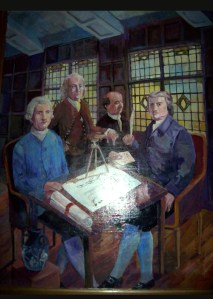
Another of my murals, four gentlemen meet to discuss the building of the Trent and Mersey canal. They included Josiah Wedgwood and James Brindley. They were said to have met in the back room of the Leopard Hotel in Burslem.

This image was found on a ghost hunter website. I didn’t give my permission for him to use it, but I guess I can’t complain because it means I now have a record of it. I will keep looking for more.

Almost midnight

She stands in front of her cottage. Molly Leigh, the Burslem witch. Notorious and buried in the local churchyard at 90° to the other burials. The painting is based on a peasant woman painting by Theodore Gericault.

This was one of my murals in the Leopard Hotel in Burslem. The pub burnt down at the weekend. I am bereft. I am trying to pass on my memories to keep a feeling of what it was. I painted these on the walls. Emulsion on lining paper directly onto the wall. I’ve had a few comments that they could have been taken down. I don’t think people understand what a mural is.

Callous Culture Cuts for Stoke Museums Undermines Future Chances of Tourism In The City

Permanent Five Month Closure for Gladstone and 13 Jobs Lost In Museum Shakeup

Callous Culture Cuts for Stoke Museums Undermines Future Chances of Tourism In The City

I saw this on WordPress Reader and had to share. The council claim its only a minimal cut (of around £600,00!). Its important that our industrial heritage is saved, otherwise Stoke on Trent would lose its raison d’etre.

Etruria Flint Mill

I added my easle yesterday. Today I’m showing you my easle two years ago, I did a painting of Etruria Flint Mill. It’s also called Jessie Shirley’s Bone and Flint mill I think? It’s the only working Steam driven Flint mill in the country and the flints and bone  were crushed and ground using the power of the steam driven beam engine there.

The buildings are part of Etruria Industrial Museum, a complex of cafe, the museum displays, and the Flint mill on the Trent and Mersey and Cauldon Canals at Etruria, Stoke on Trent. I’m not sure of its opening times. But once a month it used to be fired up and you could watch the fly wheel rotating round and the pans where the flints were ground rumbling as the engine turns them. Its amazing to see the industrial archeology of the potteries in action.