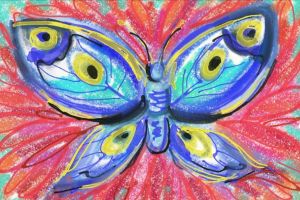
A quick sketch for a prompt “flutter” for a group I’m in called bandofsketchers. A butterfly drawn in Artrage app on my phone. It’s a bit scribbly, but it is meant to be a sketch…

New paintings and regular art updates.
A quick sketch for a prompt “flutter” for a group I’m in called bandofsketchers. A butterfly drawn in Artrage app on my phone. It’s a bit scribbly, but it is meant to be a sketch…
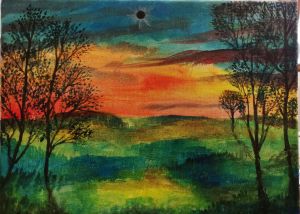
Sketch of an eclipse on canvas in acrylic paint. I challenged myself to just paint with red, yellow, blue, white and black so I had to mix new colours using the primary colours on the pallette. I added a tiny moon surrounded by the corona of the sun visible against the darkened sky. It might be something I paint properly in future.
What’s your favorite time of day?
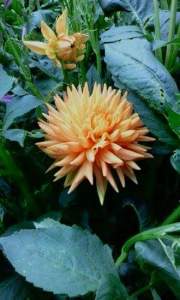
When the sun is overhead
Light shines down on bright flower beds
Makes the hazy colours shine
On plants and flowers and bees divine
At the stroke of noon I see
Primary colours, one two three..
Red and blue and yellow too
And the other colours hue
Make me want to paint and draw
All the beauty that I saw
Afternoon is the key
Makes my mind feel oh so free
Mornings are OK I guess
But post meridians are the best!
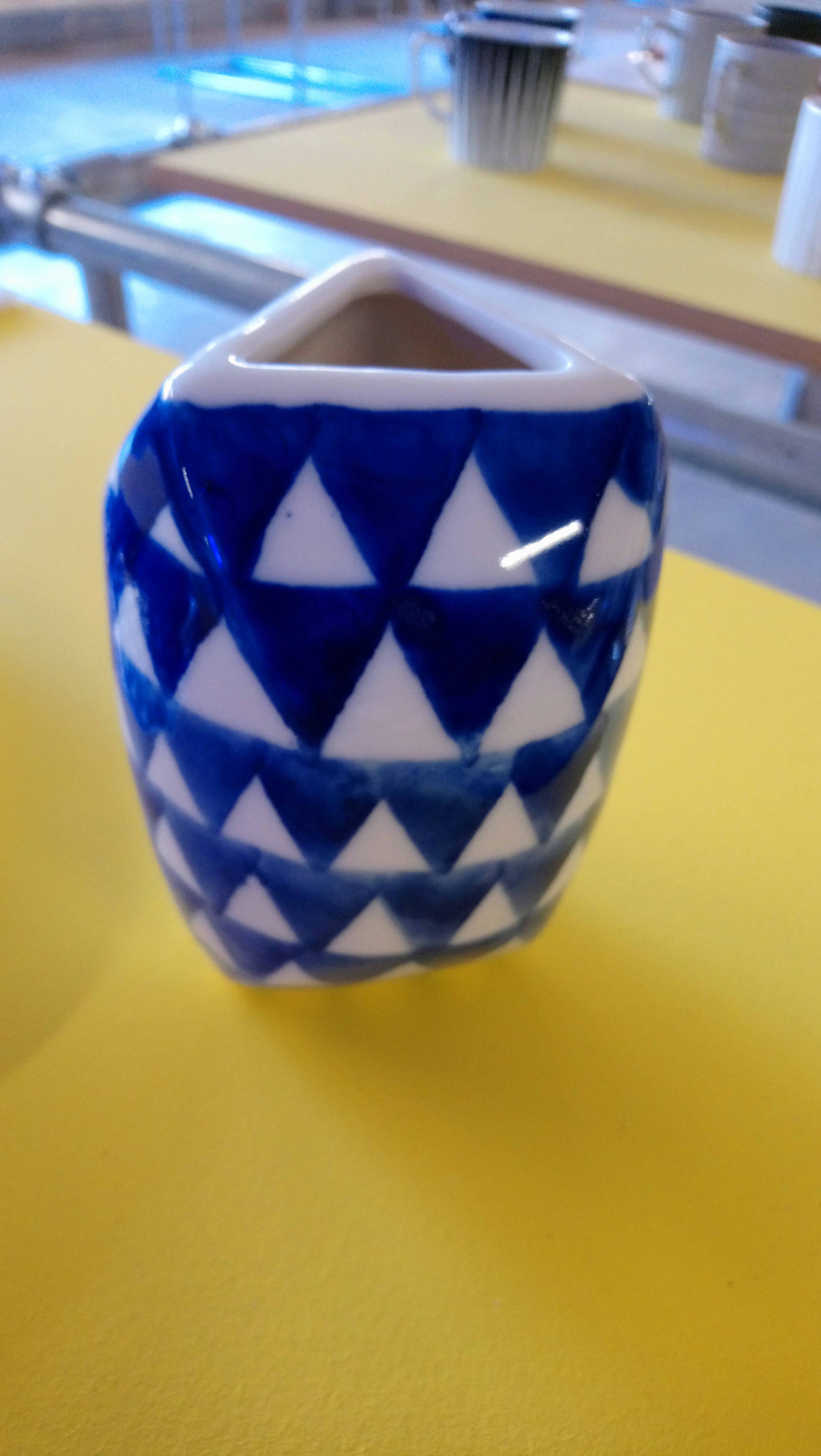
I love the colours in this photo which I took at the British Ceramics Biennial held in Stoke-on-Trent last year.
I like the triangular patterning on the body of the pot, and the shape of is neck. I think the blue glaze is painted by hand. I love it. The yellow table surface is a brilliant contrast, making the pot stand out well against it. These primary colours are a lovely combination.

Saw this bright and breezy tablecloth in a cafe today. I don’t know who designed it so apologies for using it. I really like sign writing and shaded letters so this appealed to me. It’s neat and tidy and eye poppingly colourful, with primary yellows and orangey reds. The dark and light blues add contrast, and the whites tie it all together. Is this surface pattern or graphics, or a mixture of both.
X

You might have heard of the colour wheel.. a rainbow of colours running from red to orange, yellow, green, blue and purple.
Red, Blue and Yellow are known as primary colours. These are the ones you can mix together to get Orange (yellow and red) Purple (blue and red) and finally Green (blue and yellow)
There are mixtures that can also make all the different colours of the spectrum.
If you know the theory of colour you also know White is all colours mixed together. This is why if you put a prism of glass in a beam of sunlight it will split the white into all of the colours of a rainbow. Newton did this experiment and helped us understand the nature if light.
On the other hand, Black is an absence of colour, all the colours that hit a black surface are absorbed, they don’t reflect back to your eyes. If you mix up all the colours of the spectrum you tend to get Brown, not as you might expect, Black.
Did you know there are complementary colours? If you spread the primary and secondary colours around a circle split into 6 equal segments you can see how the primary colours are next to one’s of a mixture of them and the next primary. So the wheel ends up with the most contrasting (complementary) colour directly opposite each other.
These are
red/green
yellow/purple
blue/orange
These colour combinations seem to sing, like a discordant chord they bounce off each other.
Some famous artists like Cezanne and Van Gogh would exploit these clashing colours to create strong images. Van Gogh’s blue skies contrasting with the orange of sunflowers makes the paintings seem to glow. Cezanne’s use of green vegetation and red soil has a similar effect.
So sometimes when I paint or draw I will chose to use complementary colours to see what I can create from them.
Of course there are other colours out there. ..the author Terry Pratchett wrote about Octarine, the eighth colour of the rainbow, I think he said it was a purplish black …..
But in reality there are colours beyond human perception. The ones nearest to the spectrum we see are Infra red, which gives heat. You need special detectors to show this colour, and also ultra violet which can cause tanning or sunburn when the uv light is strong enough.
The spectrum continues into longer and shorter wavelengths beyond infra red and ultra violet. But that’s another story….

 Mallaband-Brown