Without flicking paint! Each dot so far and each smudge is from a brush touching the canvas. It’s a bit over exposed. It’s acrylic on a small 7×7 inch canvas. I might paint a tardis on it if it works. There are hundreds of dots and I’m really struggling to find a brush with a decent point. More to do!
It’s hard to believe it’s been eight years since the New Horizons space craft flew by the now minor planet Pluto and it’s moon Charon.
The rest of the solar system had already been explored over the previous decades by other probes sent out by NASA including Voyagers 1 and 2 which had undertaken a grand tour of the systems gas and ice giant planets. These are now over 18 light hours away.
When New Horizons arrived at Pluto on 14 July 2015 it found a tiny world with a heart shaped feature on its surface. The predominant colours are reds, whites and dark greys. The surface is mottled and pock marked in some places, and smooth in others. The photos of the encounter are spectacular and can be seen online. The Wikipedia page about New Horizons is very informative. I don’t propose to reiterate all the information here.
I chose this mission because it happened in my lifetime. I could have chosen other missions or historical events, but I wanted to chose something that represented the farthest influence or encounter that humanity has ever made. Hopefully we will continue to find out more about our solar system, our galaxy and the universe in the future.
What’s something you believe everyone should know.
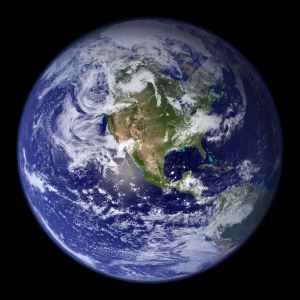
A look at the Earth from space, the North American continent is fully visible, but the South American continent follows the curve of the Earth around to the other side. Also note the left side is darker as the Earth rotates into darkness.
Question. If Earth was flat where are the other continents hiding? Why isn’t the whole planet in full sunshine? Why is the shadow the Earth casts on the moon always round? (which gives us the moons phases). If Earth was flat the shadow would sometimes be a line. Why is every planet a sphere but not Earth?
Occam’s razor says that usually the simplest explanation is the truth.
From Wikipedia :
In philosophy, Occam’s razor (also spelled Ockham’s razor or Ocham’s razor; Latin: novacula Occami) is the problem-solving principle that recommends searching for explanations constructed with the smallest possible set of elements. It is also known as the principle of parsimony or the law of parsimony (Latin: lex parsimoniae). Attributed to William of Ockham, a 14th-century English philosopher and theologian, it is frequently cited as Entia non sunt multiplicanda praeter necessitatem, which translates as “Entities must not be multiplied beyond necessity”,[1][2] although Occam never used these exact words. Popularly, the principle is sometimes inaccurately[3] paraphrased as “The simplest explanation is usually the best one.”[4]
There is a super blue moon tonight and tomorrow night. All that means is that there are 13 full moons in this twelve month period and this August there are two in the same month. This is the second and ‘blue’ moon. The moon also happens to be at its closest approach to the Earth, a few thousand miles closer, so it appears slightly bigger in the sky. The moons orbit is elliptical, so it has two centres of gravity and so sometimes it appears closer and sometimes further away. The next super blue moon will be in 2037. There are lots of articles on the Internet about it today.
Tell us about the last thing you got excited about.
Jupiter tryptic
A couple of weeks ago I was excited that one of my paintings would be entered into an astronomy competition. A magazine wanted to see people’s artwork so I sent in this image. Then I got a message asking me to send in again with a jpeg (it was) as an attachment (my phone sends the image embeded in the email).
I tried again, it did the same trick. I started to walk upstairs to send the image on my PC instead. Snap! That was when my ligament snapped.
Of course I emailed to apologise and explain. I also asked if they had anyone technically able to get the file as I only have my mobile to use as I’m stuck downstairs! I’ve had no response, no reply. I feel dismissed and fed up. Excitement, what excitement?
List three books that have had an impact on you. Why?
Cosmos by Carl Sagan
Surely you’re joking Mr Feynman by Richard Feynman
Chaos by James Gleick
I’m surprised the books I have chosen are all about various science subjects, are all by male writers and all white American writers.
I don’t have a preference for science books or something written by men, but these stuck in my mind because they pushed the boundaries of science fact books.
Cosmos was written in the 1970’s I think, and is a glorious look at the universe and how it is made up. It might not be the most up to date book about astronomy, and obviously we have learnt a lot since it was written, but it got me hooked when I was young and I have two copies of it in the house.
The Richard Feynman book is an autobiography/humourous book. Feynman was a physicist, but the book is much more than a historical retelling of his scientific work. It ranges from his penchant for safe cracking to his interest in art, teaching, and questioning authority. Along the way he talks about nuclear physics. I have another of his books, which is about QED. Quantum Electro Dynamics… No I can’t explain it!
Finally I have chosen Chaos by James Gleick. Chaos is about Chaos theory, it introduced me to fractals and the Mandelbrot set, an infinite pattern of twirling and dizzying shapes that can be created by using a small set of coordinates that make the pattern repeat. I tried drawing patterns using some of the ideas in the book
All three books are 30 or 40 years old but I think they would still hold the interest of someone coming at them from a new interest in science. They helped me navigate some concepts I would never have come across without them. If you feel like expanding your knowledge have a look.
List the people you admire and look to for advice…
Issac Asimov, three laws of robotics
Carl Sagan, pale blue dot, astronomer and scientist
Noel Fitzpatrick, exceptional veterinary surgeon
Marie Curie, discovered Polonium and Radium
Sir Patrick Moore, famous amateur astronomer,
Sir Oliver Lodge, invented the spark plug
Dr Jane Goodall, primatologist
Rosamund Franklin, jointly discovered DNA, British Chemist
David Attenborough, naturalist, broadcaster and environmentalist
Chris Packham, Environmentalist and broadcaster
Professor Dame Jocelyn Bell-Burnell, discovered Pulsars
Mary Anning, discovered fossils.
Albert Einstein, General and Special theories of relativity.
Richard Feynman, American physicist. Wrote ‘Surely you’re joking Mr Feynman’ and other books.
Is that a long enough list? I like to try and understand basic science, I don’t know enough, but I try and get some understanding. I think Asimov got me thinking about science at an early age. He not only wrote science fiction, but books about chemistry and other sciences. So I found out about the early chemist’s, physicists and astronomers. By reading his books they introduced me to Carl Sagan, who wrote books such as Cosmos.
At the same time I used to (and still do) watch ‘The sky at night’ on TV. So I learnt a bit about astronomy, but also about people like Jocelyn Bell-Burnell who discovered pulsars, and other scientists including Issac Newton.
David Attenborough introduced me to gorilla’s, in his TV programme ‘life on earth’ and so I heard about Jane Goodall and her work with primates.
Finally in the 1970’s there was a TV series that dramatised the lives of Marie and Pierre Curie. Having read about her in Asimov books it was fascinating to see what she had been doing in the early twentieth century.
It’s a random list, but it helps me explain my interests…
If you know my blog, it’s full of different things, ideas, thoughts. I try and explain things sometimes, although I might not have accurate information. But I try and get the gist of things. I like working things out. I also talk a lot about my art (which is what the page was originally set up for). Then I sometimes write poetry, although again, I wouldn’t say I was brilliant at it. And sometimes I write short stories. So all in all I try to vary things and hopefully not be too boring?
I suppose this all reflects a varied, comprehensive education. I’m definitely not a narrow minded specialist. I try and listen to both sides of an argument, but I’m not wholly impartial. If a subject seems important for the world or the environment, I will generally support it. I try not to be fooled. There are a lot of strange ideas out there, and the Internet can be an effective (and bad) way of spreading misinformation.
I enjoy science, particularly astronomy. You can find posts I’ve written where I ramble on about things like galaxies or eclipses, or disagreeing with strange ideas about the shape of the Earth.. It’s an oblate spheroid. I have collections of books, glass, paintings and other objects, so I try and keep myself enthusiastic about many and various things. And then there are Cats. That’s a whole separate post…
Recently I’ve talked about my health, but is this the right forum? Will I miraculously come across a solution to my problems? no, I think I just have to get on with things. But I certainly feel supported and I’m grateful for that.
If you could have something named after you, what would it be?
I love astronomy, I don’t know enough about it, but I learn what I can. Red dwarfs, white dwarfs, even brown dwarfs? Supernovae, Nova, planetary nebula. Planets. I probably learnt most of it from a TV programme called the Sky at Night, that used to be presented by Sir Patrick Moore. Since he passed away its been presented by Maggie Aderin-Pocock and Chris Lintott. But it seems to have disappeared off the TV recently with no plans to broadcast it at the moment! What? I’ve been watching it for decades.
You can also do citizen science like things on Zooniverse looking at Mars, or planets round other starts, or even looking for radio signals. I do find the whole thing fascinating. It’s worth looking at https://spaceweather.com for instance to find out about auroras, meteor showers, asteroids and Sunspots.




 Mallaband-Brown