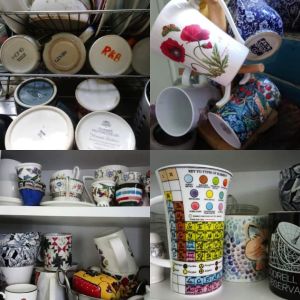
A memory of my cups and mugs a few years ago. Look at the bottom of them and you can often find out where they were manufactured. The image on the bottom is called the back stamp. There’s a lot of people in Stoke on Trent (also known as the Potteries), that check this out. They are called the turn over club? Sometimes you sneak a peak when your mug is full! A dangerous manoeuvre!
You might not live in the UK but anyway I thought I’d share this. You never know who’s reading this!
Roll up roll up! Would you like to send in a script? Three minute plays needed (2 sheets of A4) for up to four voices. In aid of the Penkhull Mystery Plays. We are holding the Harpers Titchy Theatre on 6th July 2024, at Penkhull Village Hall,Penkhull,Stoke-on-Trent. X
Thinking of potbanks and the Dorothy Clive garden.
There’s lots to visit like the local potteries, Gladstone in Longton, Middleport in Middleport, Emma Bridgewater pottery near Hanley, Stafford pottery in Burslem. Moreland pottery near Cobridge.
Then there are parks and gardens like Trentham Gardens and monkey park, Biddulph Grange, park hall nature reserve between Bentillee and Weston Coyney, and there is Westport lake.
Then railway days out at the Foxfeild light railway and the Churnet valley railway at Cheddleton. There is also a flint mill there which has a working water wheel and Etruria Industrial museum where they are having the canal festival on 1st and 2nd June. Oh and the potteries museum and art gallery. Spode visitors centre in Stoke. Lots more to see and do. Just investigate. Plus outside the city there are places like Rode Hall, Biddulph Grange, Little Moreton Hall, Mow Cop. Not forgetting Ford Green Hall at Sneyd Green I think…
Old window, light pouring through. Old packing room at Middleport pottery. It’s now the cafe. How different it must have been. I presume that plates and pots would have been packed in straw or hay so they didn’t move about too much. It would have then been put in packing cases so that the pottery could be transported on barges. The packs would have been lifted onto the boats using an old wooden crane which sits on the side of the canal. The crane was hand cranked and used a set of gears, a ratchet and a band brake to slow down the boxes of pottery as they were lowered down into the holds of the barges. I’m imagining the packing room bustling with people as the orders went out.
One advantage of the canals was that larger amounts of ceramics could be transported safely, with less breakages than would have happened on a rutted and uneven road in the back of an old horse drawn cart. It also helped speed up deliveries.
The smoke around the potteries must have caused a dark and gloomy atmosphere as the people worked there. The sunlight would not have shone into the window as it did today and the glass was probably filthy with soot and clay. The air was poor and people suffered from breathing difficulties and illnesses. The mortality rate was very bad. Life was difficult and short. I would like to suggest the book ‘When I was a child :Growing up in the potteries in the 1840’s’ by Charles Shaw, which gives an idea of the reality of the time.
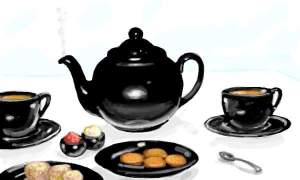
Another of my Sketchfu digital drawings. One of the things was a challenge to copy a photo just by drawing it. I think that’s what this one was. I wish I knew which pottery made the tea service. X
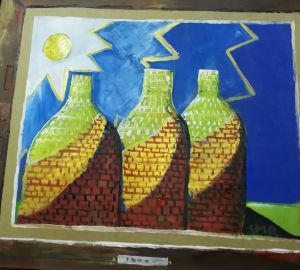
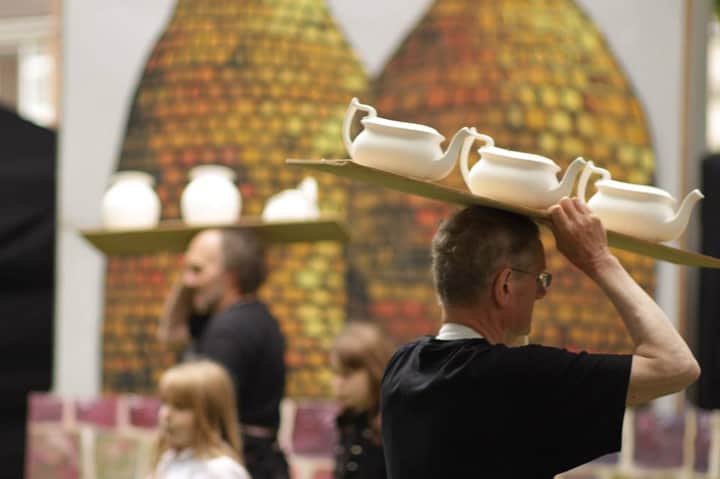
A banner for one of our Penkhull Mystery Plays. We hold them most summers and the one this was painted for was about the pottery industry and its history. This banner was based on the willow pattern famous in the potteries. Spode was one of the factories that made plates and pots with this design, but if you Google ‘willow pattern’ you can find lots of images from many manufacturers.
Blue acrylic paint on a canvas cloth. It took me a while to paint. I also painted the local church and methodist Hall as they would have appeared in the late 19th and early 20th century.
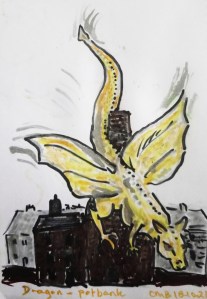
I’m getting obsessed with dragons, thus is a quick sketch of one slithering down a bottle oven at a pottery. I’m imagining it’s been attracted by the heat as the oven is heated up to fire the pottery. I probably should have a plume of smoke coming out of the top of the oven. My dragon is golden like the luster on victorian pottery. I think my dragon is a friendly one.
How many mugs and cups have you got? I seem to have enough for a small orchestra!
I think there are a few more around the house and in the garden. I am not going to search them out. They are from various manufacturers. The majority from this city, Stoke-on-Trent.
Different styles and sizes. Some that I decorated (you can book workshops to paint your own mugs, some places are more expensive than others). The small cups are for tea or expresso coffee. But I prefer a madium sized mug, pint sized ones are too much for me.
The creativity of this city shows through the designs and shapes of the mugs and cups.
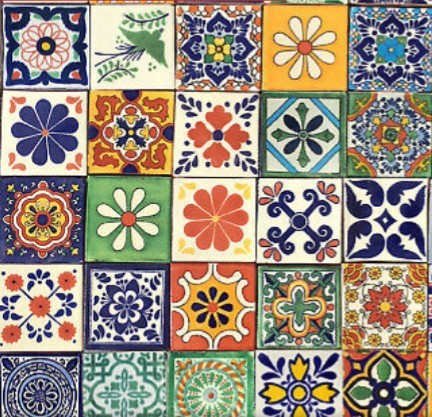
One thing about living in Stoke is that you get to see beautiful pottery. For instance these tiles may be simple for or wall decorations, but they signify the creativity of the City.
You visit the Potteries Museum and art gallery, in the city centre (Hanley), you will see amazing beauty and talent in the history of the city of Stoke-on-Trent.
A whole history and creativity that has gradually dwindled as austerity has crippled the country. Manufacturing has reduced, has been driven offshore by costs, and although some had started to return, the current situation has made things worse again. Life continues…..
The ‘Potteries’ is the name people call the city of Stoke-on-Trent in the North Midlands of England.
Built on the coalfields of the area, with an abundance of water and clay, it was an ideal place to start making pottery in factories during the industrial revolution. Bottle kilns, or ovens (so called because of their shape) were built across the six towns of Stoke-upon-Trent, Hanley, Burslem, Tunstall, Fenton and Longton. The six towns were bought together as a Federation in the early twentieth century and this created the city of Stoke-on-Trent.
The Potteries Museum and art gallery is crammed with beautiful ceramics and is situated in the Cultural Quarter of the city centre which is in Hanley. Also worth a visit are the Gladstone Pottery museum in Longton and Middleport pottery in Middleport (near Burslem). There are many places to visit here. Hopefully they will all be open again soon.






 Mallaband-Brown