Esther Chiltons weekly prompt “dark”

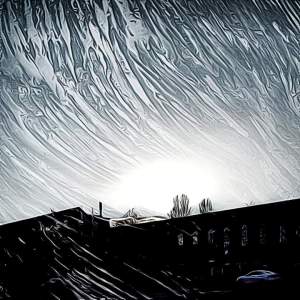
We live in a city, it’s impossible to see many stars. I just wrote this for Esthers challenge dark.

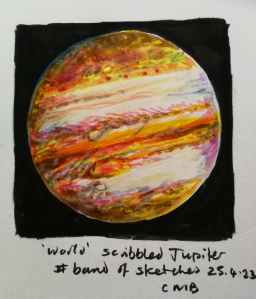
Darkness is needed for astronomy. We used to drive out at night to try and see meteor showers or comets, or stand in the garden under the shadow of the hedge and try and see Jupiter and it’s moons (we used a telescope) and even Saturn and it’s rings. We saw both planets. Once we drove under clouded skies to chase a massive meteor shower of up to 100 meteors an hour. But we never got out from under the layer of thin low cloud even though we drove at least 40 miles.

On another occasion we went out and drove into a wood so we could see a beautiful greenish comet. That was amazing.

Finally we recently saw the aurora borealis. An amazing thing to see in the UK.

Waves

I had these two paintings together and I realised they both represent waves. Water waves in my copy of Hokusai’s Great Wave of Kanagawa, and the waves in the atmosphere of Jupiter with it’s Great Red spot (and they are both ‘Great’ too). If I don’t sell them I am going to hang them together if I can find the space. The Hokusai on the left flowing into Jupiter on the right. X

Tried painting Jupiter’s pole.

I tried painting Jupiter’s pole in 2020 I think, from a photo taken by the Juno space probe. I was amazed at the colours that we saw. Not the oranges, whites and reds seen by the previous missions, but wonderful blue black and white swirls that are so difficult to capture. I saw this in my studio today and memories flooded back.

Do you love Jupiter?

Jupiter, biggest of the planets. If it had a bit more mass it might shine slightly as a brown dwarf star? In the story 2001 a Space oddessy it’s converted to a second star in the solar system. That would make the solar system a binary star system

How would it affect Earth? More light, more heat? It depends on its solar output. It might make plants grow more, but it might add to current global warming. Birds are being affected by the light pollution from streetlamps, imagine having the extra light of maybe a full moon when Jupiter was close to us in its orbit. Someone can probably work out the ramifications. I think in the original story in the book was set at Saturn and the aliens that turned it into a star wanted to heat the moon Europa as it was supposed to have organisms living in an ocean below it’s frozen crust.

Have a read of the books (it’s a series) or watch the film. I think Arthur C Clarke was a very interesting writer.

Jupiter tryptich

I just went to my studio to take a photo of this tryptic. I’m afraid the light was bad, so I don’t think I’ve captured the exact colours on the paintings, but to be honest I’m walking with a stick and everything feels a bit “off” so this was the best I could do. I’ve adjusted the colour balance, contrast and brightness.

Jupiter in a spin

I’m getting used to a new collage app. Learning all the new plot twists (I mean the tools in it). The main irritation are the in app ads. Get used to it, I won’t upgrade and I won’t buy anything. I am app resistant!

This was a photo of the South Pole of Jupiter that I painted and decided to turn into a symmetrical collage. Matching up the pattern was difficult because it wasn’t similar along the edges, but I did my best.

Jupiter’s pole

Probably my most abstract image, actually me trying to paint one of the poles of Jupiter taken by the Juno probe a few years ago. It just popped up in my Facebook memories. I find blending difficult for paintings like this. Acrylic dries to quickly to get a fluffy feel to the clouds. I might revisit this and add a bit more to it.