I had various things to do today. Part of arranging my late hubbys final passing. I find it hard to know what to say. My friend came with me to help and we went in the local pub to get a hot chocolate and try and take my mind off things.
Thinking about what hubby wanted I have chosen something very simple and have asked people to think about him on the date and time of the cremation as I am not having a service (we discussed things a while ago). I thought it better to explain so people know well on advance and don’t ask to attend a service.
I really want a celebration of his life, but it will be after Christmas because something so sad needs thought, and the festive season is looming,
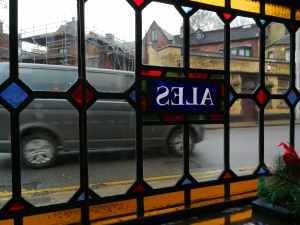
Looking out the window, the world was zooming past, unaware of how my day was going. I’m glad we had a break…..
I’m going to a spode Open day tomorrow, when I went to the studio I realised how much art I have. It’s a case of loving painting too much, but not being a salesperson! If you see anything you like let me know I guess? You could always visit me. I will be in Spode studio 21 if the wooden cat is outside my door!
My city stands on its own, not really part of a conurbation. It is between Birmingham and Manchester and there are small satellite towns dotted around it.
When I first came to live here, what always struck me, was how close the countryside is. South and East are Staffordshire farmland, West is Shropshires rolling hills and also Cheshire with it’s flat plain and salt mines, North East is Derbyshire with the pennines hilly beginnings and also the Staffordshire moorlands with old industrial buildings hidden in its valleys.
The area is crisscrossed by canals, rivers, train tracks and roads. Alton Towers is a few miles to the North east, further north is the old silk mill towns of Leek and closer to Manchester is Macclesfield.
The Trent and Mersey canal runs through the mile long Harecastle tunnel at Kidsgrove, where the water runs orange (from old iron mine workings?).
There are forests, fields, caves, lakes, walking and cycling routes. Bakewell is reasonably close, home of the Bakewell tart (pastry with raspberry jam and an almond paste topping?). Also famous for food is Market Drayton to our west. I think they make Gingerbread there.
There are National trust properties like Little Moreton Hall and Biddulph Grange. Big garden centres and antique centres. Not forgetting the gem that is the Dorothy Clive garden.
The city is not without its merits, Gladstone and Moorcroft, Middleport and Emma Bridgwater potteries and the potteries museum and art gallery all tell the history of the city.
But I like to get away from the hustle and bustle into quiet surroundings. Not forgetting the coast which is about 80 miles away in Wales.
Stoke on Trent is full of industrial heritage, a lot of it needs rescuing. But I love the place.
Another from my photos of the BCB, British ceramic biennial that was held in Stoke on Trent a few weeks ago.
Some pieces were more beautiful than others, some seemed to have more significance. Some like this seem playful. A piece that has been twiddled and twisted, creating a root like structure but with almost a trumpet bell on the end of it.
Simply placed on a surface in front if a window, the object casts interesting shadows.
I don’t know what I think of it, but it was worth documenting.
At Miso Japanese Restaurant in London Road, Stoke-on-Trent. Lovely food. I’m so happy that I was able to take my relative out there for a birthday supper.
Sushi and then Bento boxes with Plum wine to drink. It was an extravagant evening, but a real pleasure..
Miso is mentioned in Richard Osman’s book “The bullet that missed”, it’s a crime novel. Part of The Thursday Murder Club series. The owner of the restaurant didn’t know that Osman had written about it!
I took a lot of photos at the British Ceramic biennial, the ceramics were remarkable. This object is made up of several pieces. Coloured in what I would call ice cream colours, pastels that I would associate with the seaside. The rope makes me think of bouys or the floats on lobster pots. I didn’t get a catalogue so I’m afraid I don’t have the details of the artist involved.
Gorgeous window at All Saints church on Leek Road Stoke-on-Trent. The colours really are bright and spectacular. This is at the rear of the church (but on the left hand side looking from the road). It’s such a busy road, it’s surprising how clean it looks. Whether it was washed for the ceramics festival, I don’t know.
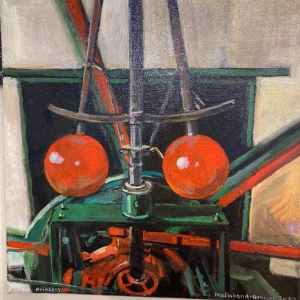
This weekend at Etruria Industrial museum, steaming the Princess engine. Pleased they’ve used my painting of it to publicise the event. (28 and 29 Oct 2023). I think the opening times are on their Facebook page.
The industrial museum includes Jessie Shirley’s bone and flint mill. The Princess engine is a beam engine that ran the belts to grind the flint in large floor pans in the adjoining building. It’s steam powered and runs by using a beam to rock up and down like a seesaw. This uses steam to push a valve down and then the vacuum created pulls it up again. I’m not an engineer, but you could come and see it running.
I was at the potbank cafe, which was part of the potbank hotel in the grounds of Spode factory site, part of the industrial heritage (and revolution) of Stoke on Trent.
The cafe was taken over by a cafe group called “the quarter”, but the hotel is still there and is based within the industrial architecture on the site.
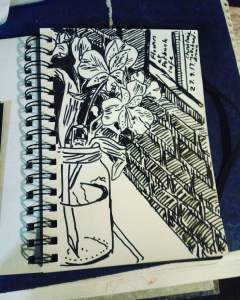
I think I drew the flower in a jam jar while waiting for a friend? I noticed the deration of the flower stem in the water, an example of how the density of matter changes the way light travels through it. When I was young I hated trying to calculate the angle of defraction. Perhaps I should have drawn it and measured my drawing?
What aspects of your cultural heritage are you most proud of or interested in?
I’ve said before I’m not religious, I don’t go to Church or Chapel anymore, but when I was younger I did. The methodist way of prayer and praise was simple. Not much adornments, no artistic decoration, just plain white walls and brown wooden pews and pulpit.
That heritage is in abundance where I live now. Just not of here is a village called Mow Cop where primitive Methodists used to preach outside to their flocks of parishoners. I believe that John Wesley preached there.
Bethesda Methodist Chapel, in Hanley, Stoke-on-Trent, is gradually being restored to it’s previous magnificent state, after being left to rack and ruin over several decades. I have had the pleasure of performing there with a choir on a couple of occasions and have seen the improvement over the years. It is rather large for a Methodist Chapel and could almost be classified as a cathedral.
Other cultural heritage I am aware of is the formation of the first co-operative movement in the world. It was started in Toad Lane in Rochdale, England. Wikipedia probably has information about that too.