Its Wednesday. ..

I think this is finished now, although I might change the blues…. added cat for scale 😀.

I’m go I to start doing some more paintings as I want some new work for an exhibition I’m in this weekend at Etruria Industrial museum.

My green man/woman pictures are built around the idea of tiles which were made in Stoke-on-Trent at factories like Mintons.

I also want to do some small paintings based on classic cars because the exhibition is at the same time as a classic car rally and a static steam engine event. That’s this weekend at Etruria, Stoke-on-Trent.

X

Photowalking


In 2015 I went on a photo walk organised by a friend round a local town called Burslem. The town is quite run down in places, but thats what made it interesting. Neglect sharpens architecture. Photos taken on an old vodaphone.

Green wood

Red sign,

Green door ,

Blue door,

Bricks by glass,

Breeze blocks behind window,

Rust and wood,

Blackberries colonise

With ease.

Document these,

Please.

Sky, trapped.

IMG_20180905_012625_148

Your sky is trapped up high,

Below the stars you spy

Cerulean blues,

Ultramarine hues.

Tiles and bricks embrace

a pale blue face,

Reflecting windows catch the rays

of sunlight dappling through leaves.

No clouds can dampen your topaz sight.

slow shading to darkest night.

Trapped blue, without rain,

tomorrow shine out again.

Surreal canal

IMG_20180905_013714_523

Using the Layout app from Instagram, I created this surreal image using a photo of a local canal with a strange thin building projecting upwards from what appears to be a circular or oval pool, the water was so still it had a lovely reflection on it, and this has added to the final picture.

The building is the edge of an old, derelict, warehouse that stands like a cliff face next to the canal, in the past ware from the pottery would have been transported from the pottery, south and east to the Midlands or north and west to the coast at Liverpool or up to Manchester and beyond. In fact Stoke-on-Trent lies at the heart of the canal system, and was built around the coal, clay and water of this area. Manufacturing of pottery, steel making and coal mining was on a massive scale here. Industrial archaeology will reveal the landscape as an amazing historical treasure trove of creativity. Some of the buildings were lost to demolition and decay, many bottle ovens have gone. The rest have protection orders on them, but are not necessarily being maintained. Warehouses and factories are crumbling. It is sad that history is being lost.


Started again

I’m just starting a painting about 2ft by 2ft 6 inches.

It’s a view of the Spode site looking from the building that houses Hulton Pottery which is a small studio pottery on the Spode site, looking down the run of buildings then on to the iconic Spode Chimney that stands high above the site.

Spode is changing, parts have been demolished, other parts will be gone soon. However new people at moving into the studio’s on the site. Together with the visitor centre and the hotel it is becoming more vibrant and interesting.

Hopefully the weather won’t get too cold this winter, that’s what really puts me off going. I have a studio but my mind isn’t on things really. I have found it really hard to get motivated but perhaps I have turned a corner…..

So I will leave you with the beginnings of a painting..with luck I can get it finished soon.

X

Weeping Window


We visited Middleport pottery in Middleport, Stoke-on-Trent today to see “weeping window” a memorial made of 11,000 ceramic poppies placed on a bottle oven in the pottery. The poppies are some of the ones that were on display previously at the Tower of London and have been travelling around the country for the last couple of years. You are supposed to book a visit but as the number of people going to see the display has reduced we were allowed in without booking. We had to park on a designated car park as the local streets have parking restrictions at the moment and you could get fined.

The poppies commemorate the worth anniversary of the 1st world war,”the war to end all wars” which sadly did not stop humans fighting over and over again as they have since our ancestors first fought many thousands of years ago. Many if the poppies were made in Stoke-on-Trent so its good to see them come home although there was a fight to get them.

The display of poppies cascade down the oven, spreading out on the ground, representing blood and the fallen soldiers that were killed in the war.

I drew the scene but had to slightly shorten the bottle kiln to fit it on the page. I also struggled to represent so many poppies. We then visited the rest of the pottery, including the steam engine although it was not working today. There was quite a crowd so I only sketched it briefly.

On our return to the car park there was a large poster with the poem by John McCrae written in 1915. I decided to draw my own version of a poppy to go along with it.

Middleport pottery is very interesting, there is a museum on site, plus artists and ceramicists with their own studios. The tea shop was very busy but we managed to get a table. There was also a display by students from clay college who are doing a two year full time course to learn the skills of pottery making before they are forgotten.

Although the weeping window display ends in mid September the pottery is well worth a visit. It’s surprising how much goes on round here!

Visiting the Moon

Today we visited the museum of the Moon, an art installation which is on till tomorrow. We got in free but there have been events there that you had to pay for.

The Moon is a huge inflated sphere, a balloon, hung from the ceiling of the Kings Hall in Stoke-upon-trent, part of Stoke’s town hall.

I’m afraid I didn’t get the details of the artist who made it, but it is very beautiful. The Moon is fully rendered with all its craters and mare (or seas). The seas are actually flattened areas where magma or lava has welled up from the interior and flowed out across the Moon’s surface. They are caused because of the speed of impact from asteroids and meteors hitting the Moon, the energy of momentum is converted into kinetic, heat, energy.

But thats the side we see, because the Moon is tidally locked with us, so the face we see is always pointed towards the Earth. If you observe the Moon over time it swings and sways so you can see slightly more than 50% of the Moon but we never see the back. The sides, top and bottom is squashed up so its not easy to distinguish what is visible.

So walking around the installation you can see things you might only have seen in blurry film from the Apollo missions almost 50 years ago. Huge craters where impacts must have shook the Moon to its core. You realise how much more scarred and cratered the dark side of the Moon is. Pitted and dented, the back of it has been impacted over millennia.

The Moon has also slowed the Earths spin which is why when humans are shut away in dark caves to experiment with our body clocks, we think a day ends after 23 hours or so. That is because as we evolved over millions of years the Moon was orbiting the Earth closer to us, and as it moved away gradually  (less than a centimetre a year?) it slowed the Earths’ spin to 24 hours a day.

At the moment the Sun can be eclipsed by the Moon. It just happens that the Moon is 400 times closer to us than the Sun and 400 times smaller. So the Moon appears to be exactly the right size to cover the Sun when there is an eclipse. As time goes by the Moon will move further out and “perfect” eclipses will end. Finally the Moon will break away from the Earth. When that happens the Earths rotation will become chaotic. It already spins on an axis that is tipped over at about 23°. If the Moon flys off into space its gravity will no longer help hold the Earth steady. Who knows we could end up tipped right over.

I’m not an expert so my figures might not be completely accurate. If you want more information please check out Astronomy websites.

The Museum of the Moon is an installation run be Appetite. They help produce various arts projects over the year. We also heard diary entries from the First world war, and a dance performance called “in Flanders feilds.”

I drew the Moon because my camera isn’t good in low light levels. The juxtaposition of the Moon installation and the old Kings Hall made for a marvellous and eerie afternoon out.

The murdered woman….

FB_IMG_1527629599785

In 2007 I did a series of murals in The Leopard Hotel, Burslem, Stoke-on-Trent.

One image was based on a story of a woman in the 18th or 19th century who had been murdered in the back rooms of the hotel. Stabbed to death, in one of the small “snug” rooms which the back room was divided into.

In the painting the woman is slumped in an old high backed arm chair, her glass of red wine lying on its side on the floor. At first she just looks like she is asleep, but the pool of wine is slowly mingling with another red liquid. The woman sits in front of a raging fire. But her skin is pale. Almost white. She wears a mob cap and a low cut blue dress. Is she a maid in the hotel, a pottery worker, or a lady of the night plying her trade?

No one I spoke to knew her name or why she had been murdered. It could have been a crime of passion or a theft of money. If anyone had heard anything surely the criminal would have been caught?

Does her ghost walk the back room of the hotel,  looking for her killer or his children down through time. Is it her footsteps that are heard when the room is quiet and empty?

I don’t even know if the story is true, but I made her a simple maid, cut down on a dark cold night, abandoned with no care about how it would affect her family, her parents, her siblings.

Murder looks so simple, a moment of rage, without thought to the victim or their family.

I hope it did not happen….that it is just a story and the chill that runs down my spine is just the central heating playing up.

Spode site progress?

Spode site in Stoke is continuing to change,  the area up by the new hotel and visitor centre remain the same and work is almost completed on the hotel itself which is housed in one of the old Spode buildings.

Half of the site has been sold to a developer, this is the side closest to the A500 road. You can see the civic centre in Stoke across the cleared land.

The other half which is nearest stoke town centre will soon have more (larger) units for artists and creative’s to rent from Acava and the City council. The China halls that have been used for putting on the British Ceramic Biennial and also performances of plays, is still there but some of the more modern ancillary buildings have been demolished. As a studio holder its a strange experience walking through the site. It’s a bit of an excuse not to go in. But I must!

The visitor centre and the hotel both have cafes you can visit, and the visitor centre has recently been refurbished with a new exhibition space called centre space . I need to get organised and try and get an exhibition there.

I think the changes to the Spode site will be documented. It is go I to see it is not just being left to become derelict.

Rudyard lake railway.

IMG_20180816_095858_654

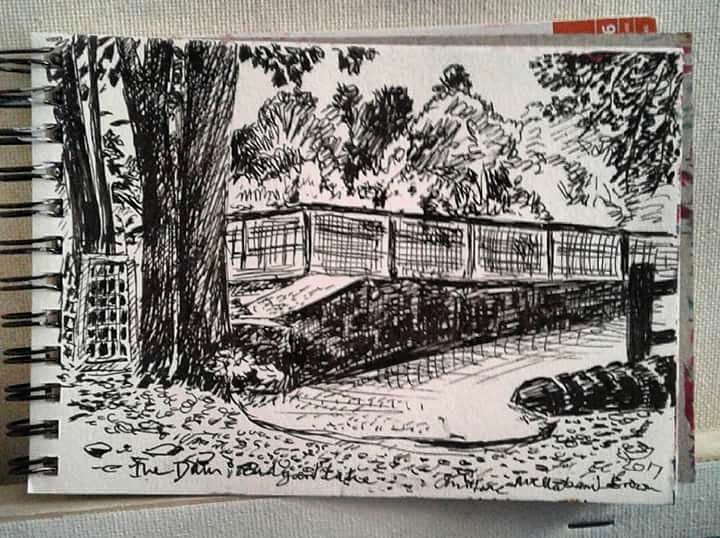
This is a drawing I did last year of the dam, a little station on the Rudyard Lake railway, a miniature railway which runs over a railway bridge above the road going out of Rudyard village towards Macclesfield.

The station for the railway is situated just beyond the bridge on the land alongside it, you can drive up a slope to get into the car park. The miniature railway consists of small steam engines  (I’m not sure of the scale,  maybe a 5th or a 6th of the size of a fully grown one). There are small passenger carriages some with windows and some without that are towed behind the engine.

The line is open at weekends in the summer months to take you along the wooded valley that leads up to the lake.  (Not sure how much it costs sorry). The first stop is at the Dam  (pictured) which is where the lake has been dammed to collect water. That is because Rudyard Lake is a reservoir for the local canal system. The train journey then continues down the length if the lake to the far end of it.

The journey is very scenic, with views over the lake with boats sailing on it and the wooded hills beyond. Sometimes we get out of the train at the dam station so I can do a drawing or painting.

The railway was built by a school several years ago. It’s on the track bed of the Great Central railway which went from Manchester to Birmingham and then London. The track was taken up in the 1950’s  we think. It went through Rushton Spencer and on to Macclesfield then Manchester apparently.

Anyway, I think the lake was named after Rudyard Kipling? But it might be the other way round. His parents used to visit the area, but I don’t know the story about that I’m afraid.

The miniature railway has a snack bar with teas and coffees. Rudyard Lake has a tea room and other facilities. Parking can be difficult by the lake but you can also park at the railway and walk along the track bed which is also a footpath up to the dam where you can walk across to the little area with the tea room. This is where the boat club is based together with a little visitor centre. The footpath continues along the track bed up to the head of the lake and there are also little paths that you can follow to get closer to the lake.

Other access to the lake is along a narrow road which takes you into the Rudyard lake hotel carpark. I’m not sure about the parking there. I don’t remember having to pay but it can get crowded.

Rudyard lake is a couple of miles away from the main road between  Stoke-on-Trent and Leek. You can also get to it from the road between Leek and Macclesfield.

I’m not a travel writer so this may not be totally accurate.

X