Oatcakes are comfort food for me. Warm and sustaining. My hubby went out to the oatcake shop and got us some cheese and bacon oatcakes for breakfast because I’m not feeling well (I’ve done a lateral flow test today and it’s negative so I think I’ve got a cold, sore throat, sniffles and aches). I added the dots of brown sauce to make a smiley face. A Stoke on Trent /Staffordshire delicacy, oatcakes are our pancake / tortilla /crepes. You can eat them savory or with things like jam and butter. Our oatcakes are big and floppy, not like Scottish oatcakes which are far smaller and drier.
I was struggling to sleep again last night so I got up at 5am to have a warm drink. Sometimes I can sleep in the armchair.
I decided to turn the radio on for something to sooth my nerves. There was a programme called Test Match Special on. It was a cricket match between England and Australia. Australia were ahead three games in a five game series. This was the fourth test match.
The match was likely to go Australia’s way because they were well ahead on runs (in cricket you run between two sets of wickets with bales on top called stumps) . The bowler throws a ball at the stumps and tries to knock the bales off. The batsman has to defend the stumps. They try and hit the ball with a cricket bat. If they hit it they try and get runs. There are two batsmen (or women) at a time. They run between the stumps. You get four runs if you get the ball to run over the boundary line and six if you hit it over the boundary in the air.
Anyway, Australia was well in the lead. England had lost six men out of eleven and were batting. The commentators said that the last four of England’s batsmen had either suffered injuries or not done well in previous test matches. It looked very bleak!
I listened and was enthralled. There were missed catches and the Australians were trying hard, bouncing the ball high and hurting the batsmen (cricket balls are very hard). Lots of calls for leg before wicket (the batsman has his leg in the way and stops the bales being knocked off). Slowly the score crept up, three batsmen were caught or given LBW. (leg before wicket). I couldn’t sleep, this was too exciting! There were two batsmen left. Each round of bowling is called an over (where six balls are bowled) the last two overs came up. The first batsman tried to hit some runs so he could get to the other end and take the strike for the last over, if he did the last batsman would not have to play. But the Australians managed to stop him and the final over started with England’s last batsman waiting to be bowled at or bowled out! They couldn’t win but if he didn’t get knocked out they would have a draw.
Six balls. One after the other. It was radio so I couldn’t see what was going on, I could only listen to the commentary. Five balls to go, the daylight was going, the floodlights were on. Four balls, my heart was thumping. The batsman (Anderson) calmly prodded the ball away. Three balls. If the batsman tried to hit the ball the fielders (the rest of the Australian team) might catch the ball and get England out. Two more chances, the batsmen again stopped the ball. This was the last ball coming up. Australia had to dismiss the batsman to win. The bowler ran up, pitched the ball at the batsman and…. The batsman carefully pushed the ball away (I didn’t actually listen to what he did, I was too busy jumping up and down!) He ended the match safely not out. England drew the fourth test! Not a win, but a hell of a lot better than the previous three tests. The next text match is starting in Hobart, Australia on Friday. I’m expecting at least another sleepless night.
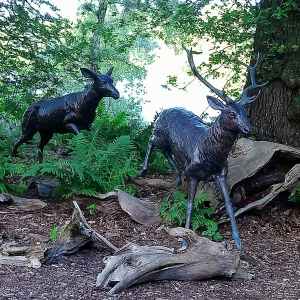
Stag and hind sculpture at Trentham Gardens today. I walked about four miles, not a great distance but it was warm and humid. I think they are casr bronze, they are hollow. There is a small herd of deer at the Gardens, or there were a few years ago. They are up higher on the hill, or they were. There is a path round the lake and a longer one, so I wonder if they are up there. We will explore further.
I wish that I was driving on this road, following it round the bends, storing by a stile at the side of the road and climbing over it, walking up the hill, maybe past a few grazing sheep, till at the top I would see mountains in the distance in one direction, and tree covered hills in another. If I looked in one direction hard enough I think I would see a distant view of the sea.
Where am I? I could be in Scotland, or some parts of England, but this winding road is in Wales 🏴 land of ancient people’s and dragons. Wales is in a lockdown for just over two weeks at the moment. I hope the people will all be safe. In the meantime I’m expecting where I am now to have another lockdown soon…. When will this end….
Text taken from Wikipedia. I only heard about the Chained Oak today and I don’t live too far away from it!
Apologies to Wikipedia :
an autumn night, the Earl of Shrewsbury was returning to his home at Alton Towers when an old woman suddenly appeared in the road ahead of his horse and coach. The coach stopped to find why she was there at which point the old woman begged for a coin. The Earl cruelly dismissed her, so the old woman stated that she would place a curse on him. The old woman told the Earl that for every branch on the Old Oak Tree that fell, a member of the Earl’s family would die. The Earl dismissed this and carried on his way.
That same night, a violent storm caused a single branch from the old oak tree to break and fall. Later that evening, a member of the Earl’s family suddenly and mysteriously died.
Now firmly believing the power of the curse, the Earl is said to have ordered his servants to chain every branch together to prevent other branches from falling. To this day, the Oak tree remains chained up.
Note, the Oak is near Alton Towers which is now a massive theme park in the county of Staffordshire, England.
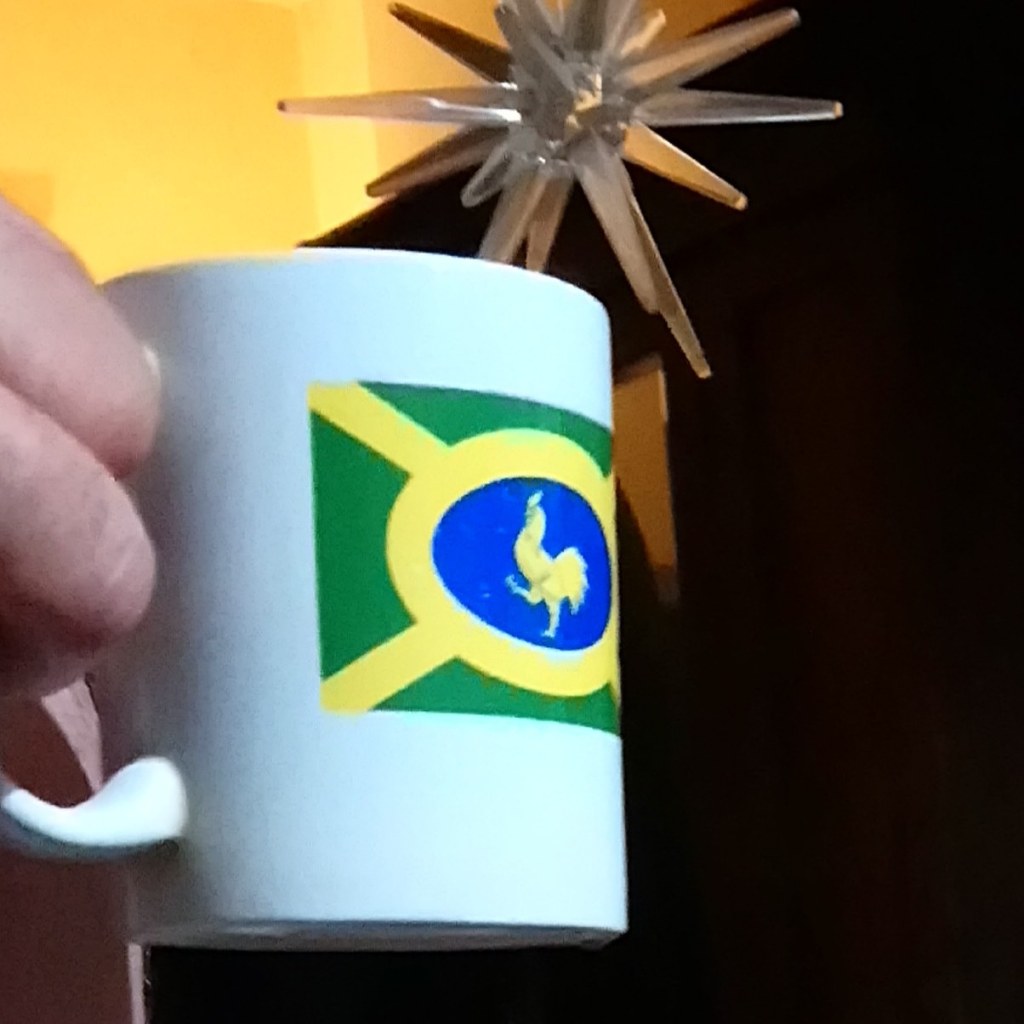
I live in Stoke-on-Trent and the village at the top of our hill is called Penkhull. It was mentioned in the Domesday book and was a Royal Manor from 1086 to the time of Edward the Second. It is a village in a city and people like it so much that they had a competition to design a flag.
The flag has a golden Cockerel symbolising the weather vane on top of the church steeple. It stands on a blue ground which is for the blue of Spode, the old pottery firm in nearby Stoke-upon-Trent that manufactured ceramic products including the willow pattern pots that became synonymous with the factory.
The yellow oval and lines radiating out are for the road around the village green and the four roads each leading downhill from the village.
The green is to show that is a green place in the middle of a city. The whole design was approved by vexillologists (no I didn’t know that word before the competition) from a charity called the flag institute.
So why am I up? Penkhull is taking part in a competition being run by @theflaginstitute on Twitter. It is in the #WorldSeriesOfFlags and is up against the golden rays of barley from #tiree in Scotland. This is the final. I have not been able to sleep since I saw that Tiree had got ahead of us in the final they are on about 51.8% and we are on 48.2%? Something like that. Its very even between the two places.
Don’t know if I can get back to sleep…. The vote on Twitter ends at 11am. I think I’m in for a long night.
This was a sign in a local museum that someone shared on Facebook.
It was strange coming to live here. In my home town people would say hello chick, or love. But Stoke people say ‘duck’. I had no idea of the origins, and the first few times I heard it I literally did duck! I thought someone was warning me! Eventually, though, I got used to the greeting. Together with the phrase ‘cost kick a bow agin a woe an it it wi yer hed til ya bost it?’ I may have misspelt this but it means ‘Can you kick a ball against a wall and hit it with your head until you burst it?’
As you can see, the old dialect and pronunciation is interesting. But as someone with a west Midlands accent. Oim not reealy botheered abowt iyt.
The Anderton Boat lift is somewhere I would like to visit. Its near the village of Anderton, in Cheshire, England. It is fifty foot high and joins the Trent and Mersey canal to the river Weaver. Boats go from the canal or river into a lift filled with water and the boat and water is either lowered or raised to the other one. It’s called a two caisson lift lock, although I’m not sure why it’s called that.
The lift is a scheduled monument, and was built in 1875. It was closed in 1983 because of corrosion, but luckily it was restored in 2001and reopened in 2002. We intend to visit later in the year, there is a visitor centre run by the Canal and River Trust. I’ve checked and it is open at the weekend.
We’ve found a place to stop for lunch when we are driving home through the hills of North Wales. Its about halfway or a little less. Before you come back down the hill into Wrexham and cross the border into England. On a sunny day its good to stop for a refreshing cup of tea and maybe a scone or a salad.
With all the rain we have just had I wish we were back up in the hills. Bathed in sunshine, watching fish in the pools.
It’s a pleasant daydream instead of watching water run down the glass of the living room window. Hearing it patter onto the window ledge from the guttering, spattering the plants. Letting moss grow on next doors roof…..
Painted several years ago, my painting of Maiden Castle Hill Fort imagined a woman dancing in the landscape, and also her bones as if they were found in the land.
The idea was inspired by visiting Maiden Castle in the 1990s,thinking about it being a hill Fort and part of the Celtic world.
It is located in Dorset near Dorchester. If I remember correctly it is reached by a small road, then you walk up through the ditches and mounds that lead up to the top of the hill Fort.
I think I got the idea from watching archaeology programmes on TV. I imagined the woman being aware of the changing seasons and how time passes. The little skull below her is a rabbit skull we found on a walk.
It’s a bit weird, but I wanted to include a figure in the dramatic landscape.






 The Anderton Boat lift is somewhere I would like to visit. Its near the village of Anderton, in Cheshire, England. It is fifty foot high and joins the Trent and Mersey canal to the river Weaver. Boats go from the canal or river into a lift filled with water and the boat and water is either lowered or raised to the other one. It’s called a two caisson lift lock, although I’m not sure why it’s called that.

 Mallaband-Brown