Clematis and Canal roses

Clematis and canal roses with bottle oven

Every so often I paint one of the iconic bottle ovens from Stoke-on-Trent. These were where pottery was originally fired with coal fires. The city would be covered by a pall of thick smoke, morning noon and night.

They sometimes had metal bands wrapped round them to strengthen them, and the old bricks can shine like gold when there is a lovely sunrise or set. Arthur Berry, famous artist of Stoke-on-Trent used to speak about the beauty of the potteries towns. He painted and drew abstracted views of the six towns. He’s known as the potteries Lowry.

This painting is of a derelict oven, I’ve painted clematis growing up it, rewinding the ancient landscape. The blue area represents the local canals, it’s shape mirrors the bottle oven. The flowers in it represent the abstract canal roses that are found adorning canal barges throughout Britain.

Bottle oven day

Happy bottle oven day! 29.8.23. It’s celebrated every year. I think there are only 47 bottle ovens left from the thousands that used to be in Stoke on Trent. A  lot of them are deteriorating but hopefully the heritage of them will be preserved.  The potteries, with their bottle ovens were the creative heart of the city.

Cat mug

Cat in a hat mug. My design that I draw to make children laugh if they are grumpy. I’ve been drawing it for years and so I decided to paint it onto a mug a few years ago when we went to a pottery to do some decorating. I don’t even remember where I did it, but the mug says 20, so it must have been three years ago. I have black and white cats but I always imagine this as a ginger tabby cat. X

The Art and Craft

What do you love about where you live?

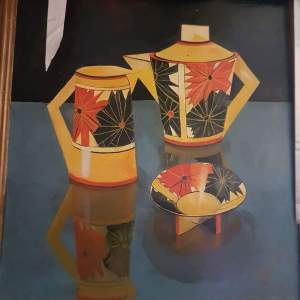
My mural based on a ceramic design called Umbrella by Clarice Cliffe.

Stoke-on-Trent is a city built on Art and crafts. From Wedgwood and Brindley and the industrial revolution.

Ceramics were the main manufactured goods in the city. So much so that it became known as ‘the Potteries’. Different pottery owners experimenting with different materials, trying to make pots that could stand up to the quality of Chinese wares.

Manufacturers had water, clay and coal from the local area. Pots were transported out of the city on the newly built canals that linked it to the rest of England and then on to the world.

Designs were transfer printed onto plates and cups, opening up cheaper wares to the general public. But other work was hand painted and lined with gold and other precious metals.

What was needed to make all the pottery? Workers, making, turning, transfer printing, painting. Numerous jobs including the famous Saggar Makers bottom knocker. (You can Google this). The work couldn’t be completed without skilled labour that could translate designs into reality. Some female paintresses were allowed to sign their names to their work. Like Susie Cooper and Clarice Cliffe.

So much skill in one city. Burslem school of art taught many of the artists that were to work in the ceramic trades. One famous artist, Arthur Berry, became a fine artist and writer and play writer. He was one of my tutors at college. That’s why I love this place.

Jug time

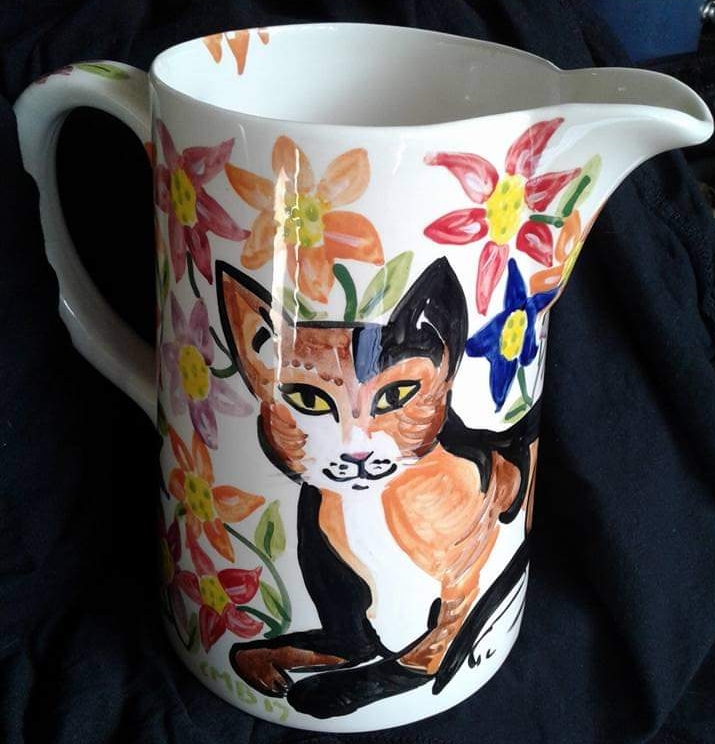
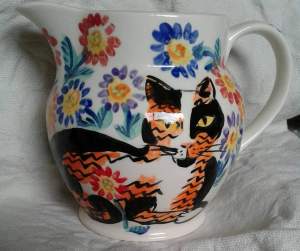
After posting the picture of a jug I decorated at the Emma Bridgwater pottery in Stoke on Trent, I just had this picture pop up on my Facebook memories.

This one was double the size, decorated a few weeks later at the Stafford Pottery in Burslem. I noted this was a third of the cost?

They were given as Christmas presents, I enjoyed the creative process and it was good to give something like this to family. I wish I had more time to decorate pottery, but at the moment everything is difficult.

Canal boat

Photo taken outside Etruria Industrial museum. This is not a colourful tourist boat. Painted with castles and roses. But careful lines have been painted on it to delineate it’s shape. I think its part of the industrial museum exhibit? Perhaps it was used in the past to transport the flint and bone that had been ground into fine powder at the Jessie Shirley flint mill. This is the main part of the industrial museum. A stationery steam engine called Princess was used to provide power to do the grinding. The boat or barge might have transported the powder to the local potteries to add to clay and produce fine bone China pottery. So much history in this city of ours.

Flower head

Pottery head I made over twenty years ago. It’s planted up with straggly snapdragons this year but this photo from two years ago looks better. I really need to get out in the garden but I don’t seem to have the strength to sort things out at the moment. I’m fed up and I know gardening would help but the heat over the lost few days has made me really weary. It’s been close to 30°C. At least my hubby has been watering plants. Today? We are expecting heavy rain showers, so the plants will get a little water.

Window

Old window, light pouring through. Old packing room at Middleport pottery. It’s now the cafe. How different it must have been. I presume that plates and pots would have been packed in straw or hay so they didn’t move about too much. It would have then been put in packing cases so that the pottery could be transported on barges. The packs would have been lifted onto the boats using an old wooden crane which sits on the side of the canal. The crane was hand cranked and used a set of gears, a ratchet and a band brake to slow down the boxes of pottery as they were lowered down into the holds of the barges. I’m imagining the packing room bustling with people as the orders went out.

One advantage of the canals was that larger amounts of ceramics could be transported safely, with less breakages than would have happened on a rutted and uneven road in the back of an old horse drawn cart. It also helped speed up deliveries.

The smoke around the potteries must have caused a dark and gloomy atmosphere as the people worked there. The sunlight would not have shone into the window as it did today and the glass was probably filthy with soot and clay. The air was poor and people suffered from breathing difficulties and illnesses. The mortality rate was very bad. Life was difficult and short. I would like to suggest the book ‘When I was a child :Growing up in the potteries in the 1840’s’ by Charles Shaw, which gives an idea of the reality of the time.

People sketching

When I was out sketching a few weeks ago there were lots of other people drawing. After I finished I took this photo of my friend drawing the same view I’d done. He was working in charcoal and pencil I remember. The day was overcast with patches of blue sky. The ground is covered in concrete, but the way it is breaking up I think there are probably cobblestones underneath. There is a large area of cobbles around the corner where you enter the Middleport pottery complex. In the backdround you can see a small wooden crane which was used to load and unload barges. Forty years ago my hubby worked at another pottery, he actually used one of these to lift packed pottery ware to load onto a lorry. He said you could lift a big weight easily because of the gearing on it. The one he used was cast iron. It had a band brake and a pawl and ratchet to hold the load in place as it was swung over the lorry.

We are not that far away from the past, history is not that long ago. A lot of the old industry in the area was using old machines and equipment, because they had always done things that way and it probably saved a lot in investment. Even now there are lots of pottery molds to be found in the area. Sadly a lot of them get smashed. Losing our heritage. Do we really want to wipe our history out completely?