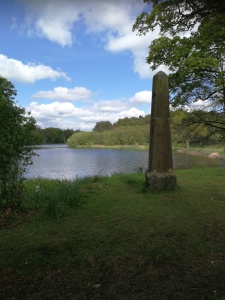
By a lake, an old obelisk. No inscription except carved trysts, g+j, p+b? How old are they? The letters are neatly carved, so I would guess early twentieth century, when people were taught to be neat (even when defacing this!). I guess they will be related to the owners of the hall? I would have taken a close up but other people wanted to take photos. Perhaps we will go back and investigate more. There may be details on the websites. Whatever it signifies or memorialises, it is a strong statement on the hill above the lake….
List the people you admire and look to for advice…
Issac Asimov, three laws of robotics
Carl Sagan, pale blue dot, astronomer and scientist
Noel Fitzpatrick, exceptional veterinary surgeon
Marie Curie, discovered Polonium and Radium
Sir Patrick Moore, famous amateur astronomer,
Sir Oliver Lodge, invented the spark plug
Dr Jane Goodall, primatologist
Rosamund Franklin, jointly discovered DNA, British Chemist
David Attenborough, naturalist, broadcaster and environmentalist
Chris Packham, Environmentalist and broadcaster
Professor Dame Jocelyn Bell-Burnell, discovered Pulsars
Mary Anning, discovered fossils.
Albert Einstein, General and Special theories of relativity.
Richard Feynman, American physicist. Wrote ‘Surely you’re joking Mr Feynman’ and other books.
Is that a long enough list? I like to try and understand basic science, I don’t know enough, but I try and get some understanding. I think Asimov got me thinking about science at an early age. He not only wrote science fiction, but books about chemistry and other sciences. So I found out about the early chemist’s, physicists and astronomers. By reading his books they introduced me to Carl Sagan, who wrote books such as Cosmos.
At the same time I used to (and still do) watch ‘The sky at night’ on TV. So I learnt a bit about astronomy, but also about people like Jocelyn Bell-Burnell who discovered pulsars, and other scientists including Issac Newton.
David Attenborough introduced me to gorilla’s, in his TV programme ‘life on earth’ and so I heard about Jane Goodall and her work with primates.
Finally in the 1970’s there was a TV series that dramatised the lives of Marie and Pierre Curie. Having read about her in Asimov books it was fascinating to see what she had been doing in the early twentieth century.
It’s a random list, but it helps me explain my interests…
I don’t have any pictures of the Coronation of King Charles III today as they will all be copyrighted.
I didn’t watch it except for the royal carriage taking King Charles and Queen Camilla back to the palace after the service in Westminster Abbey. The British do create a marvellous spectacle, ceremony or pageant. Not everyone is a royalist in the UK. But we still call ourselves the United Kingdom.
I was amazed at how many people slept out in chairs just to have a place there. And the weather was typically British for the occasion (raining).
How do you sum up something that happens so irregularly. The Queens Coronation was 70 years ago and who knows when Prince William will be king? but he is next in line in the succession to the throne. This is despite King Charles having a sister and brothers. The rules of who gets the crown are laid down in history.
Old window, light pouring through. Old packing room at Middleport pottery. It’s now the cafe. How different it must have been. I presume that plates and pots would have been packed in straw or hay so they didn’t move about too much. It would have then been put in packing cases so that the pottery could be transported on barges. The packs would have been lifted onto the boats using an old wooden crane which sits on the side of the canal. The crane was hand cranked and used a set of gears, a ratchet and a band brake to slow down the boxes of pottery as they were lowered down into the holds of the barges. I’m imagining the packing room bustling with people as the orders went out.
One advantage of the canals was that larger amounts of ceramics could be transported safely, with less breakages than would have happened on a rutted and uneven road in the back of an old horse drawn cart. It also helped speed up deliveries.
The smoke around the potteries must have caused a dark and gloomy atmosphere as the people worked there. The sunlight would not have shone into the window as it did today and the glass was probably filthy with soot and clay. The air was poor and people suffered from breathing difficulties and illnesses. The mortality rate was very bad. Life was difficult and short. I would like to suggest the book ‘When I was a child :Growing up in the potteries in the 1840’s’ by Charles Shaw, which gives an idea of the reality of the time.
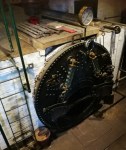
What a job, to stoke a boiler like this. (Shovelling in coal). I asked my hubby to explain how it works and he tried, but all I got was ‘fire’, ‘water’ and ‘hot air’. I think a boiler full of water lies above the fire and a large tube of hot air sits in the water, somehow the hot air also circulates along the sides of the boiler and smoke goes up the chimney. The fire and hot air heat the water into steam, which then powers a piston, which has hot steam expanding, is pushed down, and is then cooled by water so the pressure releases. And that turns the wheel that turns the gears and belts….. This is a Cornish boiler that is old so it only runs at about 15 pounds per square inch…
So, I hope I got that right and I haven’t made any horrendous mistakes. But having a vague idea of how things work is important I think? Bored yet?
Glung! The springs in my bed make that noise. Shhhhh the wind in the trees.
It’s the word that is written that sounds like the sound that is being made. Cats Miaow (or miroaw), sheep go Bahh. So lambs are called Baa Lambs. There is a Baa lamb hill near here.
Just thinking, maybe that’s how language started? Imitating sounds, and then other describing words. How can we know.
Translation of language was helped by the Rosetta stone which had three languages carved into it. Because each was a translation of the previous one it took linguists back in time to understand ancient voices.
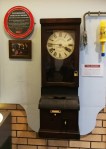
Have you ever clocked on? I did for a few weeks one summer when I got a holiday job. The clock machine we had to use was a big grey box with cards in slots next to it.
I also clocked on for an art project. Each time I went into my studio I clocked on, and off. The cards were collected and turned into an artwork later on.
So seeing this at the museum rang a bell… Some forty year old thought woke up and reminded me of a dirty grey factory floor, oil splashed on the machines, knurling air filters for cars (joining the concertinerd paper together) with two clogged wheels that pressed the ends together to hold them in place before they had cages and the rubberised circles fixed to the top and bottoms, then clock off and go home at the end of a long, boring day. So clocking on? I’ve done that.
Describe a decision you made in the past that helped you learn or grow.
Things happen and suddenly you have to decide what to do. Your life can carry on the same old way or you can adjust it. Mostly though that happens when you get a little older. That’s what happened to me.
I knew I would be OK as I was taking a calculated step, but what I didn’t bank on was Brexit (why?), then the pandemic and now the cost of living crisis, and health issues.
So would I do it again? Yes of course. I know I’m not probably as well off and secure as I would have been, but I know I’m happier. I won’t describe why I left, but I wasn’t happy. Things changed and I could explain, but it’s in the past now. All I know is that I feel more confident, it has definitely helped me grow as a person.
What’s next? I’ll keep trying to make things work. I have to. I wish anyone else who has made a similar decision all the best and good luck.
Describe a positive thing a family member has done for you.
I will always be grateful for my mother’s encouragement for me to go to art college. She had to work to support us all and when I finished school she might have insisted that I work full time.
Instead she let me go to college (though I had a couple of part time jobs). I initially went on a preparatory course, then left home to do my degree.
I was aware that my cousin who was also artistic had to go to work in a factory and forget her dreams. I don’t know what happened to her after I moved away. But in my case I was always welcomed home in the holidays.
I’m glad my mom gave me the freedom to do art. Learning has always been something that I enjoyed, and to do a subject that I love? I will always be eternally grateful to her.
Going home over the years I realised how proud she was of me. She was always encouraging us all to do the best we could.