Justification

I’ve got into a bit of a debate on Facebook about whether the exhaust from airplanes is from water vapour (yes) or chemicals (no). I’ve got especially annoyed since they have said they will be getting rid of fact checkers. I think if you see something on line that does not make sense you should not ignore it but at least put in an alternative realistic point of view. I finished one comment with the words Occams Razor.

Following a series of comments when I rebutted each strange argument with an alternative reasonable comment, someone asked where was I getting my information from? I could of course just said Google. But I don’t. I have had a long life and I like learning information. My memory is very retentive. I can remember telephone numbers from more than 40 years ago (0992 37963) my old home number. I learnt the Greek Alphabet for fun… Alpha, beta, Gamma, delta, epsilon, zeta, eta, theta….. Etc…

So I answered the question, how do I know things by stating :

Mainly science programmes on radio and TV. Reading the new scientist magazine, I’m also interested in the environment and am a member of various nature groups. I’m interested in astronomy. I took science classes at school (biology and chemistry) and had to take physics in one of my diploma courses. I’ve always been interested in science and try and keep abrest of up to date information. My favourite authors when I was growing up were Arthur C Clarke, Issac Asimov, Carl Sagan and Richard Feynman. I enjoy reading biographies of scientists such as Mme Marie Curie and about the Leakies who discovered  the Australopithicine Ape Lucy. I am interested in what’s going on in the world. Does this answer your question? I just enloy thinking things through and trying to understand. If that is wrong I will stop commenting.

I try and be polite and as accurate as I can be.

Science

What’s something most people don’t understand?

Science is hard, it is very difficult to understand or often to explain. I think the world is split into people who get science and those that do not.

I don’t know if you have to have a particular brain? I found science hard, and being a girl didn’t push myself forward in classes. The boys always had their hands up shouting me sir, me! Answering the teachers questions.

And yet I eventually found I loved science. I used to watch a BBC programme called Horizon which had a great many subjects from Chemistry to Astrobiology, to the Big Bang as subjects of hourly  shows. Suddenly my interest was piqued. I started to understand things and got more aware of science and it’s ramifications.

I also loved the Sky at Night, a monthly astronomy programme, it’s only short, 20 minutes, but really interesting. And then children’s programmes used to be informative, including the Royal Institution Christmas Lectures. I remember seeing one about magnetic levitation of trains, it was a lecture by Professor Eric Laithwaite. Wonderful.

So my take from this is that you might not like science, but give it a chance, it helps you understand the world..

Successful?

When you think of the word “successful,” who’s the first person that comes to mind and why?

It’s taken me ages to decide on a person or group of people to represent this.

I could have chosen a single person, a musician, an actor, sportsperson, vet, doctor, or a news caster, and of course the richest people in the world.

But no, I’ve decided scientists would be the best choice. There success has bought us so many inventions and knowledge. Yes there have been bad inventions too, but these are because of political influence to some extent? Yes, there are bad scientists that either create bad things, or alter the results of research to allow bad things to happen. For example Thalidomide was originally being used for elderly arthritic patients, but to sell more of the drug it was sold to pregnant women as a tablet that would stop morning sickness, with the resultant tetaragenic damage to babies (see the Sunday? Times report into it’s effects).

But then these are weighed against chemistry’s inventions such as the creation of analine dye that led to the discovery of quinine? The invention of batteries, using chemistry and physics. The use of x rays following discoveries by Marie Curie. And biological knowledge including genetic treatments, monoclonal antibodies, knowledge of how our behaviour is damaging the environment.

As with all successes they are balanced with failures. Each person will have their own opinions on this.

Knowledge?

What do you think gets better with age?

Thinking about this question is a challenge. As I age I know I’m not getting physically better, but I hope and believe that I have better knowledge now than I did in the past. I try and keep up to speed with many things. I would say I’m a generalist, not an expert. My brain cannot take all of that information in, but I can try.

I think you always need to be willing to learn. Why not? Why be afraid of finding things out? It makes life more interesting.

For instance, the images that The James Webb telescope is taking of the universe really interest me. Our eye on the universe has got so much better in recent years. Then knowledge about chemistry might help us reduce or stop some of the carbon dioxide emissions that are causing global warming? Changes in computing and AI might help with human health?

And knowledge should be something we all seek. Having knowledge can give us a personal key to what is going on in the world. Avoiding fake news and fake facts. Being wary of things that are too good to be true (They probably are). There is a lot to sift through. But I think its worth seeking out true knowledge.

Mostly scientists

List the people you admire and look to for advice…

Issac Asimov, three laws of robotics

Carl Sagan, pale blue dot, astronomer and scientist

Noel Fitzpatrick, exceptional veterinary surgeon

Marie Curie, discovered Polonium and Radium

Sir Patrick Moore, famous amateur astronomer,

Sir Oliver Lodge, invented the spark plug

Dr Jane Goodall, primatologist

Rosamund Franklin, jointly discovered DNA, British Chemist

David Attenborough, naturalist, broadcaster and environmentalist

Chris Packham, Environmentalist and broadcaster

Professor Dame Jocelyn Bell-Burnell, discovered Pulsars

Mary Anning, discovered fossils.

Albert Einstein, General and Special theories of relativity.

Richard Feynman, American physicist. Wrote ‘Surely you’re joking Mr Feynman’ and other books.

Is that a long enough list? I like to try and understand basic science, I don’t know enough, but I try and get some understanding. I think Asimov got me thinking about science at an early age. He not only wrote science fiction, but books about chemistry and other sciences. So I found out about the early chemist’s, physicists and astronomers. By reading his books they introduced me to Carl Sagan, who wrote books such as Cosmos.

At the same time I used to (and still do) watch ‘The sky at night’ on TV. So I learnt a bit about astronomy, but also about people like Jocelyn Bell-Burnell who discovered pulsars, and other scientists including Issac Newton.

David Attenborough introduced me to gorilla’s, in his TV programme ‘life on earth’ and so I heard about Jane Goodall and her work with primates.

Finally in the 1970’s there was a TV series that dramatised the lives of Marie and Pierre Curie. Having read about her in Asimov books it was fascinating to see what she had been doing in the early twentieth century.

It’s a random list, but it helps me explain my interests…

Another prompt

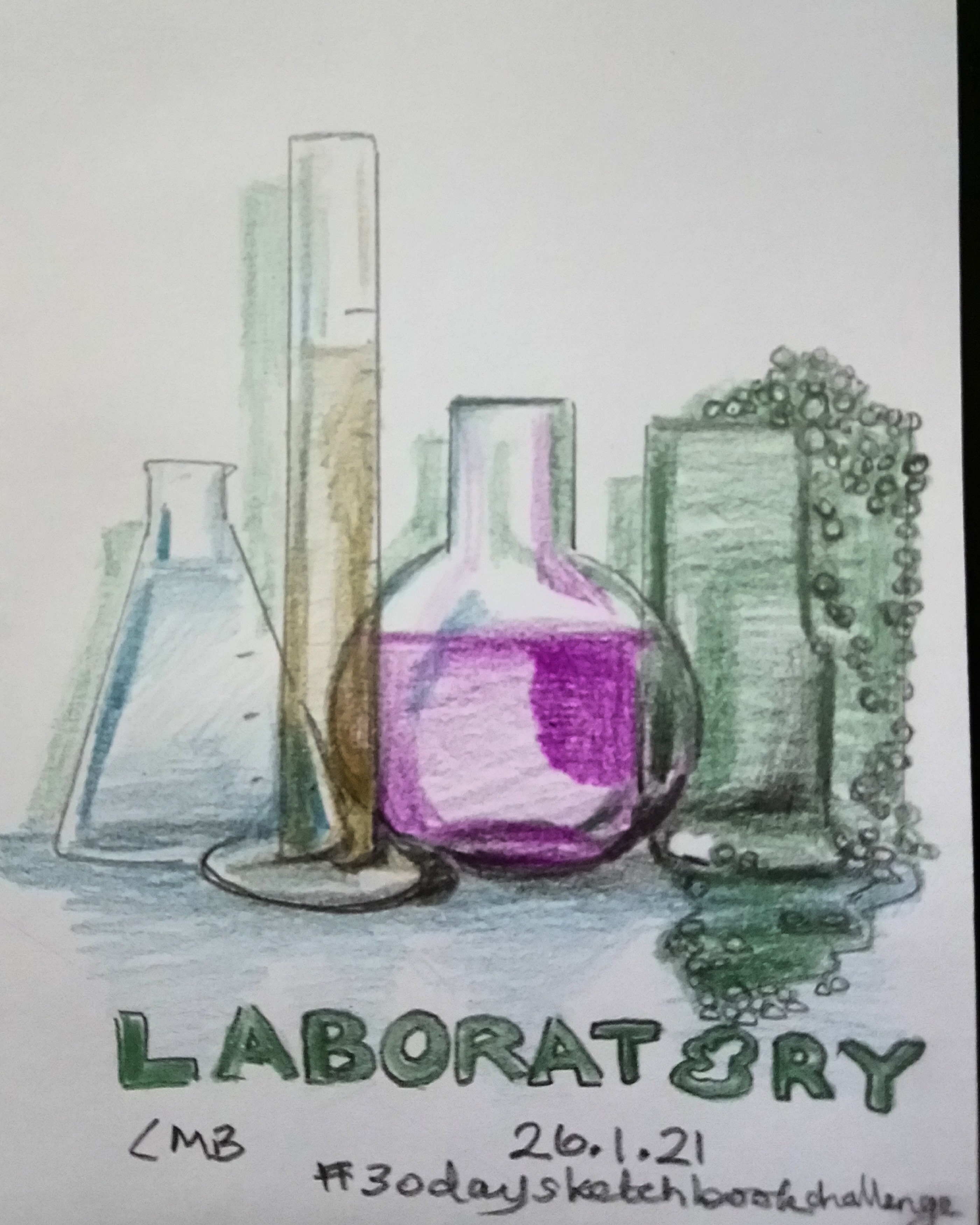
Laboratory was the #30daysketchbookchallenge for today. I decided to draw some glass vessels full of coloured liquids. I suppose that’s the stereotypical image people have of the equipment in laboratories, but they come in all sorts of types, for physics, chemistry, biology, geology, archeology, with lasers, scanning electron microscopes, x-ray machines, burettes and pipettes….. So much to find out about the world around us…

Chemicals

sketch-1563553239030

One thing I hear a lot of nowadays is, I can’t eat that it’s got chemicals in it.

I agree that some things are not good for you. But that’s not because of ‘chemicals’. Why? Because unless you try and live on sunshine (some people do, believe it or not ) everything is made of chemicals, that’s because it’s made of atoms and molecules that make up the basic building blocks of the world.

Atoms and molecules? Single chemicals are elements, and if you have more than one sort, joined together they make compounds.

Oxygen is an element, hydrogen and oxygen is water, H2O. The air we breathe is made of chemicals… Nitrogen, oxygen, carbon dioxide, argon and other trace elements.

Food is made of chemicals, mixtures and aggregations of elements and compounds, from meat to yoghurt, lettuce to lemon merangue to coffee or tea. It’s only when things are added that food can become bad for you. Like if you treat vegetable oil (made if chemicals) to make it harder you get hydrogenated vegetable oil, which is bad for you as it can clog arteries.

We have to be aware of what is good and bad for you, but using a generic term about chemicals does not help clarify the issue.