Clear sky

It’s a clear sky tonight, the clocks go forward in the UK today. I would love to see the Aurora Borealis which has been visible in lower latitudes over the last few nights, while it has stayed stubbornly cloudy here. The information about Auroral displays and asteroids etcetera you could check out a website called https://spaceweather.com

There is also a large asteroid passing between the Earth and the Moon tonight, but as that distance is around 250,000 miles and it’s about 264 meters across there’s no danger. I guess with a clear sky astronomers will be able to watch it.

I always watch the BBC programme ‘The Sky at Night’ every month when it’s on. But they seem to have stopped showing it. More dumbing down? How do you find out information if its not shared.

Jupiter’s pole

Probably my most abstract image, actually me trying to paint one of the poles of Jupiter taken by the Juno probe a few years ago. It just popped up in my Facebook memories. I find blending difficult for paintings like this. Acrylic dries to quickly to get a fluffy feel to the clouds. I might revisit this and add a bit more to it.

Whirlpool

My digital drawing of the whirlpool galaxy. Visible through powerful telescopes, wouldn’t it be amazing if it was visible to the naked eye?

Why is our galaxy, the Milky Way, so faint? Partly because of light pollution which drowns out the hundreds of thousands of stars visible in a dark sky area, and partly because there are dust lanes n the way of the view to the centre of the galaxy. Plus if you live in the Northern Hemisphere your view is out of the galaxy. If you live in the Southern Hemisphere your view is towards the centre of the galaxy, plus the small and large Magellanic clouds.

Galaxy

Light pollution is destroying our view of the night sky. In cities and towns only a few stars are visible at night, but if you get out away from them the sky can be full of thousands of faint stars including our Galaxy, the Milky Way. Our Galaxy is one of Billions or Trillions in the known Universe. It might look a bit like this if we were outside it, but as we are about a third of the way into a spiral arm of the Milky Way, it’s impossible to see that. Plus we are surrounded by dust lanes that obscure the view. Our galaxy has a supermassive black hole at its centre, and is made up not only of normal matter but dark matter and dark energy as well according to Astronomers and Astrophysical scientists.

The image is a digital drawing I did several years ago. You can only see something like this through a telescope though.

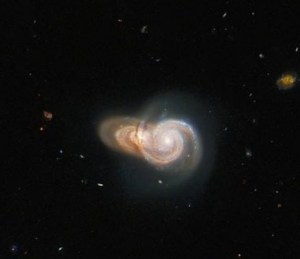
Two galaxies

Two galaxies in line of sight. Taken by the hubble space telescope. They are not colliding but are completely separate, (like the moon going in front of the sun).

Imagine how big the view of one galaxy would be from the other one? If we were on  a planet there half the sky would be dazzling and full of stars, the other half facing the dark of space. It could be amazing!

What’s out there?

Worlds, planets, galaxies

We cannot know it all

Universe or multiverse?

Astronomy or astrology?

The latter is not science

But beliefs

Do you follow faith

Or try and ascertain

What is real

Black holes

Neutron stars

Spinning crazily

In infinite space.

Viewed through telescopes

On Earth, in Space.

Thank you Galileo

For your grace.

Lunar Eclipse, thanks spaceweather.com

Just got an email about this. I don’t think I will be up, and it’s cloudy here…

Space Weather News for May 15, 2022
https://spaceweather.com
https://www.spaceweatheralerts.com

TOTAL LUNAR ECLIPSE–TONIGHT: The full Moon is about to pass through the shadow of Earth, reddening the lunar disk for almost an hour and a half. Totality begins at 11:29 pm EDT on May 15th (03:29 UT on May 16th). This eclipse could be a deeper darker red than usual because of lingering exhaust from the Tonga volcano. Full story @ Spaceweather.com

The Lyrids 2022

From the explaining science blog on WordPress. I love watching meteor showers so decided to share.

The night of  22/23 April will be the peak of the Lyrids, one of the most famous prolific meteor showers. Meteors (also known as shooting stars) are bright streaks of light caused by small lumps of rock or metal called meteoroids hitting the Earth’s atmosphere at very high speed. As they pass through the atmosphere they get heated […]

The Lyrids 2022

Draco

Draco, the dragon constellation and Ursa minor. Draco writhes up the northern night sky from the constellation Hercules up to Lyra. It sits near the north pole of the ecliptic. It was first identified by Ptolomey in the 2nd century. It remains one of 88 modern constellations.

I’ve found out a lot as I’ve written my college report. Eastern dragons are wise and benign, western ones evil and dangerous. They have lots of different appearances that vary depending on where they are were from or the time they were imagined. No legs, two legs, four legs, winged. Dragons seem to have evolved through time and now a more standardised anatomy seems to have emerged. I wonder how dragons will change in the future?

Coronal Mass Ejection

https://spaceweather.com

Image of the Sun showing a solar flare leaving the Sun. The flare was huge, but it was on the far side of the Sun. If you go to Spaceweather.com you can find out more. Apparently it was from a large group of sunspots. (darker areas of the sun involved in the magnetic lines of force within the sun, they get twisted together and produce solar flares). I am not an expert. But I do know you should NEVER LOOK DIRECTLY AT THE SUN. EVEN DURING SOLAR ECLIPSES, Spaceweather.com has all sorts of information on it.