Almost a Sacred Duty.

We went to see a production of Almost a Sacred Duty tonight. A play and presentation at the New Vic theatre. The start was a brief history of what had happened in 1918 by a local historian. This was followed by a play with people from the present and three characters from one hundred years ago. It was about the Minnie pit disaster in 1918, the 18 months it took to find the 156 bodies of men and boys working in the mine who died in the disaster and about 80 miners who survived.

The inquest was held in 1919 after the last body was found. After the hearing, which took weeks, the conclusion was that dust in the mine had contributed to the explosion although nobody was found accountable.

The people acting were playing present day residents who were commemorating the disaster and also played people from 1919 who were at the inquest. The whole thing was only about 45 minutes long but it was really good.

Jim Worgan is a mining historian who gave a short presentation.

Sue Moffat wrote the play and it was directed by Anna Poole. There were three professional actors plus a community cast and the play was supported by the Minnie pit centenary commemoration group, the heritage fund, and New Vic borderlines.

The play used information from William Cooke, a local historian and writer who had given permission to use his book ‘The Minnie pit : Disaster and Controversy”.

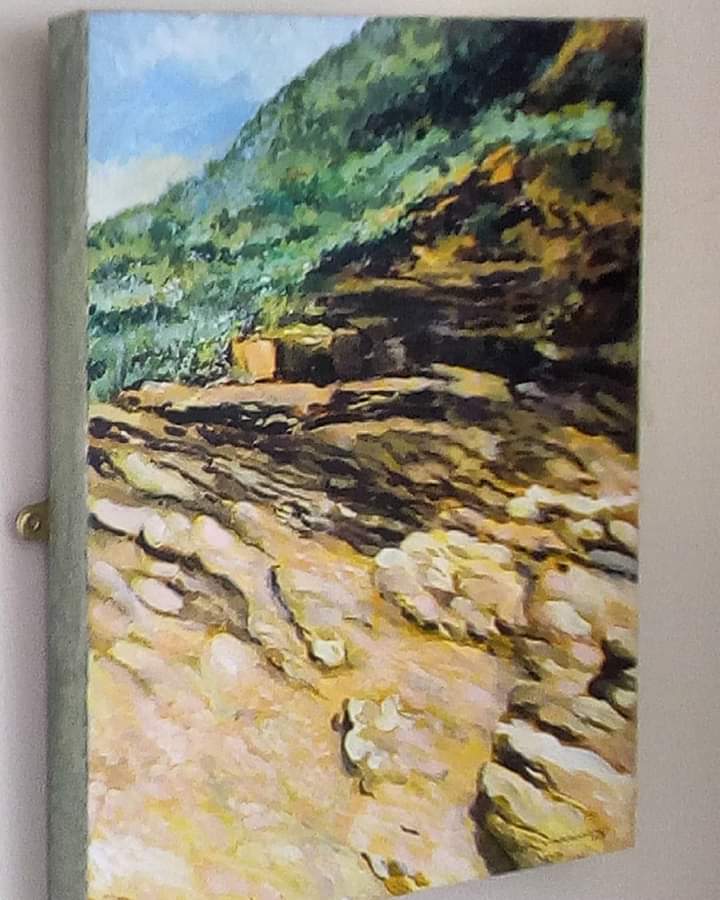
Rocks and sand

FB_IMG_1565568781253

This is a painting on my sisters wall which I did a few years ago. I’ve put it up because I want to go back. But I don’t think I will this year as the summer is rapidly running out. Maybe I can sneak off for a few days but I’ve got lots of things coming up. Is October too late for a summer holiday? We will have to wait and see what the weather is like. I don’t want to be freezing in a caravan in a storm!

The place? Bovisand Bay, in Devon. Acrylic on canvas.

Ivans talk about Iceland

We just went to a talk about Iceland by our friend Ivan. He had spent several days on the Island following trails around an area about the size of North Wales and near the capital Reykjavik. I’m sorry but I didn’t take the names of the places he visited but it was bleak and beautiful. Ice was melting in the summer sun and there were several places which were called snow bridges which would collapse under a person’s weight. These were over deep holes and hollows where the packed snow had melted underneath.

Ivan also played video of the landscape including geysers where boiling water was thrown up fifty feet into the air. Steam rose from fumerols and there were plants where power was generated from geothermal energy. Throughout his trip he made friends, camped out, and took beautiful photos. We were lucky to win one of them in a raffle he held. The Penkhull Mystery plays are to be the recipient of any money he collected. A great evening out.


Colouring in

DSC_2168

It’s doing it again, saving to draft failed. Buy I’m hoping that if I just post this without editing it, perhaps it will post?

Anyway my hubby has been having fun colouring this cat in. I guess it really doesn’t matter that it’s green, as long as he is enjoying doing it. Adult colouring books seem to be the in thing these days. They are good to take your mind off things, they give you the relaxation you need, using enough concentration to give you ‘flow’.

More people could use this technique to help themselves to calm their minds. Life is too stressful, and maybe something gentle like this, taking your mind off things, could help?

Anyway it has posted x. I still don’t understand the draft posting warning I’m getting. Anyone know why?

Colours

_20190830_193440.JPG

When you take a photo do you ever think of adjusting the colours or the hue? It’s easily done on a smart phone. You can use so thing called ‘curves’ where you can change all the colours, tones, contrast and dark and light using one tool. You have a curve indicating the colours and by adjusting the curve in different places…. I’ve taken a few screenshots to explain. First take a picture, then go to photo editor.

I don’t know how anyone else’s phone works, but in photo editor if you find the editing button in editor, choose the one for changing colours. The icon has a curve on it. Click on that and you can adjust the levels, you can see them move on the screen. When you like it choose save. You then have an image that looks completely mad, or subtle, or however you like it.

Finished Mars

_20190830_203328

Finished, the colours are a bit off as I’m painting under electric light. I’ve tried to get accurate details on it although I’m still wanting it to be painterly. I don’t want my paintings to look airbrushed or filtered.

It’s the old analogue or digital argument. Everything is HD these days. But I’m not trying to get photo realism, just realism. So, now I’m going to leave this. If I have a night’s sleep I might be able to come back to it. There are thousands of craters and trenches and rills and canyons on Mars. It’s a rocky planet with a very thin atmosphere. It can be completely covered by dust storms and the details of the surface can be covered over. The carbon dioxide poles shrink and grow dependent on the seasons. In the past the surface was imagined to be covered with canals (a misinterpretation of the Italian word Canali – meaning channels). Astronomers thought the dark patches were vegetation. Now we know Mars is a rocky, desert planet. About two thirds the size of Earth with lower gravity. It has lost most of its atmosphere and water over billions of years, probably because its molten core has solidified and it now has no magnetic shield to stop solar radiation from causing the atmosphere to stream away into space.

Painting is like knitting.

DSC_2137

The complexity of trying to paint the surface of Mars is like trying to knit a complicated pattern of cable stitch, pearl and plain knitting. I don’t know exactly how to do that, and with this painting I’m trying to get craters and ridges at least vaguely in the right place, which is like knitting the whole thing.

If I had large images of the planets I would use tracing paper to copy the main features, then transfer the tracing onto a canvas by drawing on the other side to have at least an outline to follow. But no, I do it the hard way. Holding my phone up with the image then trying to paint the right colours and features and attempting to get them in the right place. You also have to keep tapping the phone to stop the picture going off.

Well so far I’ve splodged in whites, violets, blues, rust colours and dark areas. It’s starting to work but it’s got more complicated as I’ve gone on. I have overpainted several areas. I can see that it will take a while yet.

X