View of Dartmoor

FB_IMG_1532825135535

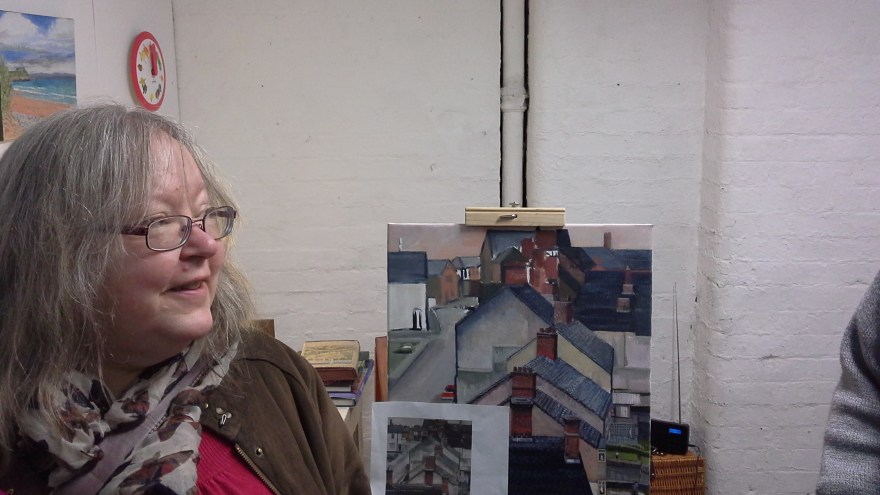
This is a painting I did a few years ago of a friend standing beside one of the outcrops at the top of a hill in the Dartmoor national park.

The rocks have been weathered over the millennia to create flat plate like structures stacked up on top of each other. Sometimes the base will be of softer rock and so the stack will be formed above a narrow neck of rock where the surrounding stone had been worn away. Another place to find these sort of outcrops is in Yorkshire. You can also get limestone pavements where the rock is at ground level but there are large cracks going down deep between the rocks with plants growing up, taking shelter between the stones. These can be found up at Malham cove in Yorkshire.

My friend used to fly gliders over Dartmoor, so he knew his way around the area. It is a beautiful part of the world, high up above the surrounding countryside with rolling hills and wide skies. Sometimes it snows up there and it can be very bleak in the winter . I can imagine trying to shelter behind these rock on a cold winters day with an northerly wind blowing snow and sleet at you. I guess Dartmoor ponies might even have sheltered there.

The painting was quite small and was painted with acrylic on canvas. It went to a good home.

X.

Twins?

20180727_114203

One of the things about being a painter is being asked to do copies of your work. This was the case with these paintings. The original was painted by looking at the photo on my mobile phone. The second was copied from the first.

Question, can you tell which is the original? When I asked my husband he recognised the first one straight away ( although he had seen both of them being painted so that was not difficult).

It’s actually quite hard to copy a painting, especially as I do it free hand without drawing it out first. I think I didn’t make a bad job of it and I hope its new owner will like it.

Why this painting? Because I like both the colours and the challenge of painting her hat/snood? Trying to get the colours and details right. I hope you like it too….

Rejection

IMG_20180617_131433_540

How to deal with rejection?

I entered three paintings for our local 3 Counties Open art exhibition, but yet again all of them have been rejected. I thought they had a good chance, but no, nothing. I’ve entered in the past and been successful on a few occasions. …maybe my idea of art is too different from anyone else?

I have not added photos if them I don’t want to remind myself…

It’s a hard thing to accept, I know its nothing in the middle of all the bad things happening in the world. But I feel a gut wrenching sadness…I’m clearly not good at this….

Thinking about it, really it is a personal choice by the judge’s. There is nothing in the entry form to give you a clue what they like, and in any case, I think art should be original not made for a criteria. I guess they didn’t fit in with the rest of the show. I don’t know if I will bother with the opening, I can be very self critical and I might end up getting upset.

So, I will do what I always do, carry on with my own ideas. Not get too despondent. Life carries on. I need to take a breath and relax, get over it and start over…

I try too hard

To make you see,

My art is mine, alone to me.

I know I am frustrated by rejection

But life’s like that,

I must temper my reaction.

My pain will be brief

No death here,

Just feeling bereft

Not shedding a tear.

I will carry on

I will go ahead,

My art is my own

I will not regret.

Xx

This years mystery

FB_IMG_1530922945410FB_IMG_1530922935765FB_IMG_1530922953432

This afternoon (Saturday 7th July) I will be in the Mystery Play. This is the scenery that I have painted for it. The last photo is the two boards joined, the grey bars of cloud is not the finished effect because I decided to change them to flatter clouds. Unfortunately I could not take another picture because my phone went flat.

I have lost the book I was working from so I just tried painting cumulus and stratus clouds.

I think the looming clouds make it feel more oppressive. The play is about war, family, and woman’s equality. I hope it does work on the day.

Our play starts at 2 pm and only runs for 20 minutes, I think it will be good.

I am still here!

FB_IMG_1530408130558FB_IMG_1530406056019FB_IMG_1530406044806

Just busy at the moment. I’m painting some of the scenery for our local mystery play next Saturday. The theme is the Tittensor Evictions by the Duke of Sutherland, and including two wars and the suffragette movement all in twenty minutes.

The scenery is based on a painting by Corot. I think it’s a landscape in the south of France. I’ve added a thatched cottage and there will be figures in the foreground. This is half of the panel (or flat as they call it in the theatre) its 8ft by 4ft. There will be another panel of the same size attached above it which of sky. I’m also going to add the hall where the Duke lived to this panel.

I’m painting with acrylics and emulsion on hard board. This took me about two hours to paint. I also have a sign to do…. so I will be very busy again!

The Mystery play has been happening for over 10 years now at Penkhull. It started out being purely religious but has taken on different themes over recent years, including one about the river Trent. Apparently it’s the largest community arts event in Stoke-on-Trent and there were 400 people participating in putting it on last year.

It’s on 7th July if you feel like coming along…


Paint

IMG_20180623_203316_212

Paint is a wonderful thing,  a riot of colours, a rainbow of tones.

Acrylic for ease of colour use, oil paint for staying damp to ease blending. Water colours for transparency and simplicity, Gouache for more opaque colours over watercolour. The types of paint are fascinating. Each has its own method and technique. Even paints such as emulsion and gloss can be used in Art, and of course spray cans are used for graffiti.

From millennia ago humans have made marks, on cave walls, on rocks, papyrus and paper. Canvas and screens. The need to make pictures seems to have been with us almost from the cradle. Children learn to draw at an early age. Scribbling, then with improved hand eye coordination comes drawing, painting, even writing. For what is language, it is an abstract representation of what was once pictograms. Egyptian hieroglyphics show the link between art and language.

Paint and art invade our society. Art and colour are used to design every day objects. Architecture is a form of art. We need artists and painters in our visual society. Art is there in video games, special effects, what colour your clothes or car will be next season. What palette you decide to use to decorate weddings and birthdays. The list is almost endless….


Maiden castle

 FB_IMG_1528716352682

This is a painting of maiden castle that I painted a few years ago.  The place is an ancient monument, an iron age hill fort, near Dorchester in Dorset which is in the south of England.

The dancing figure in the foreground is meant to signify the age of the place. Her bones, and the rabbit skull below her are collapsing into the ground, what would archaeologists find if they dug there. The slopes of the hill fort are built up in steep steps. Like huge waves breaking on the coast of an island. The grass really does like to grow in waves and clumps.

So why did I paint it? I don’t know. Except that the place is full of mystery and ancient history. I probably would just paint the landscape if I was doing it now, but I’m glad I added the figure.

Poppy painting

This is a painting I did 6 years ago outside in the garden. I love these large poppies. I had decided to  paint outside because it was a beautiful day and why not paint in situ instead of from a photo. I think then decided to take photos of the process. I guess I painted the poppy first as it was the focal point of the painting.

I added all the other flowers to make it more interesting.  One of the things with creating art is the idea if artistic licence. The other flowers were in different parts of the garden and I wanted to add their colours to the mix.

I’m not sure whether I like this painting, its a bit flat, maybe I should have used more shading as the colours are all of very similar tones, but I was looking at a shady garden and the light was changing over the time it took to paint it. it reminds me of an illustration in a book or magazine, I almost coukd see it next to a children’s story.

I love to paint, and it is always a challenge to improve.

Colour contrasts….

You might have heard of the colour wheel.. a rainbow of colours running from red to orange, yellow, green, blue and purple.

Red, Blue and Yellow are known as primary colours. These are the ones you can mix together to get Orange (yellow and red) Purple  (blue and red) and finally Green (blue and yellow)

There are mixtures that can also make all the different colours of the spectrum.

If you know the theory of colour you also know White is all colours mixed together. This is why if you put a prism of glass in a beam of sunlight it will split the white into all of the colours of a rainbow. Newton did this experiment and helped us understand the nature if light.

On the other hand, Black is an absence of colour, all the colours that hit a black surface are absorbed, they don’t reflect back to your eyes. If you mix up all the colours of the spectrum you tend to get Brown, not as you might expect, Black.

Did you know there are complementary colours? If you spread the primary and secondary colours around a circle split into 6 equal segments you can see how the primary colours are next to one’s of a mixture of them and the next primary. So the wheel ends up with the most contrasting (complementary) colour directly opposite each other.

These are

red/green

yellow/purple

blue/orange

These colour combinations seem to sing, like a discordant chord they bounce off each other.

Some famous artists like Cezanne and Van Gogh would exploit these clashing colours to create strong images. Van Gogh’s blue skies contrasting with the orange of sunflowers makes the paintings seem to glow. Cezanne’s use of green vegetation and red soil has a similar effect.

So sometimes when I paint or draw I will chose to use complementary colours to see what I can create from them.

Of course there are other colours out there. ..the author Terry Pratchett wrote about Octarine, the eighth colour of the rainbow, I think he said it was a purplish black …..

But in reality there are colours beyond human perception. The ones nearest to the spectrum we see are Infra red, which gives heat. You need special detectors to show this colour, and also ultra violet which can cause tanning or sunburn when the uv light is strong enough.

The spectrum continues into longer and shorter wavelengths beyond infra red and ultra violet. But that’s another story….

Canal art

The main art on canal boats or barges consists of old fashioned lettering, this then has shadows cast to make it appear 3 dimensional. See the photos above.

FB_IMG_1528048827285

I tried to draw this canal rose pot to keep me occupied while I was at the canal festival.

What you regularly see is this castle and roses pattern on barges and canal boats. It consists of a landscape painted  with a stylised castle, often next to a river, and  roses and leaves will appear either around the castle or on a different part of the bucket, jug, pot, table, stool or whatever peice of equipment carried on the barge. These historical paintings are also often painted on the inside of the doors so that when they are opened against the side of the hull they are on view.

I think this style of art is lovely. It may be old fashioned, but its interesting.

To paint the roses you start with a  filled in circle of paint, then the leaves are painted in, then the petals are added. These seem to be created using the brush shape and are simple but neatly done. Finally details like highlights and stamens are added.

When these barges were in use, the main part of them were used for hauling coal or pottery. Whole families might live in a space not much bigger than about 10 foot by 6 foot…., is it any wonder that the barges were decorated with these patterns to make them more like home?