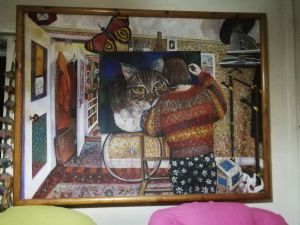
1980s large canvas. Painted in oils, it was only a few years later that I started using acrylics instead. It’s about 5 ft by 4 ft or something like that. It depicts our old front room, in the house we used to live in. The cellar underneath the front room was starting to collapse, its vaulted ceiling held up with an acroprop. Why was I painting a giant cat? Because I love them, and patterns (wallpaper, clothes etc). The small cat in the corner is playing with a roll of wool. The box says Walsall Art supplies, where I came from. I’d call this a narrative painting.
Where to start a story? From experience? Imagination, or a bit of both?
This was my first panel in a 9-panel illustration. You may have seen it on another blog page. Where could this go? My idea was about the problem of hoarding in the present day, consumerism, the need to have objects to comfort you. But maybe it could have gone a different route. Perhaps she visits an antiques fair and finds an undiscovered painting or a jewel that has been thought of as trash. Maybe she goes to a secondhand shop and discovers a first edition book by H Ryder Haggard. Or adds some new kittens to her family.
Is she alone, does her collection cause a conflict with relatives. Has she got enough money to feed her collecting hobby? Where does she fit all of her belongings? She might have a lock up garage that is broken into causing despair when her family heirlooms go missing. Perhaps she meets a like minded collector or the Police investigate her for keeping stolen goods?
Maybe, even, it could be a murder mystery, a jeweled dagger is amongst the effects she receives following the death of a maiden aunt from Glastonbury? Why Glastonbury? Because I’ve always wanted to visit it!
I’m doing a single page narrative of how someone’s life has changed for the worse. So I chose hoarding as it’s insideous and creeps up on people. This is close to finished but I may add more. What do you think….
We had training at work about how to try and help hoarders. You can’t just tell people to throw things away, it won’t work. People become attached emotionally to their objects, an empty biscuit box might remind them of a relative they have lost. A pair of old shoes, a romantic holiday. Each item can be invested in memories and if they lose the object they fear they can lose the memory…. Sometimes people’s lives are overwhelming, if they live on their own with not many social contacts or an illness they may no be able to cope. Who do they turn to? And there is the embarrassment factor as well. Turning friends and family away because it’s hard to admit they have a problem. That’s what this little 9 panel story is about.
This image is in CYMK colours as it may be printed later. The size has to fit an A4 page with enough margins so the ink doesn’t bleed off the edges.
Part of the college course is narrative and storytelling. The webinar today was to write a short story then retell it in different styles. We had to use headings such as metaphor, dream, vision, retrograde etc.
For instance for the subject ‘dream’ I could say :
The day was quiet when a sudden roar was heard outside the door, a figure wearing a helmet and visor appeared in the room. I shall tilt at windmills on my steed he said. I will search out dragons. I watched as he rode up our street but as he rode the landscape turned to a seascape. He was riding a seahorse, his sword raised to kill the Kraken, but it turned into a wisp of smoke and he was swallowed whole..
From this you can see I probably don’t have the ability to write fantasy stories!
As part of my illustration course I have to learn about narrative and storytelling. This weeks subject is about building tension in a story and we had to chose a book to look at:
I don’t have any graphic novels to look at, so I chose ‘Guards! Guards!’, by Terry Pratchett.
It tells the story of how Carrot, a human who was brought up as the step son of dwarves, and who may or may not be the heir to the throne, comes to join the City Guard of Ankh-Morpork and ends up fighting dragons to save the city.
The book cover is illustrated by Josh Kidby who helps raise the tension of one of the crucial scenes whilst including many of the cast of characters in the book. The illustration is full of drama but also emphasises the emotions of the guards.
Pratchett’s writing style is humorous and descriptive, he also uses the device of writing a continuous narrative, with no chapters, but swapping between different scenes which create a series of cliffhangers. His narrative carries you through the book with the images he creates almost visible to the mind’s eye:
The dragon accelerated. The drunken rooftops of Ankh-Morpork blurred as it passed over, wings sneering at the air. The neck stretched out straight ahead, the pilot flames of its nostrils streaming behind it, the sound of its flight panned across the sky.
Just reading that makes me want to read on. I can see the flames and smoke billowing around the dragon. Will Carrot and the guards overcome this monster? Does Carrot die in a blaze of heat and fire? Will a million to one chance with an arrow save them?
You can see how much I have enjoyed this fantasy story by the state of the well thumbed cover. I often look through the characters on the cover and try and match them up with those in the book. There is sometimes a mismatch between the words and the image but I think Kidby handles it well.
I don’t have permission to use an image from Guards! Guards! So I did a quick doodle.




 Mallaband-Brown