Comet

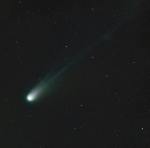
There is a Facebook post saying there is a really bright big comet that will appear in the sky tonight. I do get annoyed with these sort of posts because they are so illogical.

I decided to reply: If it was in the sky we would have seen it coming. It wouldn’t just appear. It might be travelling at a few hundreds or thousands of miles an hour but it wouldn’t appear instantaneously. There is a comet called Atlas (not sure of the full name) that is in the southern sky after recently passing the sun. It’s only a low visability comet and is starting to fly out of the solar system. Visible with binoculars just before sunrise. Gradually dimming as it becomes more distant.

Copper sky

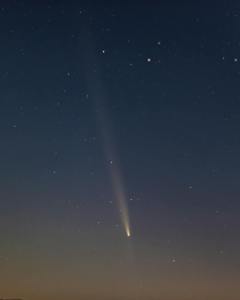
The clouds shone like copper tonight, not red or gold. This is the closest I can get to the colour like in this photo. I’m still looking out for a view of the comet that’s in the evening sky after sunset  when it’s clear, but I haven’t spotted it yet.

I wish I could have taken a photo of the actual sunset but I was driving and my camera was in the handbag on the back seat and I couldn’t find anywhere to stop. I will try and look again tomorrow

Comet waiting

The rain and clouds are stopping us seeing an evening comet in the west of the UK as the sun sets. Details can be found at http://www.spaceweather.com

It looks like it’s going to be a beautiful and hopefully naked eye comet although as it moves away from the sun it will fade and rise higher in the sky. I’m not sure but I think it’s come in from the Oort cloud on a long trajectory. I want the clouds to clear, soon!

Pink sky in the morning, my camera couldn’t show how pink it was, I really need to adjust my camera settings. Then it rained and rained and rained. Part of the time with a very cold wind. Autumn is on the way. As the saying goes, red sky in the morning, Shepherd take warning.

I really wish the dawn sky had been clear, there is a comet in the morning sky that could be visible to the naked eye in the next month or so. I’m afraid I don’t know the name of it but you can find it out on https://www.spaceweather.com

Meteors

If it’s clear tonight you might catch the end of the gemini meteor shower! There might be up to 100 meteors (shooting stars) an hour. They are grains of dust the size of a grain of sand burning up in the atmosphere. Bigger pieces can appear as fireballs. They are the remains of dust particles from a comet or asteroid. The Geminids are named after the sign of the zodiac they seem to come from. Gemini (the stars are castor and pollux). Bigger pieces that land are known as meteorites and can be worth a lot of money.

From Google :

Meteor showers tend to be associated with a particular space body; in the case of the Geminids, the source is an asteroid or space rock known as 3200 Phaethon. Every December, Earth runs into the stream of debris the asteroid leaves behind, bringing a new wave of crumbs into our atmosphere that shine as shooting stars.

So if you look out tonight I hope you see the shooting stars x

There’s a comet out there…

Somewhere at sunset a comet called Leonard is heading in towards the sun. It has two tails and is near Venus in the night sky. The tails are quite long and have become more visible. One is a tail of cometary gases heading away from the sun, and the other is an ion tail which curves due to the sun’s magnetic field. I love astronomy and the information is what I remember from watching TV shows. The trouble is it’s foggy here now! I think it will have disappeared by the time our weather improves.

For more (and much better) information go to Spaceweather.com it’s full of interesting information about the sun’s coronal Mass ejections, X Ray flares, Cosmic Radiation and Near Earth Objects (chunks of rock, asteroids, meteors, that are near the earth and flying past us), sunspots and its magnetic field. There are also videos and photos of the sun’s activity. Worth a look.

Comet Neowise

sketch-1595445833950

I have not seen it. It keeps being to cloudy. But I just read this at Spaceweather.com so I tried to draw it.

COMET NEOWISE APPROACHES EARTH: Tomorrow night might be your best chance to see Comet NEOWISE for the next 6,800 years. On July 23rd, the comet makes its closest approach to Earth. The fading comet is still visible to the naked eye from dark-sky sites and an easy target for photographers everywhere. Get the full story at Spaceweather.com .

There is then the Persid meteor shower in August. Around the 15th? That might be a good show. Meteor showers are caused by the dust thrown off from comets as they get close to the sun. It’s called out gassing when cometary ice is heated by sunshine and boils off into space taking dust with it. A comets tail is made up of two different parts, the dust tail and an ion tail which is made up of ionised gas. The comets tail always points away from the sun because it is blown by the solar wind.

X

In other news..

sketch-1584608662732

Digital illustration of a comet. Didn’t want to use someone else’s copyright photo. This is just to give an impression of its colour….

I get alerts from Spaceweather.com about all sorts of astronomical events. I got this alert about a comet this morning. As we are in ‘interesting times’ I thought I would let you know.

Here is a short excerpt with the link:
COMET ATLAS IS BRIGHTENING FASTER THAN EXPECTED: Get ready for a wild ride. Comet ATLAS (C2019 Y4) is plunging toward the sun and, if it doesn’t fly apart first, it could become one of the brightest comets in years. Amateur astronomers are already getting fantastic images as the comet brightens even faster than expected. Visit Spaceweather.com for the full story.

I don’t think the link will work from here, but it’s an easy address to find.

X

Geminids

sketch-1575579002253

We (the Earth) is heading towards a stream of bits of rock from a comet called 3200 Phaethon. This is what  causes the annual Geminid meteor shower. It is expect to peak on December the 13th and 14th. The night before is the full Moon. But the Geminids are bright and can have brilliant fireballs during the shower so they may be visible even through the moonlight. The main problem in the UK is that its often too cloudy to see things like meteor showers. I’ve often stood outside and looked for meteors, but seen nothing.on one occasion long ago we drove off into the night to see if we could get out from underneath the cloud. We drove from Stoke to Buxton and Macclesfield, but to no avail. Apparently they had a good show in Liverpool that night. But we missed it.

Meteor showers can appear at all times of the day, but are best viewed at night. As the Eath turns different bits of it can be pointing into the comet debris at different times of day. Generally they are more visible after local midnight, but one part of the world may see nothing and another part several meteors a minute. It can also be dependent on the width or narrowness of the dust stream.

Happy viewing, wrap up warm!