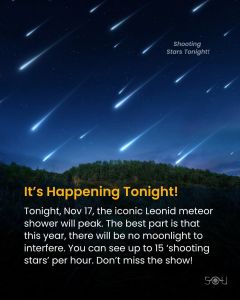
Misleading astronomy

I do hate it when people hype astronomical events. If you’ve ever watched a meteor shower you know it doesn’t look like this! It’s cloudy here so I’m unlikely to see anything..

Some showers have a lot of meteors or meteorites (the ones that land).

I’ve commented on the post:

It won’t look like this. The Leonids radiate from the constellation Leo (the direction they come from, not the actual stars). They won’t look like blue fireballs, just thin fast streaks of light shooting through the night sky. Unless a large chunk of material falls through the atmosphere. But it’s worth looking up, usually after local midnight. You can really see some great shows if the weather is clear.

For info go to spaceweather.com or look up details at the BBC’s The sky at night TV programme.
Spaceweather.com

What are your favorite websites?

I’m interested in astronomy and follow Spaceweather.com

It’s full of information about comets and meteor showers, solar flares and corona mass ejections that can lead to auroras at the north and south poles. There are so many different phenomena that you can find out about there, and images of astronomical events.

Take a look, you might be surprised ar what’s up in space and how it affects us down here on Earth

Comet waiting

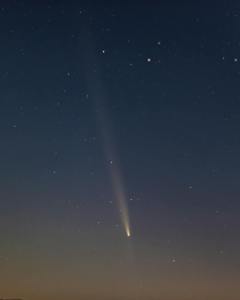
The rain and clouds are stopping us seeing an evening comet in the west of the UK as the sun sets. Details can be found at http://www.spaceweather.com

It looks like it’s going to be a beautiful and hopefully naked eye comet although as it moves away from the sun it will fade and rise higher in the sky. I’m not sure but I think it’s come in from the Oort cloud on a long trajectory. I want the clouds to clear, soon!

More space weather

Aurora glow earlier this week.

Space Weather News for Oct. 9, 2024
https://spaceweather.com
https://www.spaceweatheralerts.com

SEVERE GEOMAGNETIC STORM WATCH: An X-class solar flare on Oct. 8th hurled a fast-moving CME directly toward Earth. NOAA and NASA models agree that it could arrive as early as Oct. 10th, with NOAA forecasters warning of a possibly severe geomagnetic storm. Full story @ Spaceweather.com.

Pink sky in the morning, my camera couldn’t show how pink it was, I really need to adjust my camera settings. Then it rained and rained and rained. Part of the time with a very cold wind. Autumn is on the way. As the saying goes, red sky in the morning, Shepherd take warning.

I really wish the dawn sky had been clear, there is a comet in the morning sky that could be visible to the naked eye in the next month or so. I’m afraid I don’t know the name of it but you can find it out on https://www.spaceweather.com

I’d love a planet to be named after me!

If you could have something named after you, what would it be?

I love astronomy, I don’t know enough about it, but I learn what I can. Red dwarfs, white dwarfs, even brown dwarfs? Supernovae, Nova, planetary nebula. Planets. I probably learnt most of it from a TV programme called the Sky at Night, that used to be presented by Sir Patrick Moore. Since he passed away its been presented by Maggie Aderin-Pocock and Chris Lintott. But it seems to have disappeared off the TV recently with no plans to broadcast it at the moment! What? I’ve been watching it for decades.

You can also do citizen science like things on Zooniverse looking at Mars, or planets round other starts, or even looking for radio signals. I do find the whole thing fascinating. It’s worth looking at https://spaceweather.com for instance to find out about auroras, meteor showers, asteroids and Sunspots.

Clear sky

It’s a clear sky tonight, the clocks go forward in the UK today. I would love to see the Aurora Borealis which has been visible in lower latitudes over the last few nights, while it has stayed stubbornly cloudy here. The information about Auroral displays and asteroids etcetera you could check out a website called https://spaceweather.com

There is also a large asteroid passing between the Earth and the Moon tonight, but as that distance is around 250,000 miles and it’s about 264 meters across there’s no danger. I guess with a clear sky astronomers will be able to watch it.

I always watch the BBC programme ‘The Sky at Night’ every month when it’s on. But they seem to have stopped showing it. More dumbing down? How do you find out information if its not shared.

Auroral display

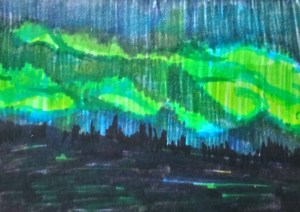
I’ve always wanted to see the Aurora Borealis and last night and tonight might have been the chance. But two things are against it. I live too far south and its cloudy. The reason why it might have been visible is because there is a large area of sunspots that had come into view around the edge of the Sun. It has strong magnetic North and South currents which increases the chance and strength of Coronal Mass Ejections and Solar flares. These could be directed Earth-wards and spark Aurora in both the North (Aurora Borealis) and South (Aurora Australis).

I’d like to see the nothern lights one day. It’s on my bucket list. More information can be found at Spaceweather.com.

Lunar Eclipse, thanks spaceweather.com

Just got an email about this. I don’t think I will be up, and it’s cloudy here…

Space Weather News for May 15, 2022
https://spaceweather.com
https://www.spaceweatheralerts.com

TOTAL LUNAR ECLIPSE–TONIGHT: The full Moon is about to pass through the shadow of Earth, reddening the lunar disk for almost an hour and a half. Totality begins at 11:29 pm EDT on May 15th (03:29 UT on May 16th). This eclipse could be a deeper darker red than usual because of lingering exhaust from the Tonga volcano. Full story @ Spaceweather.com

Coronal Mass Ejection

https://spaceweather.com

Image of the Sun showing a solar flare leaving the Sun. The flare was huge, but it was on the far side of the Sun. If you go to Spaceweather.com you can find out more. Apparently it was from a large group of sunspots. (darker areas of the sun involved in the magnetic lines of force within the sun, they get twisted together and produce solar flares). I am not an expert. But I do know you should NEVER LOOK DIRECTLY AT THE SUN. EVEN DURING SOLAR ECLIPSES, Spaceweather.com has all sorts of information on it.