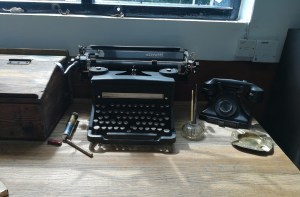
Etruria Inustrial museum today

In the check office at Etruria Industrial museum. There was an interesting video being shown.

We went and watched a half hour video compilation by ( I think) Ray Johnson. The film was showing areas in and around Etruria and Shelton. These included the old Potteries loop line that ran through Etruria, Shelton, Hanley, and Cobridge. The line up to Shelton bar, which was the steel works was so steep it had to have special four cylinder 0-6-0 steam engines to take ore and coal up the steep slope from Kidsgrove up to the Steel works. A lot of the film showed the working conditions there with temperature s in the blast furnace area between 1500 and 2000 °C!

The film also showed how much work was done by steam engines. Apparently there was 50 miles of track in the steel works. Not only did they make steel, but they supplied the gas works next door with coal gas that was converted into ‘town gas’, that used to be stored in the old gasometers next door. The film also showed coal being dug from the ground. It also the coal being used to power the flint mill. It showed the crushing of bone and flint at the Flint mill that was produced by the Princess beam engine at Etruria. A very informative video.
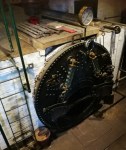
Boiler room

Pressure, boiler, heat.

What a job, to stoke a boiler like this. (Shovelling in coal). I asked my hubby to explain how it works and he tried, but all I got was ‘fire’, ‘water’ and ‘hot air’. I think a boiler full of water lies above the fire and a large tube of hot air sits in the water, somehow the hot air also circulates along the sides of the boiler and smoke goes up the chimney. The fire and hot air heat the water into steam, which then powers a piston, which has hot steam expanding, is pushed down, and is then cooled by water so the pressure releases. And that turns the wheel that turns the gears and belts….. This is a Cornish boiler that is old so it only runs at about 15 pounds per square inch…

So, I hope I got that right and I haven’t made any horrendous mistakes. But having a vague idea of how things work is important I think? Bored yet?

S

Staffordshire landscape

Black lion pub at Consall Forge

I wanted to show you a part of the Staffordshire Moorlands that we visited today. Consall Forge once was an industrial landscape and is part of the industrial archaeology of the area. Sitting in an isolated valley it was connected by a narrow gauge railway between Leek and Froghall Wharf. The Consall Forge was about half way along the valley. We have ridden on the preserved railway several times, but I have never found out about its history before. I have seen old lime kilns there but didn’t know their origins. I think the lime was used in the pottery industry and I think there may be a pottery there?

GOOGLE SAYS: Consall Forge kilns. At Consall Forge against the canalised River Churnet stands a bank of four large limekilns. These date from the early nineteenth century and were linked to the North Stafford Railway, a plateway built between 1815 and 1819, running from the Caldon Canal to north of Caverswall.

The valley continues to Froghall Wharf where there is a station for the railway with a good tea room and station shop. The line passes through the ruins of a copper factory which is possibly going to be developed. This makes Froghall much less picturesque than either Cheddleton, where the Churnet Valley Railway starts and Consall Forge which is where we were. The Cauldon canal was used for transporting coal from Froghall Wharf to Uttoxeter but was closed after losing money because of its rural location. It opened in 1811 and closed in 1849.

There is also a nature reserve at Consall. You can get there along narrow country lanes, along the railway or along the canal or its towpath.

Eye don’t know

What is that? I can see something. It’s dark but shining. Glowing from within. Like a coal surrounded by a gas flame. But it’s floating in the air and it’s big. Huge, still, hot, but not very, a sort of terrifying? No one else seems bothered.

Cars are driving around. People walking. I can see it but they can’t. I don’t understand. I don’t know what to think. Is it in my mind, my imagination? Am I hallucinating? I will try and get closer and see…….

Moss on a wall

Moss klinging to the church wall. That wall is blackened by years of coal smoke pollution that was burnt on house hearths and to fire up the bottle ovens that fired the pottery made in old factories. In those days I doubt that moss would have grown on the church wall even in Penkhull village which stands on a hill above most of the city. The city has transformed over the years and is now much cleaner.

You can see photos of the hundreds f bottle ovens that crowded the city. The smoke belched out of them. Look up the Potteries Museum and Art Gallery and Gladstone Pottery Museum on the net for more information.

International Women’s Day 2018

FB_IMG_1552180755078

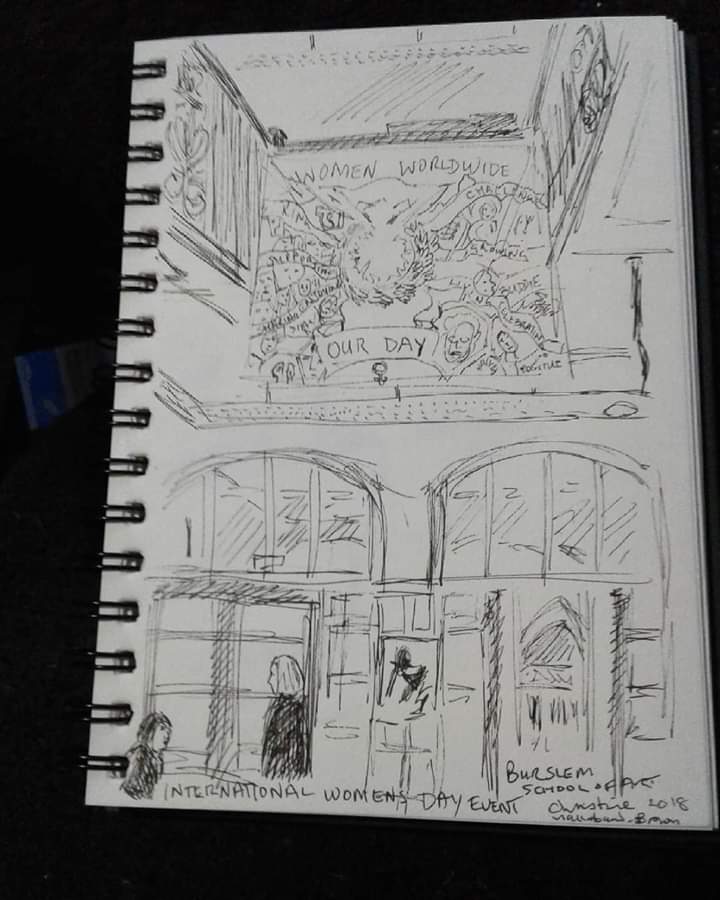
I just found this sketch of International Women’s Day from about a year ago. I had a stall with art for sale at Burslem school of Art. I think this was the first time I ever drew the main gallery and I also tried to draw the banner that was on display there.

The school of art is very crooked. Burslem is old and suffers from subsidence or is undermined by coal mines. The whole of the city is built on clay and coal and the coal field under the city has caused a lot of damage over the years. Parts of the city also have geologic faults running underneath them so it’s not surprising that the buildings are affected.

There is also a volcanic plug  where I live, the very base of an ancient volcano that was worn away by erosion over thousands or millions of years. The hill that is left dominates the valley of the river Trent, but the ground rises in other places too. There are coal tips (slag heaps) where the spoil from the collieries was dumped as the coal was hewn from the ground.

The wonder of Pottery and artistic design was the result of the geology in Staffordshire.