Ancient civilizations

Which topics would you like to be more informed about?

I recently did a course in illustration and one of the modules was to do in depth research into a subject of our choice. I chose dragons.

I was aware of Chinese imperial dragons, and Japanese dragons, as well as western European ones. But I had no idea about the complexity of the subject. For instance how many wings they had (if at all), how many legs or toes? Whether they were good or evil. So much to know.

Then I found out about other civilizations, Australia, various African countries, ancient Greece and Rome, North and South America, each had versions of dragons (also called great snakes), The Australian one for instance was a snake that seemed to link rivers and water holes. The American ones might have been linked to dinosaur bones. How would they know they were fossils and not recently deceased? It was fascinating.

But that’s when I realised I know only very little about ancient civilizations. And watching I Claudius on television recently, I understand I know virtually nothing about the Romans, let alone the Celts, ancient Chinese, Vikings, and so many peoples from across the whole world.

I know I cannot gain an encyclopedic knowledge, but I want to learn more. I’m interested in finding out.
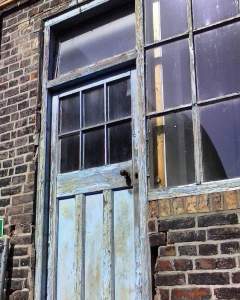
Old door

I took this photo of an old door at Spode pottery five years ago. I guess you could call it shabby. I would not have seen it but there was some work going on at the main entrance to Spode studios so we had to use a side entrance.

I only found this again because of the marvellous Facebook memories. I don’t know how many hundreds or thousands of photos I’ve taken since this, but not that many get put online, so this one must have felt special to me.

I think this might have been a pottery mould store, there was a collection of several thousand old pottery moulds that were a historical record of the shapes of the ceramics Spode used to make. Unfortunately I think they were destroyed a couple of years ago because they were not going to be used again. I think that sort of destruction is unforgivable.

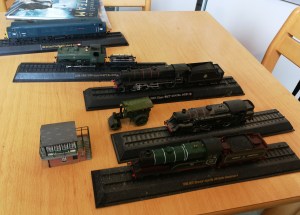
Train models

Not a good photo, but my hubby is lending some train models to the Etruria Industrial museum for the weekend. We may donate them as they have a display case they can be shown in. We have too many bits of collections and sometimes we have to declutter. It feels strange letting objects go. But like paintings, you can’t keep all of them.

Barges at Etruria

Etruria Industrial museum is steaming it’s engine again I think this weekend.

Wet weather is still in the forecast, but we might go up and see what’s happening. It’s good to see historic things like these old barges. It’s amazing how they can stay strong when effectively they are half in and half out of the water. Every few years mu friend used to put his barge in dry dock to recaulk the gaps between it’s wooden planks. You can get steel hulled barges, and I think they last longer?

There is a whole art of decorating barges, look up roses and castles if you are interested. They are traditional designs that are often painted on barges together with spectacular lettering for their names and the companies they belonged to such as Fellows Moreton.

The canal system in Britain has been greatly improved by volunteers that help keep them going. This after years of neglect until the 1960’s and 1970’s when groups of people got together to restore them. We have a lot to thank them for X.

Old work in progress

This is my phone screen saver. It just cheers me up to see it. I only have it because someone asked me for a copy of a painting I did forty years ago.

You can see how I’ve laid the scene out and started filling in the image. I don’t tend to underpainting but go straight in with colour. I rarely sketch in the image, but because this was going to be a copy I had to fit the buildings on properly and also it helped with the perspective.

This is about four years old. I can confirm its new owner was very pleased with it.

Ustinov

Quick sketch of Peter Ustinov.

I just watched a compilation programme of Peter Ustinov being interviewed by Michael Parkinson. It was fascinating to see him after so many years. He was a writer, actor, mimic, humorist. He was of Russian and descent but also had ancestors from other countries. He acted in Spartacus and Quo Vardis amongst other films.

Hearing his tales of his time in the army, film, school life, and theatre among other things was hilarious. He was charming and debonair.

I had forgotten how funny he was. He made Parkinson laugh and chuckle as he told tall stories. This was in the 1970’s or 1980’s. I can’t remember much about the programme when it was first shown, but this was wonderful. If you can get the BBC Iplayer I would suggest trying to see it…. Or if not look him up and try and find some of the films he was in.

Canal boat

Photo taken outside Etruria Industrial museum. This is not a colourful tourist boat. Painted with castles and roses. But careful lines have been painted on it to delineate it’s shape. I think its part of the industrial museum exhibit? Perhaps it was used in the past to transport the flint and bone that had been ground into fine powder at the Jessie Shirley flint mill. This is the main part of the industrial museum. A stationery steam engine called Princess was used to provide power to do the grinding. The boat or barge might have transported the powder to the local potteries to add to clay and produce fine bone China pottery. So much history in this city of ours.

Scotland

What countries do you want to visit?

As a non flier, and someone who isn’t keen on ships I’m rather limited to where I would like to visit. I have been over the Channel on a ferry once and visited a few countries, but things like the Herald of Free Enterprise sinking put me off the idea, and going in a very long tunnel? No thanks.

I’ve enjoyed visiting Wales, I still do, but I’ve only got as far north as Carlisle in England and not even into the Scottish Borders. The thing is Scotland is a big country, there are Highlands and Lowlands, and all the beautiful lochs. The biggest mountain in the UK is Ben Nevis, and that’s in Scotland. Also the summer days are longer there as it is nearer the North Pole (not much closer) but it does affect the day length. And you are more likely to see the Aurora Borealis in Scotland than anywhere else in the UK.

Scotland had it’s own kings, and King James the sixth of Scotland became James the First of England when Queen Elizabeth the first died. There have been other famous Scottish Royals including Bonnie Prince Charlie.

I would like to visit the capital one day. Edinburgh is renowned for it’s yearly arts Festival, and it together with Glasgow, Aberdeen and Inverness are it’s main cities.

Scotland has world fame for it’s Whisky brewing and many fine Scottish Malts are distilled on the mainland and also on numerous islands about the coast.

I’d like to paint the scenery and visit some of its famous landscapes. I’m sure I could spend a great deal of time exploring. Maybe one day we will visit.

A long time ago…

I couldn’t find a photo of an old PC

Do you remember life before the internet?

I do remember, but it’s a long time ago. I even remember the time before PC’s. I can remember seeing them at school just before I left. Obviously there were computers before that but they were massive things with rotating discs of tape, or before that mechanical calculators that could be used to work out enemy codes for combating attacks in war.

I think the “Internet” was invented by Sir Tim Berners-Lee. I’m not sure exactly when, but he came up with the idea of the “World Wide Net”. The idea of a Web of knowledge was often talked about in science fiction stories as I was growing up. Computers had strange names like “multivac”? They would become sentient over time and would decide to take over how humans ran the world, realising the damage we were doing. Often only being foiled in their plans by some ingenious human.

I guess what they were talking about fifty or sixty years ago is what could come from ChatGPT now. And the Internet, which could be seen as a huge web of synapses, might allow that spark of genius to ignite.

Would the Internet have emotions? Or would it rather be senseless as it has no way really to experience them. So many questions that have been investigated in the old style of science fiction stories. Not the “cowboys in space” sort, but old fashioned storytelling by people like Issac Asimov, or Arthur C. Clarke, or others of their era. Literature may have some answers for us.

I remember the time before the Internet. It was good to do adventurous things, and we had to learn things from books. Sometimes it was very boring. But I do remember the moon landings. So exciting!

Coins

Copper coins

Some younger people might not recognise these! Pennies and two pence, change from all those £*. 99 purchases. * being 0 and above pounds.

When British Money was decemalised in the 1970’s we went from 240 pence (D) in a pound (L). That was made up of 20 shillings (S) each of twelve pence. And the shilling was also made up of two sixpence, or four threepenny bits, or 24 half pence or 48 farthings (1/4 of a penny) and apparently there was a mite (1/8 of a penny). There was also half a crown which was two shillings and sixpence. (a florin was two shillings). A crown was five shillings. Ten shillings was half a pound and twenty one shillings was a Guinea. Somewhere among the smallest coinage were groats…..

Hence the Pounds, shillings and pence, or L. S. D. You can imagine how confusing that was for a child. My pocket money was either two threepenny bits or a sixpence, going up to a shilling as I got older.

When we went to 100 pence in a pound, the smallest coin was 1/2 new pence (p), a new penny came next, two pence (all copper coloured), five pence (silver coloured) ten, twenty and fifty pence. The fifty and twenty are not round but have seven sides I think? Eventually the half pence was discontinued and later a bi coloured pound coin was bought in, followed by a bi coloured (bronze and silver coloured) two pound coins.

So we get to recent times where notes are now plastic instead of the paper and rag (cloth was used for strength) notes of the past.

Coins and notes are still used, if you can’t afford credit or use the Internet it’s still needed. But smaller denominations, like pence, might disappear. Some of the coins have got smaller over time. Will we see king Charles third on coins? I guess they will be introduced over the next few years. Maybe the copper coins will disappear soon.

(The .99 pence idea fools you into thinking you are spending less than a full pound £1.00) well you are but only 1% less!