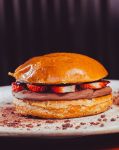
I looked up both words to find images on the free image search here. Smug (feeling very pleased with yourself, but in a selfish sort of way) came up with a picture of a mug. Smarmy (pleased with yourself whilst not thinking much of others) came up with salami sandwiches.
I’m tempted to post a dictionary description for both these words as I know I probably haven’t got them right, but I’ll leave that to you. I just enjoy using interesting and different words.
I asked people on Threads if they had heard the word Mithered and was surprised at the large response I got.
To me Mithered means worried or bothered, pestering someone, being mithered. I found out there are other meanings….
“Mithered” (or “mithering”) is a Northern English dialect word meaning to be bothered, pestered, or to make an unnecessary fuss/moan, often used to describe someone being nagged or someone complaining persistently, as in “Stop mithering me!” or “I can’t be mithered” (meaning “I can’t be bothered”). It conveys a sense of gentle irritation or exasperation. ” (from Google).
I had found out it’s mainly used in Northern England, but it’s even used in the West Midlands where I moved away from in my teens.
I originally heard it from my husband “Stop mithering about things”, who was from Lancashire. He used words like “nesh” feeling the cold, “owt/nowt” anything/nothing, “mardy” moody.
I love the way English is still full of dialects and different accents.
Somehow I’ve learnt to relax, I’m getting better at letting my muscles loosen and feeling so tense.
I was talking to someone and they suggested thinking of a word of at least 7 letters. Maybe omnibus? the idea then is to take each individual letter, one at a time, and think of several words starting with that letter. For instance:
Oval
Occipital
Organic
Oscillating
Overall
Then the next letter…
Mobile
Manic
Masters
Malleable
And so on. Because you are thinking of different words it takes your mind off anything else, mostly be the time I get to the third letter I’ve got to sleep. Think of a new word each time, it seems to work.
If you could permanently ban a word from general usage, which one would it be? Why?
What possible word could be banned? What language would it be in? Would it be an old word or new? Could it be a profanity or a religious word?
The question what word would you ban from general usage is impossible if I were to make the choice. Thinking about so many words that I hate or dispise gets me nowhere. Words that are political, or hate filled may have a use in describing a group or a situation. Remove the word and you remove the significance of it. Like editing out a person from a photo, you don’t remove the existence of them. You just try and hide a secret that should be left visible.
And again, what language is it in? I only speak and write English, but is the word German, or Swahili, Moroccan, Portuguese? What right do I have to chose? I say again, this is impossible.
I’m sure certain words do spring to mind. Perhaps we should consider using different words instead, not putting a blanket ban on it but considering a substitute.
I has to check the meaning of Monochrome because someone said on Facebook that black and white is achromatic. I’m pretty sure that means without colour. Like transparent liquids. But I wasn’t sure whether black and white was dichromatic or duochromatic? Anyway I think I was correct in my original suggestion. Words re such interesting things,
Can you spot the mistake? It’s funny how the brain works – writing the word “buidling” instead of “building” is just an example. Apparently if you have all the right letters and the correct first and last letter of the word, your brain can unscramble it. For instance if I write :
The qcuik bowrn fox jmpus oevr the lzay dog?
You should still be able to read it.
Spelling only became regularised when the dictionary arrived. Once the spelling of words was written down with a definition the spelling was more fixed. But spelling is still quite phonetic, based on sound sometimes. For, four, fore all sound the same but have different spellings and meanings.
The example above is more likely to have occurred because of a computer mistake when the author or designer did not proof read the art work.
I guess I make a lot of mistakes too. I do rely on spellchecker but even that gets it wrong sometimes.