Donated

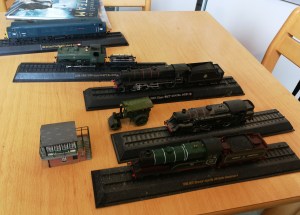
My hubby has finally agreed to cut down his collection of train memorabilia. He has static trains as well as various models, but these were sitting in the summerhouse and getting covered in spiders webs. He has enjoyed them for a couple of years, but we decided (so it’s my fault) that it would be better for other people to see them too and get hooked by a love of trains. The thing is if they get left outside they might get brittle in the sunshine and temperature variations. So donated they are. I hope others get as much pleasure from them.

White bridge, Etruria

Spanning the Cauldon Arm of the Trent and Mersey canal. This white painted metal bridge arcs over the canal near the Etruria Industrial museum. The steps are metal too so when people walk over it their steps ring metallicaly.

The other side is a car park on Kilndown Close. This is where Canada geese used to congregate, but netting has been tied to the fencing to keep them off (possibly because of bird flu?). They still swim on the canal.

Notice the sky? It was blue with puffy white clouds floating in it. Today was the best day we have had for a while. There was even a hint of heat from the sunshine despite a strong wind that was rippling the surface of the canal. Lovely bridge, lovely day.

Etruria Inustrial museum today

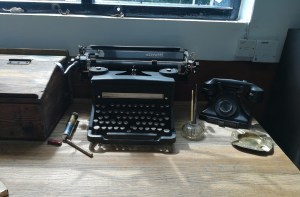
In the check office at Etruria Industrial museum. There was an interesting video being shown.

We went and watched a half hour video compilation by ( I think) Ray Johnson. The film was showing areas in and around Etruria and Shelton. These included the old Potteries loop line that ran through Etruria, Shelton, Hanley, and Cobridge. The line up to Shelton bar, which was the steel works was so steep it had to have special four cylinder 0-6-0 steam engines to take ore and coal up the steep slope from Kidsgrove up to the Steel works. A lot of the film showed the working conditions there with temperature s in the blast furnace area between 1500 and 2000 °C!

The film also showed how much work was done by steam engines. Apparently there was 50 miles of track in the steel works. Not only did they make steel, but they supplied the gas works next door with coal gas that was converted into ‘town gas’, that used to be stored in the old gasometers next door. The film also showed coal being dug from the ground. It also the coal being used to power the flint mill. It showed the crushing of bone and flint at the Flint mill that was produced by the Princess beam engine at Etruria. A very informative video.

Train models

Not a good photo, but my hubby is lending some train models to the Etruria Industrial museum for the weekend. We may donate them as they have a display case they can be shown in. We have too many bits of collections and sometimes we have to declutter. It feels strange letting objects go. But like paintings, you can’t keep all of them.

On display at the cafe

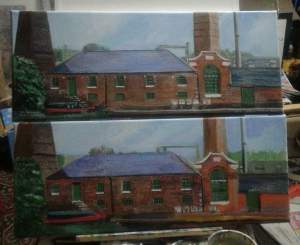
My paintings still on display at Etruria Industrial museum today. The bottom painting has just been added. It’s called Phil, morris man/cyber punk and it’s for sale.

The museum is holding steaming days tomorrow and on Sunday 30th July 2023. The beam engine ‘Princess’ will be in steam and running the grinding pans that used to break up flint and bone for use in the manufacture of fine bone China.

I love painting images that are based on pottery manufacturing, but also poppies are a favourite flower and there are two paintings there that incorporate them.

Maybe you will get a chance to visit? Have a great weekend. X

Small painting sold!

Bit of a bad photo but I had some good news today!

Great to hear I’ve sold this which was on exhibition at Etruria Industrial museum. It was only a small painting of the governor on the Princess beam engine at Jessie Shirley’s bone and flint mill at Etruria, Stoke on Trent. I took another painting up which was also based on a photograph that I’d taken at Etruria at its last steaming event.

Barges at Etruria

Etruria Industrial museum is steaming it’s engine again I think this weekend.

Wet weather is still in the forecast, but we might go up and see what’s happening. It’s good to see historic things like these old barges. It’s amazing how they can stay strong when effectively they are half in and half out of the water. Every few years mu friend used to put his barge in dry dock to recaulk the gaps between it’s wooden planks. You can get steel hulled barges, and I think they last longer?

There is a whole art of decorating barges, look up roses and castles if you are interested. They are traditional designs that are often painted on barges together with spectacular lettering for their names and the companies they belonged to such as Fellows Moreton.

The canal system in Britain has been greatly improved by volunteers that help keep them going. This after years of neglect until the 1960’s and 1970’s when groups of people got together to restore them. We have a lot to thank them for X.

Jessie Shirley’s bone and flint mill.

A few years ago I did a painting of the bone and flint mill in Etruria. I exhibited it in a small exhibition and I ended up getting four commissions to paint it again!

I had to give each painting a different name, not flint mill 1,2,3 and 4, but slightly different wordings for each.

I only remember this because the photos appeared on Facebook memories. It shows, I think, that I AM a real artist, just because I’m not doing much at the moment. I have paintings to finish, but dear old artists block keeps biting me in the bum. Things I have to do get in the way. Life gets in the way.

I painted an elephant portrait.

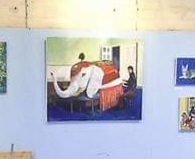
Seven years ago I had a small exhibition at Etruria Industrial museum. This blurry photo just came up on my Facebook memories.

The blurry image of my painting was taken from a photo of my friend with a white elephant she had made of paper and willow withies. She was sewing a rich red and yellow fringe around it as way of hiding the legs of the person who was to carry it. The back had a hollow ‘houda’ I think its called? Like a basket to sit in. This was so a person could carry the elephant but look like they were riding it. I loved this representation of the elephant and decided to paint this image. My friend had the painting. The elephant? I think it was destroyed in a fire in the shed where it was stored…

Canal boat

Photo taken outside Etruria Industrial museum. This is not a colourful tourist boat. Painted with castles and roses. But careful lines have been painted on it to delineate it’s shape. I think its part of the industrial museum exhibit? Perhaps it was used in the past to transport the flint and bone that had been ground into fine powder at the Jessie Shirley flint mill. This is the main part of the industrial museum. A stationery steam engine called Princess was used to provide power to do the grinding. The boat or barge might have transported the powder to the local potteries to add to clay and produce fine bone China pottery. So much history in this city of ours.