Misleading astronomy

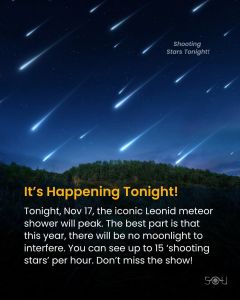
I do hate it when people hype astronomical events. If you’ve ever watched a meteor shower you know it doesn’t look like this! It’s cloudy here so I’m unlikely to see anything..

Some showers have a lot of meteors or meteorites (the ones that land).

I’ve commented on the post:

It won’t look like this. The Leonids radiate from the constellation Leo (the direction they come from, not the actual stars). They won’t look like blue fireballs, just thin fast streaks of light shooting through the night sky. Unless a large chunk of material falls through the atmosphere. But it’s worth looking up, usually after local midnight. You can really see some great shows if the weather is clear.

For info go to spaceweather.com or look up details at the BBC’s The sky at night TV programme.
Esther Chiltons weekly prompt “dark”

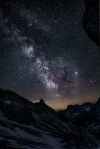
We live in a city, it’s impossible to see many stars. I just wrote this for Esthers challenge dark.

Darkness is needed for astronomy. We used to drive out at night to try and see meteor showers or comets, or stand in the garden under the shadow of the hedge and try and see Jupiter and it’s moons (we used a telescope) and even Saturn and it’s rings. We saw both planets. Once we drove under clouded skies to chase a massive meteor shower of up to 100 meteors an hour. But we never got out from under the layer of thin low cloud even though we drove at least 40 miles.

On another occasion we went out and drove into a wood so we could see a beautiful greenish comet. That was amazing.

Finally we recently saw the aurora borealis. An amazing thing to see in the UK.

Sunset

It’s cloudy again tonight, any sunlight has been stifled by cloud. I’m looking forward to a good, colourful sunset. But if we get that it means we need high pressure and less clouds. That means the sky will clear and heat will be lost so we will get colder weather and frosts. At the moment we are getting gusty winds from the south and scattered heavy showers. It’s knocking the old leaves off the trees. I hope it does clear up, apparently the Taurid meteor shower is due.

Anyway when did this blog turn into a weather forecast? Hmm, must think of something else x

The Lyrids 2022

From the explaining science blog on WordPress. I love watching meteor showers so decided to share.

The night of  22/23 April will be the peak of the Lyrids, one of the most famous prolific meteor showers. Meteors (also known as shooting stars) are bright streaks of light caused by small lumps of rock or metal called meteoroids hitting the Earth’s atmosphere at very high speed. As they pass through the atmosphere they get heated […]

The Lyrids 2022

Perseid meteor

It was about 11.40pm tonight in the UK. I was looking through my kitchen window looking west. I was ringing my sister to tell her the Perseid Meteor shower was due tonight, when I saw what I can only describe as a fireball flash by heading north west. Two seconds later, my sister who lives eighty miles away saw it too! It flew over her right shoulder and dissappeared. So it must have been travelling about 40 miles a second. Since then I’ve seen about four meteors (shooting stars). It’s clouded over now. But there should be about 150 an hour after local midnight! X

Geminid Meteor Shower

Tried to draw a meteor shower…

I tried to view the shower a few years ago. We drove miles, but we’re stuck under a cloud base that was miles across. I gave up after forty miles. Tonight it’s the same, cloud everywhere. But if you get the chance try and see it for yourself!

The Geminid meteor shower is tonight. (morning of 14th December 2020). I looked up the information on Wikipedia I’m afraid as I don’t know enough about them:

The Geminids are a prolific meteor shower caused by the object 3200 Phaethon,[4] which is thought to be a Palladian asteroid[5] with a “rock comet” orbit.[6] This would make the Geminids, together with the Quadrantids, the only major meteor showers not originating from a comet. The meteors from this shower are slow moving, can be seen in December and usually peak around December 6–14, with the date of highest intensity being the morning of December 14. The shower is thought to be intensifying every year and recent showers have seen 120–160 meteors per hour under optimal conditions, generally around 02:00 to 03:00 local time. Geminids were first observed in 1862,[1] much more recently than other showers such as the Perseids (36 AD) and Leonids (902 AD).

Comet Neowise

sketch-1595445833950

I have not seen it. It keeps being to cloudy. But I just read this at Spaceweather.com so I tried to draw it.

COMET NEOWISE APPROACHES EARTH: Tomorrow night might be your best chance to see Comet NEOWISE for the next 6,800 years. On July 23rd, the comet makes its closest approach to Earth. The fading comet is still visible to the naked eye from dark-sky sites and an easy target for photographers everywhere. Get the full story at Spaceweather.com .

There is then the Persid meteor shower in August. Around the 15th? That might be a good show. Meteor showers are caused by the dust thrown off from comets as they get close to the sun. It’s called out gassing when cometary ice is heated by sunshine and boils off into space taking dust with it. A comets tail is made up of two different parts, the dust tail and an ion tail which is made up of ionised gas. The comets tail always points away from the sun because it is blown by the solar wind.

X