I can get into the country

What do you love about where you live?

North… Cheshire and Peak District, Staffordshire Moorlands, East – Derbyshire, South- Staffordshire, West – Shropshire and Cheshire. Further West – Wales. Also Stoke-on-Trent has good road links to motorways and A roads. Sometimes they are a little congested, but you can usually get out into the countryside in 10 to 20 minutes. It is interesting because of the variations in geology depending on the direction you take. Farmland and flat land South and West, with the hills of Wales and Shropshire in the distance. North and East hills and moorland including the start of the Pennines.

Stoke-on-Trent is situated in the North Midlands of England, it also has canal and train connections and the local area has many countryside attractions including National Trust properties, historic railways and museums, Alton Towers is nearby and Jodrell Bank observatory is a few miles north west. You can even reach the seaside in Wales or the Wirral in about 80 miles.
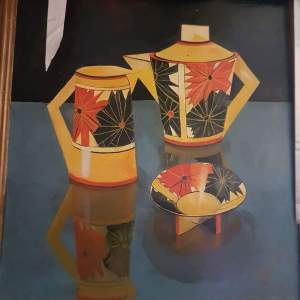
The Art and Craft

What do you love about where you live?

My mural based on a ceramic design called Umbrella by Clarice Cliffe.

Stoke-on-Trent is a city built on Art and crafts. From Wedgwood and Brindley and the industrial revolution.

Ceramics were the main manufactured goods in the city. So much so that it became known as ‘the Potteries’. Different pottery owners experimenting with different materials, trying to make pots that could stand up to the quality of Chinese wares.

Manufacturers had water, clay and coal from the local area. Pots were transported out of the city on the newly built canals that linked it to the rest of England and then on to the world.

Designs were transfer printed onto plates and cups, opening up cheaper wares to the general public. But other work was hand painted and lined with gold and other precious metals.

What was needed to make all the pottery? Workers, making, turning, transfer printing, painting. Numerous jobs including the famous Saggar Makers bottom knocker. (You can Google this). The work couldn’t be completed without skilled labour that could translate designs into reality. Some female paintresses were allowed to sign their names to their work. Like Susie Cooper and Clarice Cliffe.

So much skill in one city. Burslem school of art taught many of the artists that were to work in the ceramic trades. One famous artist, Arthur Berry, became a fine artist and writer and play writer. He was one of my tutors at college. That’s why I love this place.