
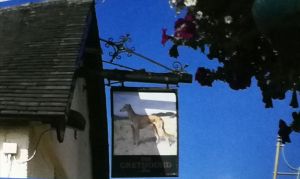
An old pub in Penkhull, Stoke-on-Trent. It was once the local court house where trials used to take place. This is my photo of its public house sign.
From The Potteries.org website:
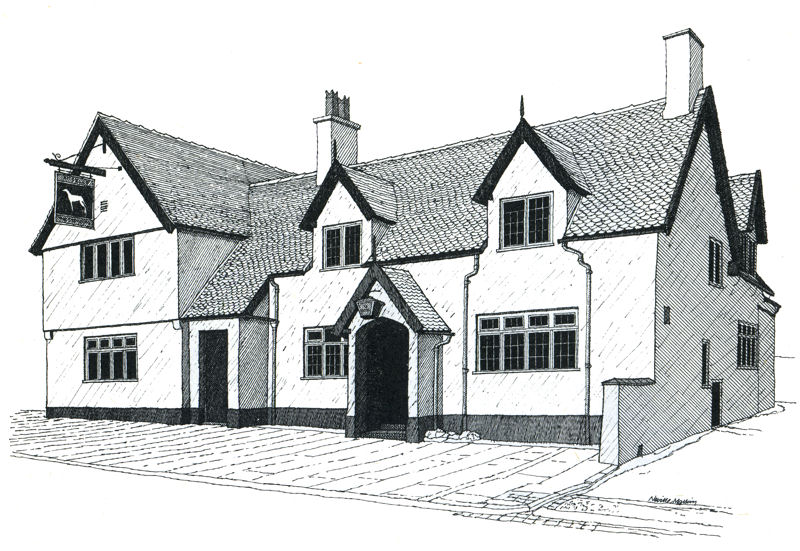
The Greyhound Inn, Penkhull
pen drawing by Neville Malkin – Dec 1975
“Opposite the west door of Penkhull church is the 16th century Greyhound Inn, a building that incorporates the former courthouse of the manor of Newcastle-under-Lyme.
During the Middle Ages the castle at Newcastle was the venue for manorial courts, but the building became increasingly unsafe, and the meeting place was transferred to Stoke, where courts were being held in the middle years of Elizabeth Ist’s reign. The court moved again in the 1580s when it was first incorporated into the Greyhound at Penkhull. Towards the end of her reign the court moved back again to Stoke where it continued to be held until the mid-1620s, when it appears to have been held alternately at Stoke and Penkhull; from 1635 to about 1817 all courts were normally held at Penkhull, except a small one at Clayton. By 1829 courts were being held at the Wheatsheaf Hotel in Stoke, and from 1854 the court was held in Hanley.
The Greyhound, which is now covered in stucco, was largely rebuilt in 1936, with parts of the original 16th century wooden frame structure being preserved. The main block, which runs parallel with the main road, and a small back wing, are still of timber construction but the two-floor cross-wing at the south end has been entirely rebuilt in brick. A massive chimney between the two main blocks originally had stone fireplaces with four centred arches on both floors, but in 1936 the one in the central bar was replaced by that from the room above. A small room at the north end of the building has original 16th century panelling, partly reset, and a courtroom with oak benches around the walls; a seat for the presiding official is said to have been in existence until the major alterations of 1936. I am also told that the cellars were at one time used for the lock-up, where prisoners awaiting trial were held.”
Neville Malkin 17th Dec 1975
I hope it’s OK to publish this information. I will delete if I breaching copyright.
 Mallaband-Brown