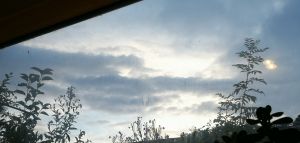
I forgot there was sky

Looking up, not at a roof, but at the sky. I’d forgotten it was there. The privet tree and hedge are missing, and I feel their loss, but if I want to look up for meteors or to try and see aurora I can do it now. And you can’t take the garden off me. That garden where I’ve seen hedgehogs and squirrels. I will try and get the rest of the garden (the bit I never show you because it’s overgrown) a bit tidier and let more light in (enough) to grow roses and honeysuckle. Xxx

Just a note. Spaceweather.com has updates of astronomical activity and there is a possibility of auroras tonight in North America and Europe!

https://www.spaceweather.com

The Lyrids 2022

From the explaining science blog on WordPress. I love watching meteor showers so decided to share.

The night of  22/23 April will be the peak of the Lyrids, one of the most famous prolific meteor showers. Meteors (also known as shooting stars) are bright streaks of light caused by small lumps of rock or metal called meteoroids hitting the Earth’s atmosphere at very high speed. As they pass through the atmosphere they get heated […]

The Lyrids 2022

Perseid meteor

It was about 11.40pm tonight in the UK. I was looking through my kitchen window looking west. I was ringing my sister to tell her the Perseid Meteor shower was due tonight, when I saw what I can only describe as a fireball flash by heading north west. Two seconds later, my sister who lives eighty miles away saw it too! It flew over her right shoulder and dissappeared. So it must have been travelling about 40 miles a second. Since then I’ve seen about four meteors (shooting stars). It’s clouded over now. But there should be about 150 an hour after local midnight! X

Perseids

sketch-1596844501892

From Spaceweather.com

PERSEID METEOR ALERT: Earth is entering a stream of debris from giant comet 109P/Swift-Tuttle, source of the annual Perseid meteor shower. Although the display is not expected to peak until August 11-13, sky watchers are already seeing some of the most beautiful fireballs of the year. Plan your Perseid watch with sky maps and observing tips on today’s edition of of Spaceweather.com.

I hope we have clear skies in the UK.

The Orionids

sketch-1571599407817

Coming up on 22nd October 2019 is the Orionid meteor shower. There have already been a few fireballs from the shower and they are due to peak at dawn on the 22nd so it might be worth setting an alarm.

Where do they come from? They are dusty remnants of the comet Halley. They are the dust cloud that came off the comet as it travelled through the solar system. Halley returns on a regular basis. It was identified as a recurring comet by the astronomer Edmund Halley when he realised it was the same comet that had been seen in the sky around the time of the battle of Hastings and then approximately every 100 years or so afterwards.

The meteors (or meteorites if they land) appear to radiate from the area around the star Orion which is why they are called the Orionids. There are other showers of meteors throughout the year. These include the Persids and the Geminids. Some showers are brighter than others. It depends on the debris cloud that the Earth moves through. The dust and debris for showers are in patches of space that the Earth moves through, hence their yearly appearance.

The Orionids apparently move faster than a lot of other meteors so they can create more of a show. The speed increases the friction and they burn up in the atmosphere faster.

You can find out more at a website called Spaceweather.com