
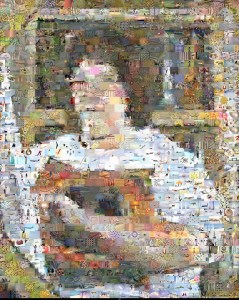
When I got to forty I did a self portrait in acrylics on canvas, then a few years later I decided to learn some filters in Photoshop. One was to turn patches of the image you had created into tiles. This was one of my attempts at creating something a little more abstract, although the colours still represent the painting and there is still some definition which gives an idea of the original piece.
I’m not sure how copyright works on these? Presumably the images in the filters are non copyright. If they were not, I don’t know precisely how many photographers I would have to credit. This is where the strangeness of digital comes in. There is so much content out there that is free for use, but artists and photographers who want to keep control of theit art and designs can easily find their work being copied when they use digital platforms. You only have to go to an internet search, look up their name and choose ‘image’ and you will see a host of original work.
Nowadays ‘non fungible tokens’ (a strange word) have become popular. An artists digital work can be bought by a single individual or group. They hold the ownership of it, as if it were a single canvas. The artist as far as I understand still keeps the copyright, and can use the image over and over but the ‘owner’ owns it? It has been difficult to get my head round this concept. It might be something I could do in the future, but like with Crypto-currency, it sounds like there is a digital payment that the artist receives, perhaps the equivalent of being paid in coloured beads instead of real currency?
We live and learn. Sometimes confusion and obfuscation reigns.
 Mallaband-Brown