
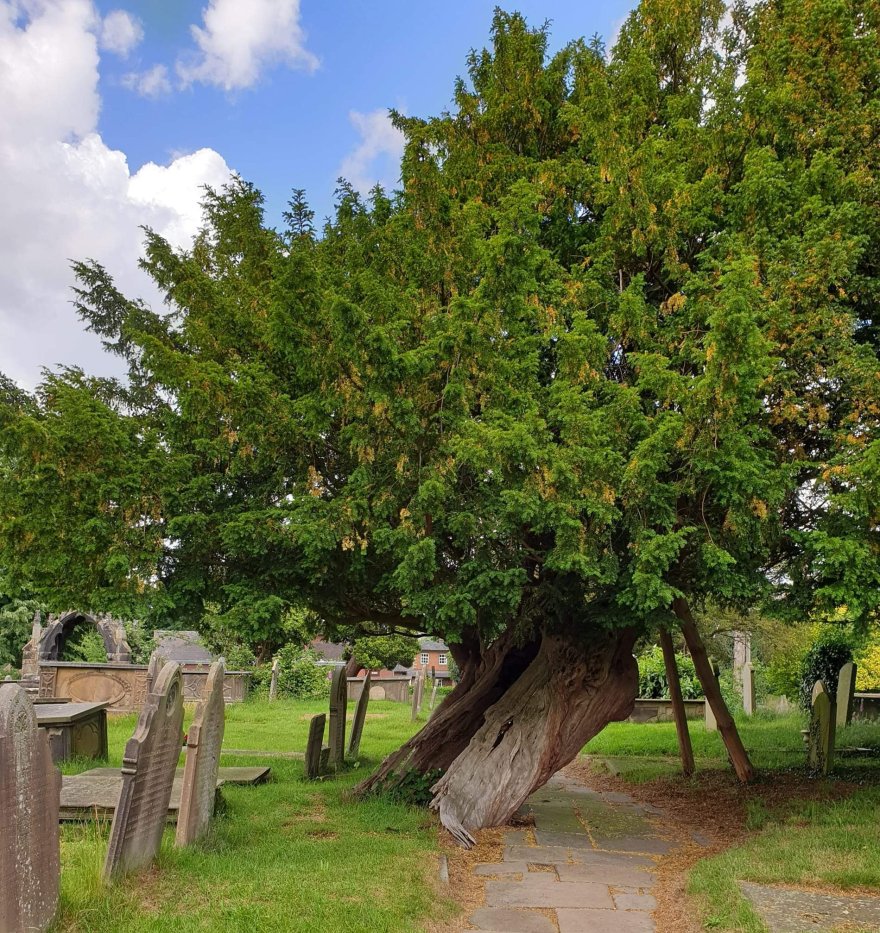
From a friend’s photo,
At Astbury just off the A34 near Stoke on Trent and Congelton. I can’t remember the church grounds it is in. The trunk is hollow. It goes to show that it is only the outer layers of plants that are really alive. Water and nutrients are drawn up the trunk by transpiration. The trunk is propped up with timbers.
I once saw an experiment on the TV when scientists cut through a mature tree, they placed the trunk into a container full of water. The tree continued to suck up the water despite being cut, this was because of capillary action. There are tiny tubes in plants called phloem and xylem which are there to take up water and also transport sugars and starches from the leaves into the body of the plant. These are the building blocks of the grass, shrub, flowering plant or tree. I don’t know much more about plant biology though. I’m searching round in my mind for facts from biology classes over forty years ago!


 Mallaband-Brown