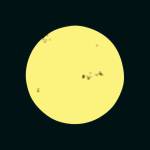
Sunspots

Want to find out more about Sunspots? Also the Solar Wind, Near Earth Objects, Meteor showers, Cosmic rays?

Try viewing https://spaceweather.com – today it has information and photos about the largest sunspot seen in years. The Sun has a solar cycle, it has a minimum and maximum activity over a period of 11 years. It is caused by the Sun’s magnetic activity. I can’t explain the science properly so have a look at the site.

It also shows information about Auroras and comets among other things, and it is understandable and not too technical.

https://spaceweather.com

There’s a comet out there…

Somewhere at sunset a comet called Leonard is heading in towards the sun. It has two tails and is near Venus in the night sky. The tails are quite long and have become more visible. One is a tail of cometary gases heading away from the sun, and the other is an ion tail which curves due to the sun’s magnetic field. I love astronomy and the information is what I remember from watching TV shows. The trouble is it’s foggy here now! I think it will have disappeared by the time our weather improves.

For more (and much better) information go to Spaceweather.com it’s full of interesting information about the sun’s coronal Mass ejections, X Ray flares, Cosmic Radiation and Near Earth Objects (chunks of rock, asteroids, meteors, that are near the earth and flying past us), sunspots and its magnetic field. There are also videos and photos of the sun’s activity. Worth a look.

Perseids

sketch-1596844501892

From Spaceweather.com

PERSEID METEOR ALERT: Earth is entering a stream of debris from giant comet 109P/Swift-Tuttle, source of the annual Perseid meteor shower. Although the display is not expected to peak until August 11-13, sky watchers are already seeing some of the most beautiful fireballs of the year. Plan your Perseid watch with sky maps and observing tips on today’s edition of of Spaceweather.com.

I hope we have clear skies in the UK.

Comet Neowise

sketch-1595445833950

I have not seen it. It keeps being to cloudy. But I just read this at Spaceweather.com so I tried to draw it.

COMET NEOWISE APPROACHES EARTH: Tomorrow night might be your best chance to see Comet NEOWISE for the next 6,800 years. On July 23rd, the comet makes its closest approach to Earth. The fading comet is still visible to the naked eye from dark-sky sites and an easy target for photographers everywhere. Get the full story at Spaceweather.com .

There is then the Persid meteor shower in August. Around the 15th? That might be a good show. Meteor showers are caused by the dust thrown off from comets as they get close to the sun. It’s called out gassing when cometary ice is heated by sunshine and boils off into space taking dust with it. A comets tail is made up of two different parts, the dust tail and an ion tail which is made up of ionised gas. The comets tail always points away from the sun because it is blown by the solar wind.

X