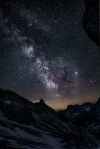
We live in a city, it’s impossible to see many stars. I just wrote this for Esthers challenge dark.
Darkness is needed for astronomy. We used to drive out at night to try and see meteor showers or comets, or stand in the garden under the shadow of the hedge and try and see Jupiter and it’s moons (we used a telescope) and even Saturn and it’s rings. We saw both planets. Once we drove under clouded skies to chase a massive meteor shower of up to 100 meteors an hour. But we never got out from under the layer of thin low cloud even though we drove at least 40 miles.
On another occasion we went out and drove into a wood so we could see a beautiful greenish comet. That was amazing.
Finally we recently saw the aurora borealis. An amazing thing to see in the UK.
Meteor showers are caused by dust and debris from old comets or broken up asteroids, or other rocks or metallic pieces that are within earth’s orbit.
A comet might leave dust as it passes through the solar system. As the Earth orbits the Sun it can pass through the cloud of dust from a comet and burn up in our atmosphere, the burning pieces are what we see as shooting stars or meteors. If one falls to Earth it is classed as a meteorite.
Meteorites come in two types, carbonaceous (with carbon compounds) and metallic (with metals such as iron inside them). If you find one that has landed it can be worth a great deal of money.
Finally the meteor shower is named after the area or constellation in the sky they apparently come from. So the Perseid shower appears to emanate from the constellation Perseus. Others include the Orionids, Geminids, and other star groups. They happen throughout the year and astronomers can predict when they are due although not always the strength of the shower or storm. Tonight’s shower may have up to 100 shooting stars an hour. They usually start after local midnight… Good luck if you try to see them, I wish you clear skies.
Want to find out more about Sunspots? Also the Solar Wind, Near Earth Objects, Meteor showers, Cosmic rays?
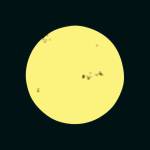
Try viewing https://spaceweather.com – today it has information and photos about the largest sunspot seen in years. The Sun has a solar cycle, it has a minimum and maximum activity over a period of 11 years. It is caused by the Sun’s magnetic activity. I can’t explain the science properly so have a look at the site.
It also shows information about Auroras and comets among other things, and it is understandable and not too technical.
I’ve been making patterns again, this time using a close up of sequins on my jumper… Very random I know.
The stiches on the jumper also add texture to the photo. I think the stars look like little dancing people holding hands.
I love stars and astronomy. I’m interested in things like the magnitude of stars, seeing comets, planets and asteroids. I read web pages like spaceweather.com which gives you information about CMEs (coronal mass ejections) from the Sun, which is caused by the sun’s magnetic lines of force getting tangled up and hurling out plasma from the sun’s surface.
If the weather is clear I will look out for meteor showers like the orionids or geminids (Based on the constellations they appear to emanate from).
I wish I lived in the southern hemisphere. I have heard of the magellanic clouds (small neighbouring satellite galaxies) which are below the plain of the ecliptic, which is the flat plain of our galaxy. Anything below that can only be seen from the south.
We (our planet) is topped at an angle of 22?degrees. So although we see constellations they vary with the seasons. They rise above the equator or sink below it depending on where we are in the year. If you sailed on a boat or flew on a plane at night you would see the constellations change as you flew north to South, or vice versa. Some constellations like the southern cross are only visible in the southern hemisphere and some like the plough or Great bear are only visible in the North.
I had a couple of little telescopes and once saw a tiny image of saturn and its rings and the galilean satellites of Jupiter – four moons that orbit Jupiter. There are more but are too small to see in a backyard telescope.
I’m no expert but I do like to learn. I’m sure there are lots of websites where you can find more information. Funny how I can ramble on after describing my jumper!



 Mallaband-Brown