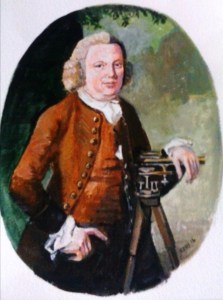
Brindley again

In 2016, nine years after the Leopard murals, I was asked to do a series of illustrations for a leaflet about the Trent and Mersey canal and the Cauldon canal. This is of James Brindley taking measurements for the canal navigation. The image was painted in acrylics on water colour paper and was one of several paintings including Middleport pottery and the Kidsgrove canal tunnel. The leaflet was published. I don’t know if they did more than one set.

Old map of Lancashire and Morcambe Bay.

_20200709_235118

An old ctc (Cycle Touring Club) map, 2 inches to the mile. Paper on cloth. Cost 2 shillings and sixpence. Printed to show heights. As it is in ‘old money’ it predates decimalisation. Probably printed in the 1950’s or 1960’s but there is no published date on it.

The area shown is North Lancashire, sheet 5, Bartholemews, coloured. I’m amazed it’s still held together and the edges of each little sheet are only slightly worn. Some of it will be changed now, new or improved roads, villages sunk under reservoirs, that sort of thing.

Nowadays everything is on line, or people use satnav. But having the skill to read maps is useful. Having a compass helps you know what direction you are moving in. When I go places I have a big compass on my dashboard of my car and I use large scale driving atlas. We also use smaller scale walking maps that show more details. If you’ve never used a map buy at least one. You can find more interesting places on a map than you might on an online one.

X


Decisions, #writephoto prompt

p1190223

For Sue Vincent’s Thursday#writephoto challenge

She hated getting lost. But she wouldn’t use satnav and or Google maps. She preferred old paper maps, the folding type or the atlas style ones for driving. She would memorise a good part of the route. Try and remember road numbers, like the A53 or A34.

She had been distracted by satnav so gave up on it, and although  she would look at Google maps before she went somewhere she would not switch her mobile on in her car, too dangerous.

When she was young she was navigating for her mother as they drove through the countryside. She took them down the wrong road, and had to admit that she had got them  lost. She also got completely bemused in a group of terraced houses near her home when she was really young, so she decided to look for landmarks like shops or trees, train stations, pubs. She also remembered trying to work out where the sun was in the sky. 

Coming up to a sign post like this, with a choice of two routes, she would try and check her map. She looked out for telephone poles because they tend to be on roads. She wanted an idea where the closest village or hamlet was.

The signpost was no use. It was so weathered and old that the words had completely disappeared. No use at all. She could see on the map that it was feilds for miles around. She could retrace her steps. Give up. Or plunge on, decisions.

Left, towards the sun which was starting to go down. Or right into increasing darkness. That was her dilemma.